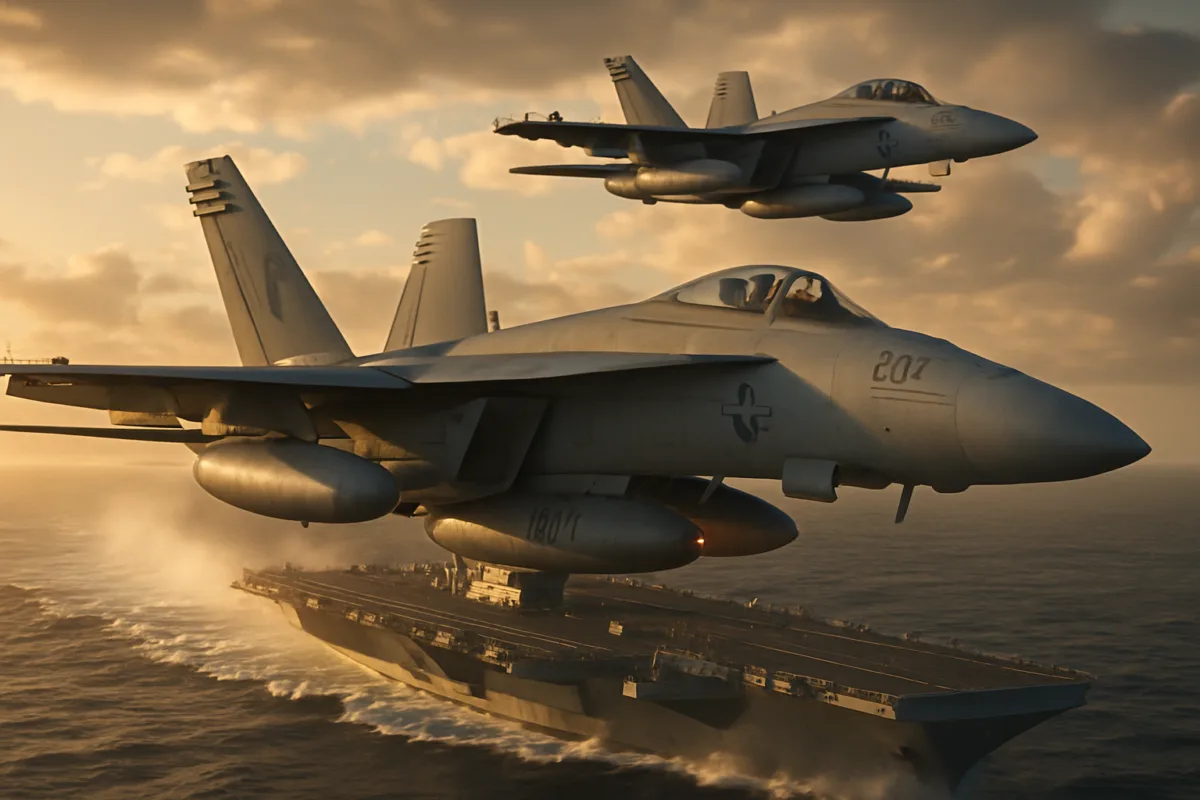
The US Navy engine support deal worth 2.87 billion dollars demands attention because it is more than a logistics contract; it is a strategic wager on readiness, industrial base resilience, and the future of carrier aviation. The Navy has awarded General Electric a five year agreement to sustain the F414 turbofans that power both the F/A-18 Super Hornet and the EA-18G Growler, and that decision has immediate operational and budgetary consequences.
Why the US Navy engine support contract matters for fleet readiness
At the most basic level, engines are the lifeblood of naval aviation. Without reliable turbofans and a predictable supply chain for parts and repairs, sortie rates drop and carrier air wings lose capability. The F414 engine family produces roughly 22,000 pounds of thrust per engine, so sustaining tens of squadrons requires sustained investment in maintenance and logistics.
Moreover, the contract is not only about spare parts. It underwrites depot-level maintenance, component repairs, and the supply chain relationships that keep aircraft mission ready. Consequently, the Navy’s choice signals a prioritization of continuous availability over rapid platform replacement.
F/A-18 Super Hornet sustainment and operational relevance
The F/A-18E/F Super Hornet remains the backbone of carrier operations even as the F-35 expands across squadrons. The Navy intends to keep the Super Hornet in service into the middle of the century, which creates a long-term sustainment obligation. If the fleet is to remain capable, investing in engines and logistics is not optional.
That said, critics argue that pouring nearly 3 billion into sustainment delays modernization. Yet sustaining an existing fleet while phasing in newer stealth fighters is not mutually exclusive. For example, maintaining a high sortie rate with Super Hornets supports carrier strike group deterrence even as low-visibility investments progress.
EA-18G Growler: electronic warfare and the asymmetric edge
Electronic attack capability is a strategic multiplier. The EA-18G Growler provides airborne jamming, SIGINT, and communications disruption that clear the way for strike aircraft and ships. Losing Growler availability due to engine failures would create a vulnerability in suppression of enemy air defenses and electronic dominance.
Therefore, funding engine support for the Growler is, in effect, funding the Navy’s ability to impose asymmetric costs on adversaries. The Growler’s role in electronic warfare makes sustainment a force protection priority as much as a maintenance decision.
Economic and industrial base implications of the General Electric award
Beyond operational considerations, the contract sustains high value work across manufacturing, repair depots, and logistics hubs. Preserving industrial capacity for advanced turbofan maintenance keeps skilled technicians employed and retains critical know-how. This matters when surge production or rapid repairs are required during crises.
Furthermore, awarding the contract to a primary OEM can reduce technical risk and improve integration between design knowledge and depot practices. On the other hand, concentration of supply raises questions about competition and pricing over the long term.
Alternatives and opportunity costs worth debating
Opponents may reasonably ask whether the Navy should instead divert funds to accelerate F-35 procurements or invest in new unmanned systems. Those are valid alternatives that deserve consideration, particularly in a constrained fiscal environment. Investing in next generation airframes could reduce life cycle sustainment costs and deliver new capabilities sooner.
Nevertheless, transitioning an entire carrier air wing is expensive and logistically complex. Consequently, a balanced approach that sustains current platforms while buying down risk on new systems appears prudent. The engine support contract buys time and preserves combat power while the Navy navigates modernization choices.
Risks in relying on a single supplier and how to mitigate them
Consolidated supplier relationships can streamline logistics, but they also introduce single point of failure risks. If a supplier faces production bottlenecks or financial stress, fleet readiness can suffer. Therefore, the Navy must build resilience into its supply chain strategies.
For instance, the service could require subcontracting to diversify component production, invest in digital twin and predictive maintenance technologies, and expand agreements with certified repair stations. These measures reduce vulnerability while leveraging the expertise of the primary engine manufacturer.
Fiscal scrutiny and acquisition transparency
Spending billions of taxpayer dollars requires rigorous oversight. The Navy should publish clear metrics tied to the contract, such as mean time between engine removals, parts turnaround times, and sortie availability improvements. Transparency will help justify the investment and identify where savings or course corrections are possible.
Moreover, the contract structure should include performance incentives that reward reduced downtime and improved reliability. Consequently, both the Navy and the contractor will share the mission of maximizing readiness per dollar spent.
Technological opportunities within the sustainment program
There is every reason to insist that sustainment be forward-looking. Predictive analytics, additive manufacturing, and condition-based maintenance can reduce lifecycle cost and shorten repair cycles. Integrating those technologies into the GE contract promises measurable efficiency gains.
For example, deploying sensors and digital twins across the F414 fleet would enable predictive replacement of components before failures occur. In turn, fewer unscheduled removals translate into better squadron availability and lower emergency repair costs.
Strategic messaging and deterrence implications
Spending on sustainment sends a signal too. A well-maintained carrier air wing communicates deterrence: forward-deployed forces remain combat ready and able to project power. This has diplomatic and strategic value that is hard to quantify but real in practice.
Conversely, public debates that focus solely on headline dollars risk obscuring that the underlying capability being purchased is readiness and survivability. The Navy should therefore frame sustainment as an investment in strategic posture rather than as a mere technical expense.
What the Navy should do next to maximize value
First, insist on aggressive performance metrics with financial incentives and penalties. This aligns contractor behavior with Navy priorities and ensures accountability. Second, require technology integration for predictive maintenance and modular repairs to lower life cycle costs.
Third, promote supply chain diversification through mandated subcontracting and certification pathways for alternative repair facilities. Doing so will protect fleet readiness in the face of supply shocks and maintain domestic repair capacity.
Practical steps for policymakers and acquisition officials
Policymakers should prioritize oversight hearings that evaluate actual readiness outcomes from the contract. Acquisition officials should publish quarterly performance dashboards and common data standards so progress can be tracked objectively. These steps will build public trust and inform better budgeting choices.
Finally, Congress and the Navy should consider multi-year procurements that lock in favorable pricing while preserving mechanisms for mid-contract technology insertion. This preserves flexibility without sacrificing cost control.
Balancing near-term readiness with long-term modernization is the central policy choice embedded in a nearly 3 billion dollar engine support award. By treating sustainment as a strategic investment, enforcing performance accountability, and pushing technology-driven efficiencies, the Navy can keep Super Hornets and Growlers mission ready while the transition to newer platforms proceeds. Those practical measures will protect carrier aviation capability, preserve industrial capacity, and deliver measurable returns on taxpayers investment, giving commanders the tools they need for deterrence and defense.

Dr. Morgan directed the Archives Program from 2014 to 2017, gaining extensive experience in research documentation, information management, and the preservation of scholarly resources. Throughout her career, she has worked closely with academic publications and research materials, developing expertise in evaluating scientific sources and communicating complex topics to broad audiences.
Her primary areas of specialization include scientific publishing, research communication, editorial review, and the translation of technical research into accessible educational content. She has contributed to projects involving space science, astronomy, environmental science, history, archaeology, and emerging scientific discoveries, always emphasizing accuracy, transparency, and the responsible presentation of evidence.
As Editorial Director of Muskurahat.us, Dr. Morgan leads the editorial review process for scientific articles, ensuring that content is based on reputable sources, peer-reviewed research whenever available, and publications from recognized universities, research institutions, and international scientific organizations.
She is committed to promoting scientific literacy through clear, engaging, and well-documented articles that help readers better understand scientific discoveries and their impact on society. Her editorial philosophy is founded on accuracy, intellectual integrity, independent journalism, and continuous learning as scientific knowledge evolves.
Through her work at Muskurahat.us, Dr. Morgan supports the publication of trustworthy scientific content that makes complex research accessible to readers around the world while maintaining rigorous editorial standards.