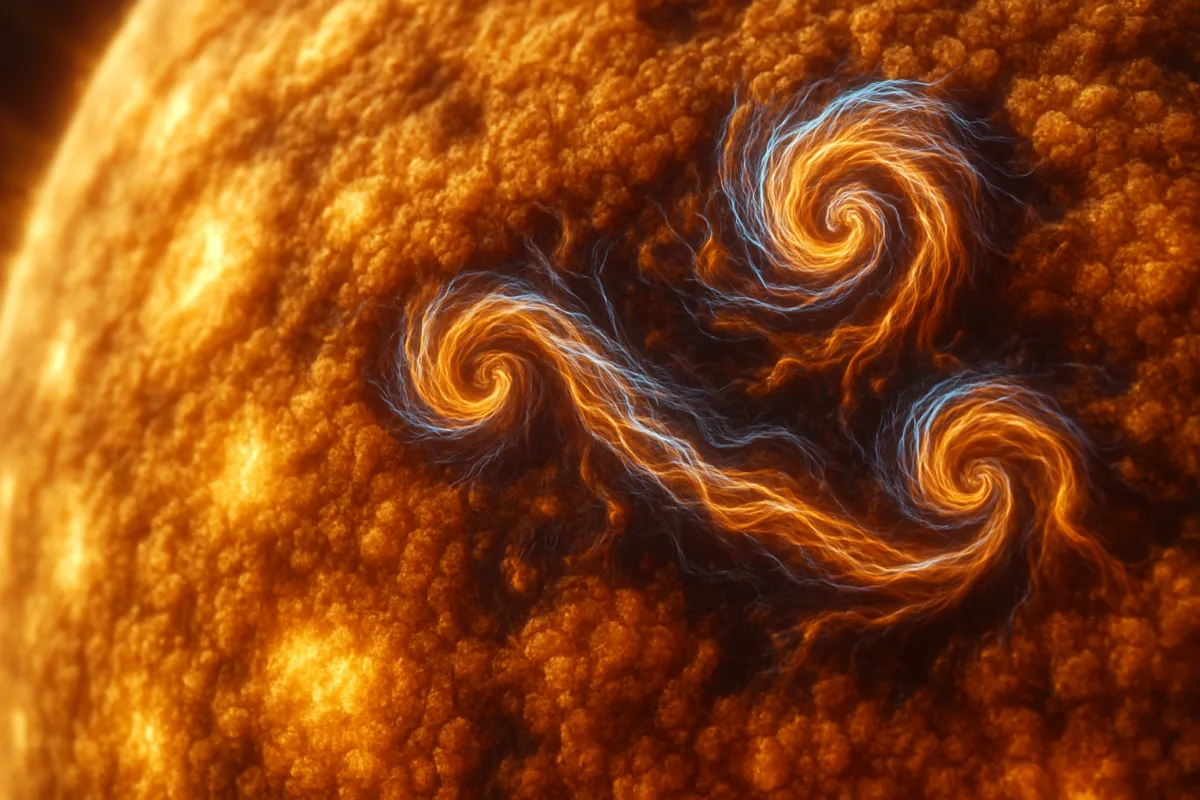
The Kelvin-Helmholtz instability has been directly imaged on the Sun for the first time, and those newly photographed plasma whirlpools — some as small as 20 kilometres across — demand a sober but optimistic reassessment of how energy moves from the solar surface toward the million-degree corona. The discovery, enabled by the Daniel K. Inouye Solar Telescope, is visually arresting and scientifically provocative, so it’s worth asking directly: does seeing these vortices mean we finally understand how the Sun’s outer atmosphere gets so hot?
Why the Kelvin-Helmholtz instability matters for coronal heating
At stake is the coronal heating problem, one of solar physics’ longest-standing mysteries: why the corona reaches temperatures near a million degrees Celsius while the photosphere below sits around 5,500 °C. If Kelvin-Helmholtz instabilities at magnetic boundaries braid and mix fields and plasma, they could plausibly shuttle magnetic energy upward where it can be released as heat.
Proponents argue that these small-scale vortices produce shear-driven mixing and turbulence that enhance magnetic reconnection or wave dissipation, both candidate mechanisms for heating. That logic is compelling; however, plausibility is not the same as quantified contribution to the corona’s energy budget.
What the Inouye Solar Telescope actually saw
The National Science Foundation’s Inouye telescope produced the highest-resolution solar images yet, imaging at 416 nanometres and resolving structures down to roughly the diffraction limit. Researchers led by David Kuridze reported dynamic swirling patterns at the edges of magnetic flux concentrations, with a median vortex scale near 65 kilometres and individual features down to about 19–20 kilometres.
Those images confirm long-standing theoretical predictions that shear at magnetic boundaries would produce Kelvin-Helmholtz instabilities in the photosphere. In effect, the telescope moved a hypothesis into the realm of observation — an essential step for any scientific claim.
Why the finding is a milestone, not a final answer
It is tempting to rush from observation to solution: see vortices, therefore coronal heating solved. That leap is premature. The Nature paper is careful: it frames the vortices as a newly confirmed process that could drive magnetic mixing and energy transport, but it does not demonstrate that this process supplies the dominant fraction of the corona’s heat.
Moreover, the observation sits at the instrument’s resolution limit. When a structure is only marginally resolved by a single, albeit world-class, telescope, measured sizes, speeds and inferred energy fluxes are likely to be refined with independent confirmation and improved instrumentation.
Distinguishing between mechanism and magnitude
Scientific progress requires separating two questions: is a mechanism real, and how much does it matter? The Inouye results answer the first question convincingly for Kelvin-Helmholtz vortices in the photosphere. The second question — the quantitative contribution of these vortices to the coronal energy budget — remains open.
That distinction matters because several other mechanisms (Alfvén waves, nanoflares, spicule-driven transport) already have observational and theoretical support. The presence of additional drivers does not diminish the importance of vortices, but it does insist that we measure, not just hypothesize, their energetic role.
Implications for the solar dynamo and magnetic diffusion
Beyond coronal heating, the same observations have been linked to magnetic diffusion and solar dynamo theory. If vortices enhance magnetic mixing at small scales, they could supply an empirically grounded diffusion term that dynamo models currently estimate rather than measure.
That is a distinct and promising avenue: demonstrating measurable magnetic diffusion from photospheric vortices would feed directly into global models of the Sun’s 11-year activity cycle. Still, it should be framed as a separate claim that requires its own verification and quantification.
Why independent confirmation and multi-wavelength work are essential
For these observations to change consensus, they must be reproduced. Independent confirmation with different instruments and wavelengths will test whether the vortices are ubiquitous or were preferentially detected under unique observing conditions.
Furthermore, multi-wavelength and spectropolarimetric observations can track how energy and magnetic topology change as signals propagate upward into the chromosphere and corona. That chain of measurements is necessary to connect photospheric vortices rigorously to coronal heating.
What targeted simulations and measurements need to prove
Numerical simulations should now focus on connecting observed vortex properties — size distribution, lifetimes, and shear velocities — to measurable energy fluxes and reconnection rates. High-fidelity magnetohydrodynamic models must reproduce the observed vortex spectrum and then quantify how much Poynting flux they inject upward.
Empirical measurements should prioritize: (1) mapping vortex occurrence rates across different solar regions, (2) measuring shear velocities and magnetic field changes at vortex sites, and (3) tracking resultant heating signatures higher in the atmosphere. Only then can we assess contribution versus coincidence.
Policy, instrumentation, and collaborative priorities
Because the result sits at the edge of technological capability, funding agencies and observatories should prioritize coordinated campaigns combining ground-based high-resolution imaging with space-based UV and EUV spectrometers. That pairing would bridge the photosphere to the corona in both time and wavelength.
Additionally, investing in increased temporal coverage and improved adaptive optics will reduce observational bias and build a statistical picture of vortex-driven processes. Collaboration between numerical modelers and instrument teams should be part of planned proposals to link measured parameters directly to simulated energy transport.
Short-term actions for the research community
Immediately useful steps include releasing high-cadence datasets publicly, encouraging cross-team analysis, and running coordinated campaigns during different phases of the solar activity cycle. Graduate students and postdocs should be invited into these efforts: measuring ubiquitous small-scale processes is labor-intensive and benefits from many eyes on the data.
That approach accelerates replication, increases the diversity of analysis techniques applied, and helps identify observational biases early.
How this finding should shape public and scientific narratives
For the public, the images are an opportunity to reconnect with the Sun’s dynamic nature and the incremental, evidence-driven character of science. The idea that telescopes can now resolve 20-kilometre features on a star nearly 150 million kilometres away is a triumph worth celebrating.
For scientists, the takeaway is a reminder to balance excitement with rigor: observational breakthroughs change the conversation, but they do not replace the slow work of quantification and replication that confirms which processes truly dominate a physical system.
Kelvin-Helmholtz vortices on the Sun are a landmark observation that transforms a theoretical expectation into a measurable phenomenon. Yet the core lesson is not that a single paper has solved a decades-old problem, but that science has advanced another crucial step: we now have a concrete, observable mechanism to study in detail. The next phase must be quantitative and collaborative — multi-instrument campaigns, targeted simulations, and independent replication — so that we can move from plausible mechanism to measured contribution. Until then, these tiny whirlpools offer both inspiration and a clear research agenda: measure carefully, compare broadly, and prioritize the observations and models that best connect the photosphere to the blazing corona.

Dr. Morgan directed the Archives Program from 2014 to 2017, gaining extensive experience in research documentation, information management, and the preservation of scholarly resources. Throughout her career, she has worked closely with academic publications and research materials, developing expertise in evaluating scientific sources and communicating complex topics to broad audiences.
Her primary areas of specialization include scientific publishing, research communication, editorial review, and the translation of technical research into accessible educational content. She has contributed to projects involving space science, astronomy, environmental science, history, archaeology, and emerging scientific discoveries, always emphasizing accuracy, transparency, and the responsible presentation of evidence.
As Editorial Director of Muskurahat.us, Dr. Morgan leads the editorial review process for scientific articles, ensuring that content is based on reputable sources, peer-reviewed research whenever available, and publications from recognized universities, research institutions, and international scientific organizations.
She is committed to promoting scientific literacy through clear, engaging, and well-documented articles that help readers better understand scientific discoveries and their impact on society. Her editorial philosophy is founded on accuracy, intellectual integrity, independent journalism, and continuous learning as scientific knowledge evolves.
Through her work at Muskurahat.us, Dr. Morgan supports the publication of trustworthy scientific content that makes complex research accessible to readers around the world while maintaining rigorous editorial standards.