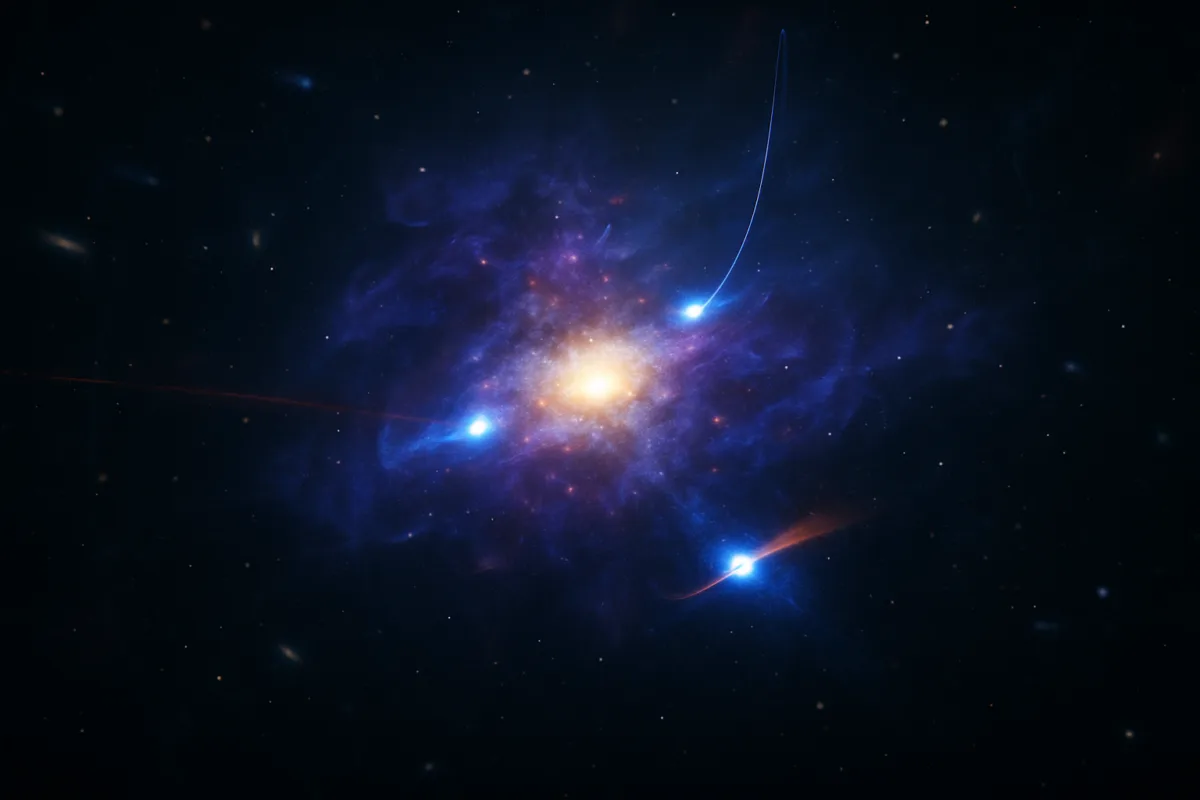
Imagine a single galaxy, only 1.2 billion years after the Big Bang, cradling three supermassive black holes at once — a finding that forces us to rethink how the universe made its first giants. The discovery of three supermassive black holes in galaxy J0148-4214 is not just an oddity; it is persuasive evidence that rapid, merger-driven growth played a vital role in creating enormous black holes at cosmic dawn.
Why the discovery of three supermassive black holes upends steady-growth models
Most textbook scenarios for black hole growth rely on steady accretion capped by the Eddington limit, where radiation pressure counteracts infalling gas. However, the presence of three actively accreting black holes in a single, relatively low-mass galaxy makes that steady, Eddington-limited picture implausible as the dominant channel for early growth.
Moreover, one of the trio is accreting above the Eddington limit, and the largest member already weighs roughly 80 million solar masses. Those numbers strain the timescales available if growth proceeded only by slow feeding of stellar-mass seeds.
How astronomers detected the trio: spectroscopy, not direct imaging
The team led by Hannah Übler used Webb’s NIRSpec integral field unit to detect broad H-alpha emission lines—smears caused by Doppler-shifted gas orbiting compact massive objects. This spectral signature reveals high orbital velocities, ranging from about 430 to nearly 3,000 km/s, that ordinary star-forming regions cannot produce.
In addition, spectro-astrometry allowed them to separate two central sources that Webb cannot resolve as distinct points. In other words, spatially resolved spectroscopy, not direct photography, unveiled the three active galactic nuclei inside J0148-4214.
The technical case for spatially resolved spectroscopy
Without an integral field unit capable of measuring tiny spatial shifts across spectral lines, two of the black holes would have blended into one and the third might have been missed entirely. Therefore, the detection argues for prioritizing IFU surveys at high redshift to reveal similarly hidden systems.
Consequently, observational selection effects mean many early galaxies labeled as harboring a single black hole might conceal multiple compact objects. This has major implications for population statistics and theoretical modeling.
Why mergers provide a faster path to supermassive black holes
If gravitational collisions and mergers were common in the young universe, then black holes could grow quickly by combining masses and briefly exceeding accretion limits through gas inflow triggered by interactions. The J0148-4214 system offers a plausible example of exactly that process.
Specifically, the two central objects sit about 620 light-years apart — close enough that dynamical friction and repeated interactions could drive them to coalesce within several hundred million years. Such merger-driven assembly short-circuits the slow, Eddington-limited growth that otherwise leaves little time to build 10^8-solar-mass holes so early.
On the role of dynamical friction and gravitational recoil
Yet the third, more distant black hole—about 5,500 light-years out—poses two credible backstories. It could be inbound, slowly spiraling toward the center under dynamical friction, or it could be a kicked remnant from a previous merger, flung outward by gravitational recoil.
Either scenario underscores the complex dynamical choreography expected in young, merger-rich galaxies and the need for models that include realistic recoil, three-body interactions, and gas dynamics.
Counterarguments and uncertainties: why restraint is warranted
Although the detection is compelling, it is prudent to treat a single system as suggestive rather than definitive. The authors explored alternative explanations — supernova-driven winds, shocks, and very massive star clusters — before favoring black hole accretion discs as the best fit.
Furthermore, mass estimates depend on single-epoch virial relations with uncertainties up to a factor of three, and the authors note a possible downward correction of an order of magnitude in some parameters. Therefore, the claim is robust but not free from substantial measurement error.
Why the paper is important despite limitations
Even accepting conservative revisions, the detection demonstrates the power of spatially resolved spectroscopy to differentiate between plausible physical processes. Thus, while we must avoid overgeneralizing from one galaxy, the observation should motivate targeted follow-up and systematic surveys.
In that sense, the discovery is a proof of concept: it shows that instruments like NIRSpec IFU can reveal previously hidden black hole multiplicity and thereby refine our census of early supermassive objects.
Implications for gravitational-wave astronomy and LISA
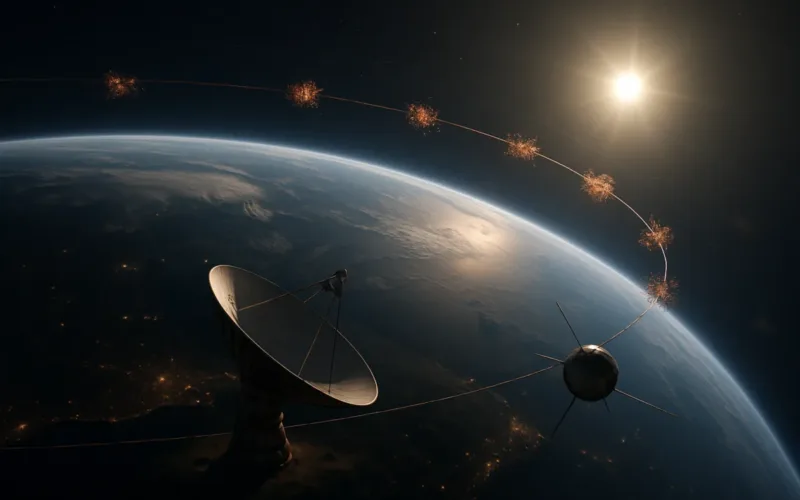
The merger pathway suggested by J0148-4214 has a direct bearing on future gravitational-wave observatories. Collisions of massive black holes at cosmological distances produce low-frequency gravitational waves that ground-based detectors cannot see.
European Space Agency’s LISA, scheduled for launch in the mid-2030s, is designed to detect these long-wavelength ripples. If triple and multiple black hole systems were common in the early universe, LISA could observe a far richer event rate than many conservative models predict.
Preparing theoretical forecasts and observational strategies
Therefore, theoretical work should update merger-rate models to include multi-body dynamics and possible recoil events. Observationally, prioritizing candidates for long-term monitoring will help match electromagnetic signatures to future gravitational-wave detections.
Ultimately, combining spatially resolved spectroscopy with gravitational-wave observations will let us test whether merger-driven growth truly dominated the early epochs of black hole formation.
Actionable research priorities going forward
First, systematic IFU surveys of high-redshift galaxies are essential. Webb’s NIRSpec IFU has already proven its value; extending such surveys and allocating significant observing time to search for multiple active nuclei should be a priority for the coming years.
Second, multiwavelength follow-up—including deep X-ray and radio observations—will help distinguish accretion signatures from other energetic processes and constrain black hole masses more tightly.
Third, simulations and theory must catch up
Simulations should incorporate realistic merger histories, three-body interactions, gravitational recoil, and gas physics at high spatial resolution. Only then can we produce quantitative predictions for the frequency of triple systems and their gravitational-wave signatures.
Fourth, prepare observational pipelines to connect electromagnetic identifications with LISA-era gravitational-wave triggers. Cross-disciplinary coordination will maximize scientific return when low-frequency signals start arriving.
What this discovery tells us about galaxy evolution and black hole demographics
At the population level, if triple or multiple supermassive black hole systems were not vanishingly rare, then many early galaxies may have experienced rapid episodes of black hole assembly via mergers rather than steady accretion. This in turn affects feedback, star formation histories, and host galaxy morphology in ways current models may underestimate.
Moreover, the very fact that two of the central objects could only be teased apart using spectro-astrometry implies that catalogues of single-black-hole galaxies at high redshift might be biased low in multiplicity. Consequently, demographic studies should adopt caution and favor methods that can detect blended active nuclei.
Policy and funding implications for astronomy
Given the potential for game-changing discoveries, funding agencies should consider prioritizing both IFU-capable instruments and long-duration programs aimed at early-universe black hole demographics. Investment in theoretical efforts and computational infrastructure is also critical.
In short, the scientific return on relatively modest investments in spectro-spatial capabilities could be high, unlocking new constraints on black hole growth and the timeline of cosmic structure formation.
The J0148-4214 detection is provocative: it strengthens the argument that mergers were a principal mechanism for building supermassive black holes quickly in the early universe, while also highlighting measurement uncertainties and the need for more data. For astrophysicists and observatories alike, the takeaway is clear — pursue targeted IFU surveys, prioritize multiwavelength follow-up, update theoretical models to include complex dynamical interactions, and coordinate with the upcoming LISA mission. By doing so, we can test whether this galaxy is an anomaly or a representative example of how the universe assembled its first monstrous black holes, and then use those results to refine our understanding of cosmic evolution and observational strategy going forward.

Dr. Morgan directed the Archives Program from 2014 to 2017, gaining extensive experience in research documentation, information management, and the preservation of scholarly resources. Throughout her career, she has worked closely with academic publications and research materials, developing expertise in evaluating scientific sources and communicating complex topics to broad audiences.
Her primary areas of specialization include scientific publishing, research communication, editorial review, and the translation of technical research into accessible educational content. She has contributed to projects involving space science, astronomy, environmental science, history, archaeology, and emerging scientific discoveries, always emphasizing accuracy, transparency, and the responsible presentation of evidence.
As Editorial Director of Muskurahat.us, Dr. Morgan leads the editorial review process for scientific articles, ensuring that content is based on reputable sources, peer-reviewed research whenever available, and publications from recognized universities, research institutions, and international scientific organizations.
She is committed to promoting scientific literacy through clear, engaging, and well-documented articles that help readers better understand scientific discoveries and their impact on society. Her editorial philosophy is founded on accuracy, intellectual integrity, independent journalism, and continuous learning as scientific knowledge evolves.
Through her work at Muskurahat.us, Dr. Morgan supports the publication of trustworthy scientific content that makes complex research accessible to readers around the world while maintaining rigorous editorial standards.