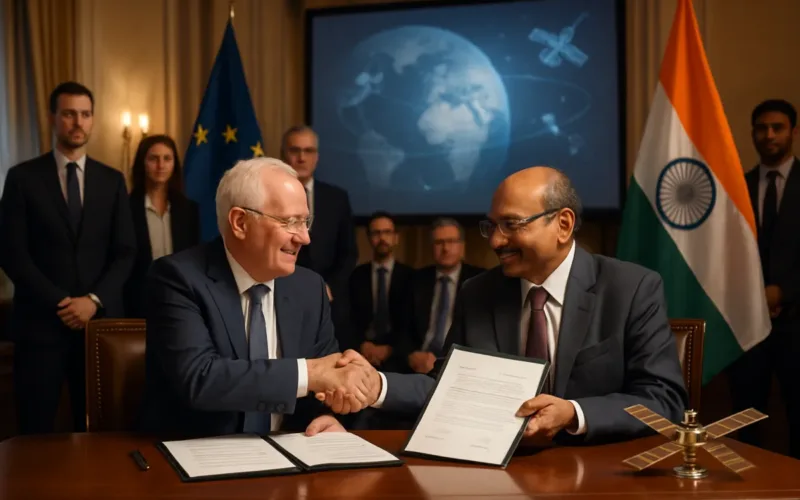
The Caucasus is not a backdrop to great power rivalry; it is a crossroads whose fate will shape trade, security, and influence across Eurasia. Washington now faces a rare strategic opening as Russian and Iranian influence dips and Armenia and Azerbaijan edge toward pragmatic cooperation. This moment demands an assertive, realistic U.S. policy that leverages economic incentives, institutional architecture, and digital resilience to secure long-term access without repeating past mistakes of overreach or complacency.
Why the Caucasus matters to U.S. strategy
Arguments for a stronger U.S. investment in the South Caucasus are not simply sentimental. The region offers tangible geoeconomic and geostrategic value: corridors that link the Black Sea to the Caspian, gateways to Central Asia, and alternatives to routes that run through Russia or Iran. In a world where supply chains and logistics corridors determine political influence as much as military deployments, control over transit routes is power. The recent thaw between Armenia and Azerbaijan, catalyzed by initiatives like TRIPP, converts what was once a frozen frontline into a potential artery of commerce and cooperation. That prospect should be seized, but not naively.
Russia and Iran are weaker — but not out of the game
It is tempting to celebrate Moscow’s and Tehran’s current constraints as permanent. Russia’s heavy lift in Ukraine and Iran’s regional entanglements have certainly reduced their bandwidth to project power in the South Caucasus. Moscow’s troop redeployments, the contentious removal of peacekeepers, and widening economic irregularities all reveal a strategic squeeze. Tehran’s diversion of resources to operations farther afield and the diplomatic fallout from aggressive regional actions similarly blunt its reach.
Yet strategic openings are often temporary. Both Russia and Iran retain local ties, asymmetric levers, and the will to exploit opportunities to restore influence. Russia has economic dependencies and historical linkages that can be reactivated; Iran has proximity, networks, and the capacity for disruptive operations below the threshold of full-scale engagement. The United States must operate on the realistic assumption that today’s reduced influence may return in different forms tomorrow. The correct response is therefore not a rush to hegemony, but a calibrated effort to institutionalize alternatives and deepen resilient partnerships.
TRIPP: a leverage point, not a panacea
The Trump Route for International Peace and Prosperity (TRIPP) is a useful case study. As a U.S.-backed, privately energized effort to knit Armenia and Azerbaijan together economically, TRIPP can demonstrate the positive payoff of cooperation in pragmatic terms. Trade, shared infrastructure, and transit revenues change incentives: for local elites, economic integration can outweigh the benefits of zero-sum confrontation.
Still, TRIPP’s promise depends on execution. Economic corridors are fragile until they become routinized: they need funding, standards, governance, dispute-resolution mechanisms, and protection from political manipulation. If TRIPP is under-resourced or appears to serve only external actors, local buy-in will evaporate. Equally dangerous is overreliance on a single instrument or donor. The United States should treat TRIPP as a central plank in a diversified strategy, not a silver bullet that absolves deeper diplomatic work.
Three strategic imperatives for Washington
If the United States is serious about converting this opening into durable influence, it should pursue three parallel priorities that blend diplomacy, economics, and capacity-building.
Advance institutional relationships
Short-term engagements must be tethered to durable, ministerial-level platforms. An SC3+1 initiative (South Caucasus Countries plus the United States) modeled on C5+1 would create a predictable architecture for interagency coordination and joint planning. Institutional frameworks reduce transaction costs, normalize engagement, and offer a venue to deconflict competing offers from other powers. They also help synchronize development finance, security cooperation, and regulatory harmonization so individual projects contribute to broader strategic objectives rather than becoming ephemeral showcases.
Fully resource TRIPP and catalyze private capital
TRIPP’s ability to change incentives hinges on finance. The U.S. International Development Finance Corporation and the U.S. Trade and Development Agency must be front-and-center, offering both direct project finance and risk-sharing instruments that attract institutional investors. Public funding should be used to de-risk viable projects—dry ports, rail links, energy interconnectors—rather than to subsidize uncompetitive ventures. Where private capital can be mobilized, the U.S. role should emphasize standards, transparency, and local procurement to build enduring economic ties rather than transient headlines.
Invest in digital infrastructure and cybersecurity
The geopolitical contest in the twenty-first century will increasingly be decided in fiber, data centers, and network governance. Investing in digital infrastructure—secure fiber routes across the South Caucasus, resilient data centers, and common standards for interoperability—would solidify economic integration and provide the kinds of day-to-day linkages that constrain conflict. Cyber capacity-building, exchanged through the National Guard State Partnership Program and civilian training initiatives, would shore up institutional resilience and reduce the vulnerability of transit corridors to sabotage or disinformation campaigns.
Risks of inaction and common pitfalls
Failure to act, or acting in ways that are poorly calibrated, invites several avoidable outcomes. First, strategic vacuums will be filled by competitors: China’s Belt and Road partners, Turkey’s diplomatic savvy, Gulf state investments, and opportunistic Russian or Iranian moves. Each of these actors brings resources and incentives that can be harnessed for regional development, but without a U.S. presence they will shape rules, standards, and political relationships in ways that may not align with American interests.
Second, a transactional approach risks crowding out local agency. Investment without inclusive governance produces dependency and fuels backlash. The United States must combine carrots with credible assurances of impartiality and local ownership. Third, securitizing the relationship too quickly—offering military guarantees before robust political settlement mechanisms exist—could entrench rivalries or draw the U.S. into disputes it cannot resolve. A balanced approach ties security cooperation to clear milestones in economic integration and dispute resolution.
How to compete effectively: partnership over paternalism
American strategy should foreground partnership. This means coordinating with the European Union, Turkey, India, the Gulf states, and multilateral lenders to present complementary offers rather than competing subsidies. It means using diplomacy to align incentives among regional actors: ensuring Turkey’s commercial ambitions are linked to transparency; inviting India’s growing role in Armenia to be a vector for technology transfer; and working with Gulf capital to prioritize climate-resilient energy projects.
At the same time, Washington must be clear-eyed about strategic competition with China and the risk that Russian and Iranian pushback could take asymmetric forms. The response is not containment through force but congestion through cooperation: make the corridor so attractive and regulated that alternatives lose their comparative advantage. Rules, standards, and interoperable customs regimes become weapons in a competition where economic governance matters as much as military posture.
Practical benchmarks for success
Success should be measurable and modestly incremental. Within 18 months, the United States should help establish an SC3+1 secretariat, secure initial commitments from the DFC and USTDA for at least two TRIPP-linked infrastructure projects, and launch a digital resilience program that includes a regional cybersecurity exercise. Within three to five years, trade volumes along corridor segments should show sustainable growth, customs procedures should be harmonized on pilot routes, and joint dispute-resolution mechanisms should be operational and trusted by local stakeholders. These benchmarks will demonstrate that U.S. involvement is producing durable benefits rather than ephemeral publicity wins.
The South Caucasus is not merely a place to compete; it is a place to build. If the United States acts decisively, it can help transform a fleeting strategic opening into institutionalized ties that bind local prosperity to rules-based cooperation. That outcome would not only reduce the region’s vulnerability to coercion but also provide Americans and their partners with new options for trade and strategic depth.
Ultimately, the choice is clear: retreat and cede influence to competitors, or engage with a strategy that respects local agency, leverages private capital, and invests in the hard work of institution-building. The latter is harder, slower, and more demanding of coherence across agencies and allies—but it is also the one path that promises a durable return on American leadership in a region whose corridors will matter for decades to come.

Dr. Morgan directed the Archives Program from 2014 to 2017, gaining extensive experience in research documentation, information management, and the preservation of scholarly resources. Throughout her career, she has worked closely with academic publications and research materials, developing expertise in evaluating scientific sources and communicating complex topics to broad audiences.
Her primary areas of specialization include scientific publishing, research communication, editorial review, and the translation of technical research into accessible educational content. She has contributed to projects involving space science, astronomy, environmental science, history, archaeology, and emerging scientific discoveries, always emphasizing accuracy, transparency, and the responsible presentation of evidence.
As Editorial Director of Muskurahat.us, Dr. Morgan leads the editorial review process for scientific articles, ensuring that content is based on reputable sources, peer-reviewed research whenever available, and publications from recognized universities, research institutions, and international scientific organizations.
She is committed to promoting scientific literacy through clear, engaging, and well-documented articles that help readers better understand scientific discoveries and their impact on society. Her editorial philosophy is founded on accuracy, intellectual integrity, independent journalism, and continuous learning as scientific knowledge evolves.
Through her work at Muskurahat.us, Dr. Morgan supports the publication of trustworthy scientific content that makes complex research accessible to readers around the world while maintaining rigorous editorial standards.