For decades the Moon has worn the label of a geologically dead world like a badge of convenience: quiet, unchanging, a static mirror that records the solar system’s ancient history. The newest global survey from the Smithsonian’s National Air and Space Museum forces a different verdict. Mapping more than a thousand previously unrecognised small tectonic ridges across the lunar maria, researchers have shown that the Moon is still contracting, still forming faults, and still capable of shaking. That evidence should reshape both scientific priorities and the way we plan to live and operate on our nearest neighbor.
Mapping activity where none was expected
The 2025 paper led by Cole Nypaver and colleagues catalogued 1,114 additional small mare ridges (SMRs) on the lunar near side, adding to earlier mapping and producing a global inventory of 2,634 SMR segments. This is not a mere incremental update; it moves tectonism in the maria from a few curiosities to a widespread phenomenon that demands explanation. Methodologically rigorous—dividing mare terrain into a five-kilometre grid, screening Kaguya Terrain Camera mosaics, and confirming features with Lunar Reconnaissance Orbiter Narrow Angle Camera imagery at sub-meter resolution—the work reduces ambiguity about whether these features are real and recent.
Why these ridges matter
SMRs are not the same as the large ancient wrinkle ridges familiar from lunar atlases. They are lower, narrower, often sinuous and relatively undegraded. Crucially, they are young in a geological sense: age estimates for analysed SMRs fall between roughly 50 million and 310 million years, with an average near 124 million years. On a 4.5-billion-year-old Moon, these are the equivalent of a recent birthmark. The ridges sit above shallow, low-angle thrust faults—compression features where one block of crust overrides another—indicating the Moon is continuing to respond to stress and cool, not simply lying inert.
Interpreting the cause: cooling, tides, and orbital recession
To call the Moon ‘active’ risks conjuring visions of Earth-like plate tectonics. That would be wrong. The evidence instead points to slow, global contraction compounded by changing tidal stresses as the Moon recedes from Earth. Thermal contraction from interior cooling produces strain; the brittle outer shell accommodates that strain by rupturing and slipping along faults. Solid-body tides, which flex the crust each orbit, modulate that stress, and orbital recession alters the tidal regime over time. The result is a suite of young contractional features that record different expressions of the same broad stress budget across basaltic maria and highland crust.
Quantifying change without dramatics
The team estimates areal contractional strain across the maria of about 0.0034 to 0.0040 percent—numbers that sound almost absurdly small until placed in context. Earlier work on highland lobate scarps produced comparable strain estimates. Those figures imply total radius decreases on the order of tens of metres over the past several hundred million years: not the Moon visibly shrinking within a human life, but a global adjustment measurable through accumulated structures. The practical takeaway is this: even small, slow deformation produces brittle structures that can slip episodically and release seismic energy.
Seismic evidence: Apollo was not silent
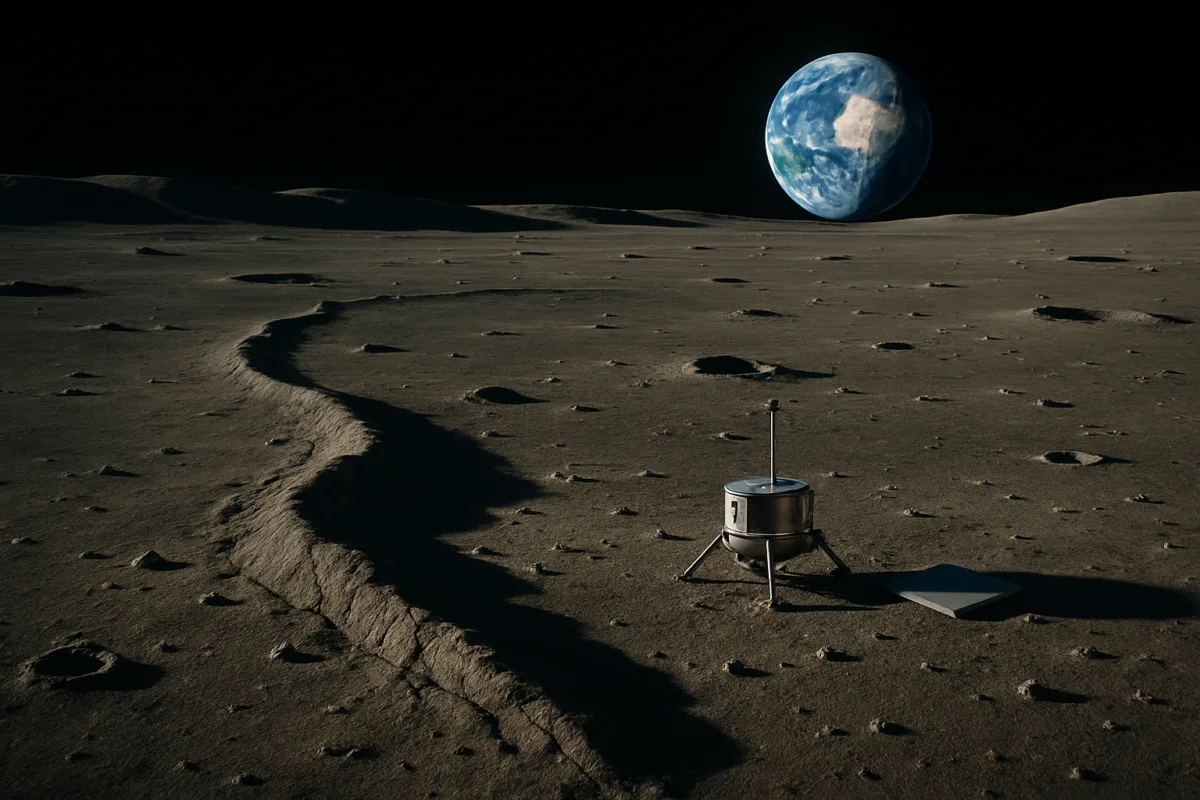
Mapping ridges tells us where faults exist; seismometers tell us whether they still move. The Apollo seismic network recorded thousands of events through 1977, including 28 shallow moonquakes that match what one would expect from fault slip. Reanalyses located several of those quakes within tens of kilometres of young faults visible in modern imagery, and many clustered when the Moon was near apogee—precisely when tidal stresses add to compression. Magnitudes of recorded events ranged roughly from about magnitude 2 to magnitude 5. That combination of geological mapping and seismic data makes the case that some young thrust faults remain capable of producing shallow moonquakes today.
Why the catalogue is useful but not a forecast
A global map of possible seismic sources is a necessary first step for both science and safety, but it is not sufficient to forecast hazard. The presence of an SMR beside a prospective landing site does not prove imminent danger: risk depends on slip frequency, maximum possible magnitude, distance, local ground response, and how seismic waves attenuate through fractured, dry lunar crust. Apollo seismometers offered tantalising hints, but they couldn’t localise events precisely. What we need now is a modern network of surface seismometers and geophysical instruments to observe current activity, quantify recurrence intervals, and constrain how energy travels through different lunar terrains.
The pragmatic case for rethinking exploration plans
Argumentatively, the policy implication follows directly from the science: if the Moon still produces shallow quakes, mission planners cannot afford to ignore geology. Permanent bases, long-duration habitats, in-situ resource exploitation sites and high-value infrastructure must be sited and engineered with tectonic and seismic risk in mind. This is not alarmism; it is intelligent engineering. On Earth we routinely apply geologic maps and seismic hazard assessments to urban planning, and the same logic should guide lunar settlement design, even when the measured risk differs in character and scale.
Concrete planning actions
First, engineers should incorporate geological surveys into site selection processes early and explicitly. Orbital mapping can highlight SMRs, fresh faults, and areas of unstable slope; these should be priorities for ground-truthing. Second, permanent sites should assume the potential for occasional shallow quakes and design redundancy accordingly—foundations tolerant of vertical and lateral slip, distributed life-support systems, and siting that minimises exposure to cliff faces and steep slopes. Third, every human outpost should include seismometers and ground-motion sensors to build a time series that turns a static map into a dynamic hazard model. Finally, mission architectures should fund science return that clarifies fault recurrence and energy release—that knowledge will reduce engineering margins and ultimately save cost and risk.
Scientific opportunities beyond hazard mitigation
Recognising the Moon’s ongoing tectonism is not only about safety; it is a doorway to fundamental planetary science. These young faults offer a rare laboratory to study how small bodies dissipate heat, how brittle crust responds to slow global contraction, and how tidal dynamics interact with interior cooling. Comparing SMRs with highland lobate scarps can reveal how lithology and thickness control fault expression. Age estimates for SMRs—tens to hundreds of millions of years—also permit studies into the Moon’s recent thermal evolution and the timing of orbital changes. In short, the Moon’s modern tectonics touch on planetary dynamics, seismology, and comparative tectonics in ways that enrich our understanding of terrestrial planets at large.
Priorities for a modern lunar campaign
What should a scientifically ambitious, safety-conscious program do next? Invest in a distributed seismic network that samples maria and highlands, prioritise polar and equatorial sites considered for human habitation, and embed geophysical payloads on rovers and landers. Sample return from faulted terrains would constrain formation ages directly and test models of fault mechanics under vacuum, cold, and low gravity. Integrate orbital mapping with targeted surface campaigns to convert an inventory of SMRs into an operational hazard atlas. These steps will transform our passive map into an active understanding of where, how often, and how strongly the Moon moves.
Resisting misleading metaphors
Finally, the argument must resist the temptation to anthropomorphise or overstate. Saying the Moon is ‘active’ does not imply it is like a miniature Earth with plate tectonics and frequent earthquakes. It simply means that processes driven by heat loss, tidal deformation, and orbital evolution continue to drive brittle faulting. The correct comparison is neither a dead rock nor a second Earth, but a slowly adjusting world whose recent history is still being written in subtle scarps and ridges. Recognising that nuance matters: it calibrates scientific expectations, informs engineering choices, and frames public understanding honestly.
We could have skirted these findings with reassuring phrases about ‘slow’ change and ‘rare’ events, but precision matters. The discovery and cataloguing of more than a thousand small tectonic ridges across the maria reframes the Moon as a planet still engaged in geological processes. That reframing demands updated observational infrastructure, a careful integration of geology into exploration planning, and a curiosity-driven push to use these faults as windows into planetary evolution. In practice, that means landing seismometers, revisiting Apollo-era conclusions with better tools, and treating the Moon as an active partner in research and habitation rather than a static backdrop where systems can be placed without geological consideration. Accepting that the Moon can still crack and shake is not a call to retreat; it is an invitation to explore more wisely, design more robustly, and learn more deeply from our closest celestial neighbor.

Dr. Morgan directed the Archives Program from 2014 to 2017, gaining extensive experience in research documentation, information management, and the preservation of scholarly resources. Throughout her career, she has worked closely with academic publications and research materials, developing expertise in evaluating scientific sources and communicating complex topics to broad audiences.
Her primary areas of specialization include scientific publishing, research communication, editorial review, and the translation of technical research into accessible educational content. She has contributed to projects involving space science, astronomy, environmental science, history, archaeology, and emerging scientific discoveries, always emphasizing accuracy, transparency, and the responsible presentation of evidence.
As Editorial Director of Muskurahat.us, Dr. Morgan leads the editorial review process for scientific articles, ensuring that content is based on reputable sources, peer-reviewed research whenever available, and publications from recognized universities, research institutions, and international scientific organizations.
She is committed to promoting scientific literacy through clear, engaging, and well-documented articles that help readers better understand scientific discoveries and their impact on society. Her editorial philosophy is founded on accuracy, intellectual integrity, independent journalism, and continuous learning as scientific knowledge evolves.
Through her work at Muskurahat.us, Dr. Morgan supports the publication of trustworthy scientific content that makes complex research accessible to readers around the world while maintaining rigorous editorial standards.