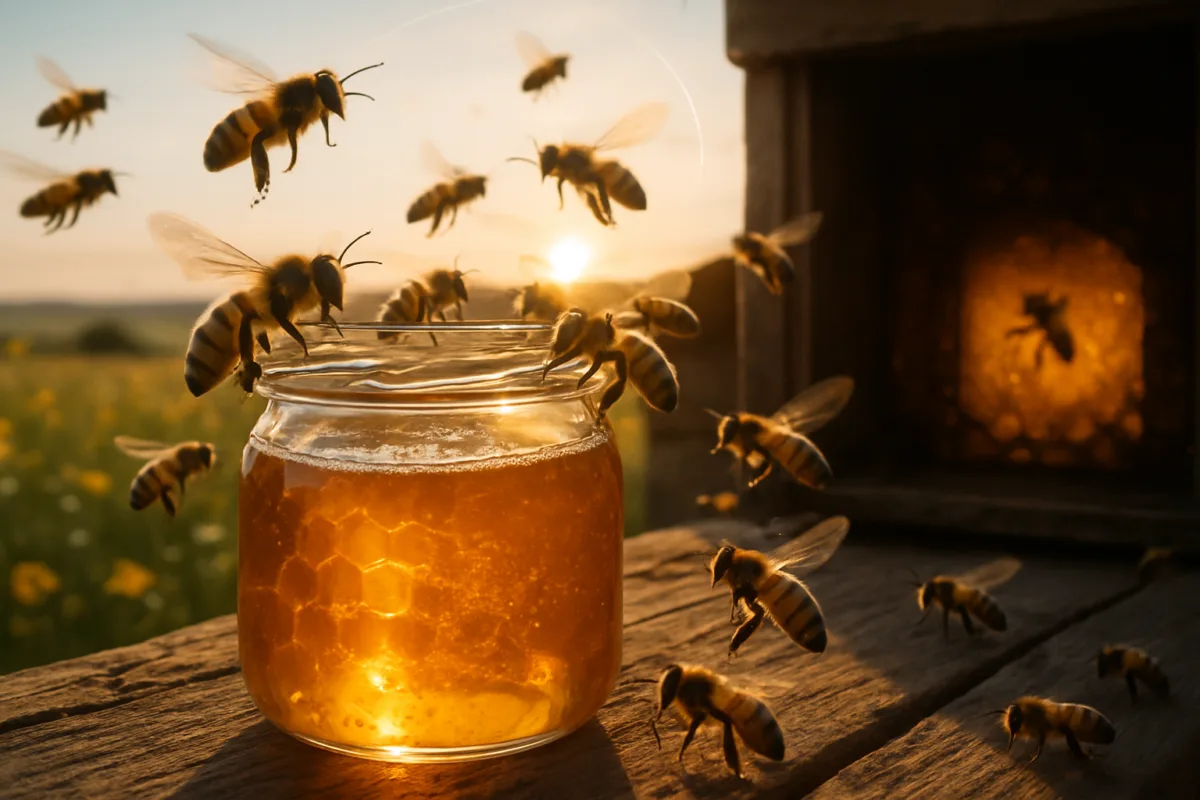
Look at a jar of honey the next time you shop: its glossy surface and simple label hide an extraordinary ledger of labor, travel and biological choreography. That golden sweetness is not merely a processed commodity; it is the concentrated product of millions of tiny decisions and tens of thousands of miles flown. Framing honey this way is not sentimentalism. It is an argument for a different consumer ethic and public policy—one that recognizes the real cost and public value of pollination.
Why a jar of honey is not just a grocery item
Bees transform nectar into honey at a scale that boggles immediate intuition. A commonly cited figure says a hive’s workers must visit roughly two million flowers to produce a single pound of honey. Other calculations nudge that number higher—around 2.6 million—depending on assumptions about nectar concentration, colony efficiency and evaporation needs. But whatever variant you prefer, the order of magnitude is the point: a jar is an aggregate of millions of individual flower visits and a highly distributed workforce.
The math behind two million flowers
Broken down, those millions of visits are spread across thousands of foraging trips. A forager typically visits 50 to 100 flowers per outing before returning to the hive. That means 20,000 to 40,000 collection trips for a single pound of honey, distributed among several thousand worker bees. Individual bees contribute almost vanishingly small amounts—the average worker’s lifetime yield is often estimated at about one-twelfth of a teaspoon. She does not become a winged honey machine; she spends roughly the first half of her short life doing in-hive tasks, only later joining the foraging ranks.
Flight miles and the contested numbers
The distance component of the story complicates the neatness of the metaphor but strengthens the argument. One common estimate suggests the combined flight of a hive’s workers to produce a pound of honey exceeds 50,000 miles—more than twice the circumference of the Earth. Other estimates creep toward 90,000 miles. The gap arises because the calculation depends on many mutable factors: how much nectar each bee carries per trip, the sugar concentration of available nectar, the distance to floral sources, and how much water needs to evaporate before nectar becomes storeable honey.
These are not mere statistical quibbles. They are central to understanding cost and impact. If bees must fly farther because flowers are scarce, patchy or chemically poor, the energetic and ecological costs increase. If nectar is dilute, more evaporative work inside the hive is required, which translates to more flights and more resources expended by the colony. Those miles are not romantic effort; they are measurable ecological expenditure.
Collective intelligence: the waggle dance
None of this happens by accident. Honeybee foraging is coordinated through a sophisticated communication system: the waggle dance. Discovered and decoded by Karl von Frisch—work that contributed to his Nobel Prize in 1973—the dance conveys direction and distance to profitable food sources. The duration of the waggle run relates to distance; the angle conveys direction relative to the sun. When colonies can share reliable dance information, they concentrate foraging in efficient clusters. When that information is obstructed, bees forage farther afield.
Put together, the dance and the pooled work of thousands of short-lived individuals produce the concentrated product on your shelf. That means the jar of honey is also a record of transferred knowledge, cooperative labor and the ecological context in which foraging happens. It is proof that markets and ecosystems are entangled: whoever buys honey is benefiting from an intricate natural service that markets do not fully price.
What this should mean for consumers and policy
If a jar is a receipt for collective labor measured in flower visits and planetary laps, then the immediate implication is that the price and treatment of honey—and of pollination services more broadly—deserve reevaluation. Currently, honey is priced like a standard pantry good with thin margins and variable labeling. Pollination, in contrast, is a public-extending ecosystem service: it underpins fruit and vegetable yields, biodiversity, and the resilience of landscapes. The discrepancy between private price signals and public value invites misallocation of resources and underinvestment in pollinator health.
Paying the true price
Consumers can do more than feel guilty at the checkout. We can choose to pay more for honey that reflects the labor and ecological cost behind it—supporting local beekeepers who maintain healthy hives and sustainable forage landscapes. Paying a premium is not a luxury; it is a market correction that signals value for pollination. For producers and policymakers, it means crafting incentives for habitat restoration, diversified farmscapes and regulations that discourage practices harmful to pollinators, such as indiscriminate pesticide application and monoculture expansion.
Protecting pollinators and landscapes
Protecting bees is not merely an act of charity toward a charming insect. It is a pragmatic investment in agricultural resilience. The waggle dance experiments show that communication and proximity of rewarding floral patches reduce wasted flight. Landscapes engineered for pollinator health—continuous bloom periods, native plant corridors, hedgerows and reduced chemical use—translate directly into fewer miles flown, higher colony efficiency and greater ecosystem durability. Those changes require policy support: subsidies for pollinator-friendly practices, research into pesticide alternatives, and urban planning that integrates wildflower corridors rather than sterile turf expanses.
Why scaling up matters: from apiculture to global food security
Commercial agriculture increasingly depends on managed pollinators. Almonds, apples, blueberries and many other crops rely on an orchestrated movement of hives and the health of wild pollinator communities. When we treat honey as a simple commodity rather than a byproduct of a complex service, we misread economic realities. The logistical choreography of moving hives, the energy expense of bees when forage is sparse, and the vulnerability of colonies to disease and pesticides all interact to determine long-term supply stability. If we want reliable harvests and a healthy environment, we must internalize these externalities.
There is also an ethical dimension. The average worker’s lifetime contribution of a twelfth of a teaspoon starkly reframes the industrial metaphor: entire bee generations, living out compressed life cycles, are enlisted in a collective work. To treat their output as interchangeable with factory-produced syrups erases the biological and moral context of production. While bees are not moral agents in the human sense, acknowledging the scale of their contribution fosters a more responsible relationship between consumers and nature.
Practical steps that would realign incentives
What should a policy and market realignment look like? First, better labeling and traceability can help consumers make informed choices. Labels that indicate provenance, forage practices and colony health create market differentiation for sustainable producers. Second, agricultural subsidies and conservation funds should be retooled to reward pollinator-friendly practices: longer crop rotations, cover crops, and hedgerows. Third, research and extension services must prioritize practical solutions that reduce bee stressors, from Varroa mite management to integrated pest management that spares pollinators.
Finally, urban and suburban planners should recognize that every patch of native flowers reduces the mileage bees must fly, increases hive efficiency, and supports both managed and wild pollinator networks. Grass lawns could give way to corridors of mixed native perennials, which would be a tangible and low-cost public investment in ecological infrastructure.
These shifts are not radical. They are pragmatic responses to the simple arithmetic behind a jar of honey: millions of visits, thousands of trips, tens of thousands of miles. When consumers, producers and policymakers start from that arithmetic, different choices become obvious. Market premiums, habitat incentives and smarter land-use decisions align private incentives with public goods.
We can still enjoy honey without guilt, but not without responsibility. Viewing each jar as a dense record of ecological labor transforms everyday consumption into a moment of decision: do we continue to treat pollination as incidental, or do we invest in the systems that make it possible? The science is clear enough to settle the ethical question: if a pound of honey represents two million flower visits and the coordinated intelligence of a colony, then cheap honey is often cheap at the wrong cost. The more honest—and ultimately sustainable—path is to pay attention, pay fairly, and protect the landscapes and communities that keep the waggle dance alive.

Dr. Morgan directed the Archives Program from 2014 to 2017, gaining extensive experience in research documentation, information management, and the preservation of scholarly resources. Throughout her career, she has worked closely with academic publications and research materials, developing expertise in evaluating scientific sources and communicating complex topics to broad audiences.
Her primary areas of specialization include scientific publishing, research communication, editorial review, and the translation of technical research into accessible educational content. She has contributed to projects involving space science, astronomy, environmental science, history, archaeology, and emerging scientific discoveries, always emphasizing accuracy, transparency, and the responsible presentation of evidence.
As Editorial Director of Muskurahat.us, Dr. Morgan leads the editorial review process for scientific articles, ensuring that content is based on reputable sources, peer-reviewed research whenever available, and publications from recognized universities, research institutions, and international scientific organizations.
She is committed to promoting scientific literacy through clear, engaging, and well-documented articles that help readers better understand scientific discoveries and their impact on society. Her editorial philosophy is founded on accuracy, intellectual integrity, independent journalism, and continuous learning as scientific knowledge evolves.
Through her work at Muskurahat.us, Dr. Morgan supports the publication of trustworthy scientific content that makes complex research accessible to readers around the world while maintaining rigorous editorial standards.