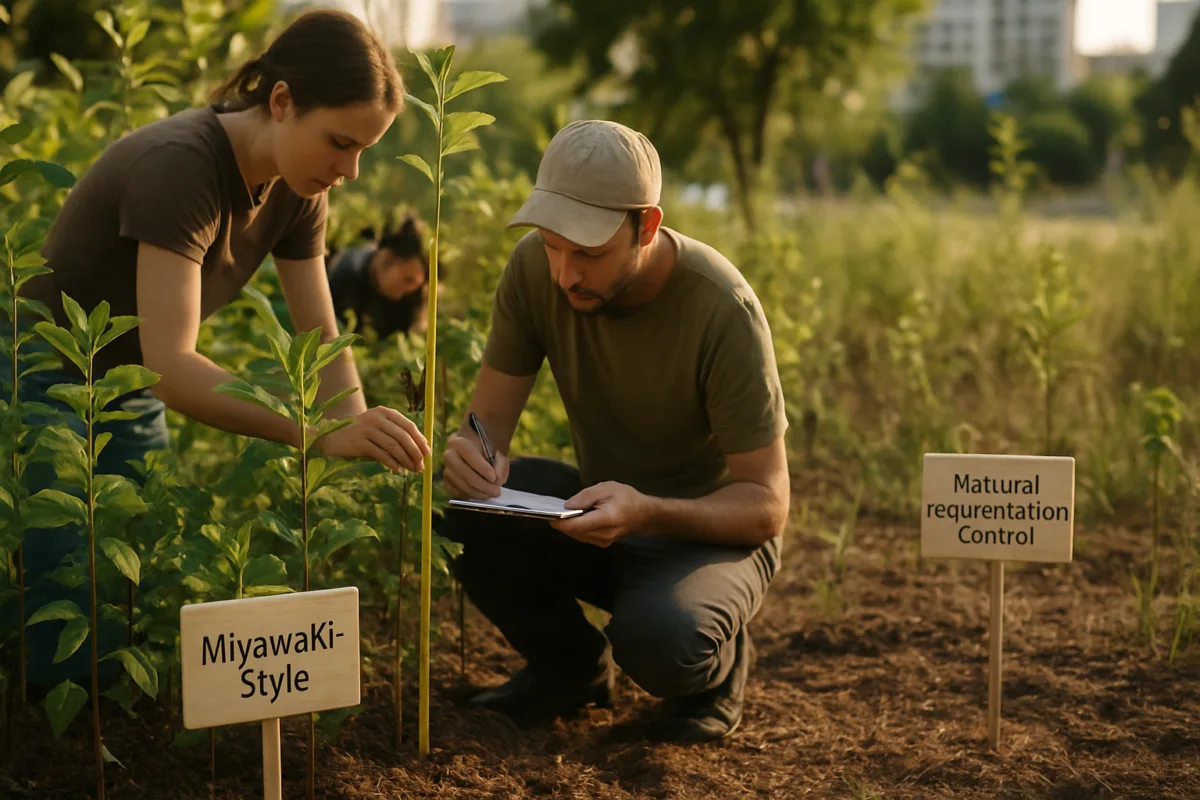
Urban planners, community groups, and conservation NGOs are increasingly drawn to small, dense patches of planted native trees that promise rapid greening and measurable climate benefits. The Miyawaki method—dense, mixed-species planting guided by a site’s potential natural vegetation—sits at the center of that excitement. But when an evidence review pulled the marketing apart, it revealed a mixed picture: some claims are plausible and partly supported, while others rest on thin or missing data. This article walks through a process-analysis approach for how practitioners and funders should scrutinize the method’s headline claims, design projects that yield useful evidence, and build realistic expectations about outcomes and trade-offs.
Step 1: Define the claims and convert them into testable hypotheses
The first step in any analytical process is to translate marketing language into precise, measurable hypotheses. Common Miyawaki claims include: ‘10 times faster growth than natural regeneration’, ‘30 times denser canopy’, ‘full ecological maturity within 20–30 years’, superior carbon sequestration, enhanced biodiversity, cost-effectiveness, and long-term self-sustainability without ongoing management.
Turn each into a testable statement. For example:
Example hypotheses
– Growth rate hypothesis: mean annual height increment of Miyawaki plots is ≥10× that of nearby natural regeneration controls during the first 5 years.
– Density hypothesis: stem density in Miyawaki plots at year 5 is ≥30× that of unmanaged reference plots of similar age.
– Carbon hypothesis: aboveground carbon stocks in Miyawaki plots exceed those in comparable restoration approaches within 10–20 years.
Formalizing claims into metrics (height, diameter, stem density, species richness, basal area, carbon stock) defines what needs measuring and for how long.
Step 2: Examine the current evidence base critically
A recent review in the Journal of Applied Ecology titled “Tiny forests, huge claims: the evidence gap behind the Miyawaki method for forest restoration” systematically examined 51 sources that make performance claims. Only 41% provided any quantitative data; 33% used a control comparison; and a mere 14% had replication—basic components of rigorous ecology. The commonly repeated ‘ten times faster’ figure mostly traces back to grey literature and advocacy materials rather than replicated, peer-reviewed trials.
Two peer-reviewed studies that measured carbon directly found no statistically significant advantage for Miyawaki-style planting after longer time spans. A Mediterranean field trial reported very high sapling mortality (61–84%) after 12 years under Miyawaki-style planting, challenging assumptions about reliable establishment. These results do not invalidate the method but underscore that the evidence is uneven and often short-term or promotional.
Step 3: Understand the mechanism—what is plausible and why
Not all claims are equally improbable. Dense planting creates immediate competition for light and resources. Mechanistically, that competition pushes vertical growth and fast canopy closure—an effect that is straightforward to observe and relatively easy to measure over a few years. This mechanistic plausibility explains why the growth-rate claim is the best-supported part of the Miyawaki narrative: you can get faster height growth in packed plots.
Conversely, outcomes like sustained biodiversity gain, greater long-term carbon sequestration, or durable self-sustainability hinge on many interacting processes—soil development, herbivory, pests, climatic variability, recruitment, and succession dynamics—that play out over decades. Demonstrating meaningful differences in these dimensions requires long-term, replicated monitoring across multiple sites.
Step 4: Design projects that are both restorative and informative
For cities or funders attracted to tiny-forest projects, a responsible approach pairs restoration goals with an embedded experimental design. That means deploying controls and replication from the outset and agreeing on monitoring protocols that capture the relevant metrics.
Practical experimental design elements
– Controls: set aside adjacent or comparable plots for natural regeneration or conventional restoration to enable direct comparison.
– Replication: implement the method at multiple sites with similar treatments to avoid site-specific anomalies driving conclusions.
– Standardized metrics and sampling intervals: height and diameter measurements, stem counts, canopy cover, species inventories, soil carbon sampling, and photographic time series at fixed points.
– Duration: commit to multi-year monitoring with clear milestones—early establishment (1–5 years), mid-term structure (5–15 years), and long-term trajectories (15–30+ years).
– Data transparency: publish methods and results, including negative outcomes, to build a useful evidence base beyond promotional anecdotes.
Step 5: Measure what matters—and do the math
Many projects stop at visual impact or short-term height gains. To evaluate the method meaningfully, track at least these indicators:
– Structural: stem density, diameter at breast height (DBH) distribution, canopy closure percentage.
– Biodiversity: species presence-absence, abundance indices for plants and key faunal groups (e.g., pollinators, birds).
– Carbon: aboveground biomass estimates using allometric equations; where possible, pair with direct soil organic carbon measurements.
– Survival and recruitment: percent survival of planted saplings, natural recruitment rates, and sapling mortality causes.
– Costs: per-hectare establishment costs, ongoing maintenance labour, and material inputs so comparisons with other approaches are transparent.
Analyze differences over time and test whether early growth advantages persist, converge, or reverse compared with controls. Where sample sizes allow, quantify uncertainty—confidence intervals and effect sizes—not just point estimates touted in marketing materials.
Step 6: Anticipate the scaling and cost trade-offs
One consistent critique of Miyawaki-style plantings is cost and scalability. Dense planting and intensive soil preparation can be labour and material intensive, raising per-unit-area costs compared to natural regeneration or assisted natural regeneration approaches. Experts such as Karen Holl have pointed to the method’s potential impracticality at large scales absent substantial funding and labour inputs.
When evaluating a city-wide or regional campaign, compare unit costs and potential ecological returns. If the objective is rapid visual greening in highly visible urban lots, the trade-off may be justified. If the objective is maximizing carbon sequestration per dollar across a landscape, other approaches—enlarging protected areas or fostering natural regeneration—may outperform dense, small patches.
Step 7: Build adaptive management and honest communication into programs
Given the evidence gaps, an adaptive-management mindset is essential. Projects should plan for routine assessment moments where monitoring results inform adjustments: thinning strategies if overcrowding causes mortality, supplementary planting where recruitment stalls, or pest management if outbreaks emerge.
Equally important is truthful public communication. If a municipal tiny-forest campaign highlights immediate canopy closure and local cooling, do so while stating limits: that claims about decadal biodiversity outcomes or multiplied carbon storage are still being tested. Funders and communities are more likely to sustain support when wins are real and caveats are candidly communicated.
Step 8: Use pilot projects to reduce uncertainty before scale-up
Pilot projects with robust monitoring can serve as learning platforms. Design pilots to answer the highest-priority uncertainties for your context: survival in your climate, cost per sapling till canopy closure, or carbon accumulation curves. A network of coordinated pilots across climatic zones can produce the replication the literature now lacks and help tease apart when Miyawaki-style approaches are most advantageous.
Checklist for a policy-ready pilot
– Clear hypotheses tied to local objectives.
– Paired control plots with similar starting conditions.
– Standardized monitoring over predefined intervals.
– Transparent budgeting, including labour and long-term maintenance.
– Community engagement that documents non-ecological benefits (recreation, education) as well as ecological metrics.
Dense native planting informed by potential natural vegetation remains a powerful idea: it foregrounds local species, structural complexity, and place-based composition rather than monocultural plantations. The Miyawaki method gives a practical planting protocol that can achieve rapid early stature in the right conditions, but the promotional figures of ten-fold or thirty-fold advantages over natural regeneration are not yet universal truths supported by robust, replicated science. For practitioners, the right approach is not blind rejection but disciplined testing: convert claims to hypotheses, design controlled comparisons, monitor the right metrics over realistic timeframes, and communicate outcomes honestly. That process will reveal where the method delivers genuine ecological value, where a different strategy would be better, and how to spend scarce restoration dollars to maximum effect.

Dr. Morgan directed the Archives Program from 2014 to 2017, gaining extensive experience in research documentation, information management, and the preservation of scholarly resources. Throughout her career, she has worked closely with academic publications and research materials, developing expertise in evaluating scientific sources and communicating complex topics to broad audiences.
Her primary areas of specialization include scientific publishing, research communication, editorial review, and the translation of technical research into accessible educational content. She has contributed to projects involving space science, astronomy, environmental science, history, archaeology, and emerging scientific discoveries, always emphasizing accuracy, transparency, and the responsible presentation of evidence.
As Editorial Director of Muskurahat.us, Dr. Morgan leads the editorial review process for scientific articles, ensuring that content is based on reputable sources, peer-reviewed research whenever available, and publications from recognized universities, research institutions, and international scientific organizations.
She is committed to promoting scientific literacy through clear, engaging, and well-documented articles that help readers better understand scientific discoveries and their impact on society. Her editorial philosophy is founded on accuracy, intellectual integrity, independent journalism, and continuous learning as scientific knowledge evolves.
Through her work at Muskurahat.us, Dr. Morgan supports the publication of trustworthy scientific content that makes complex research accessible to readers around the world while maintaining rigorous editorial standards.