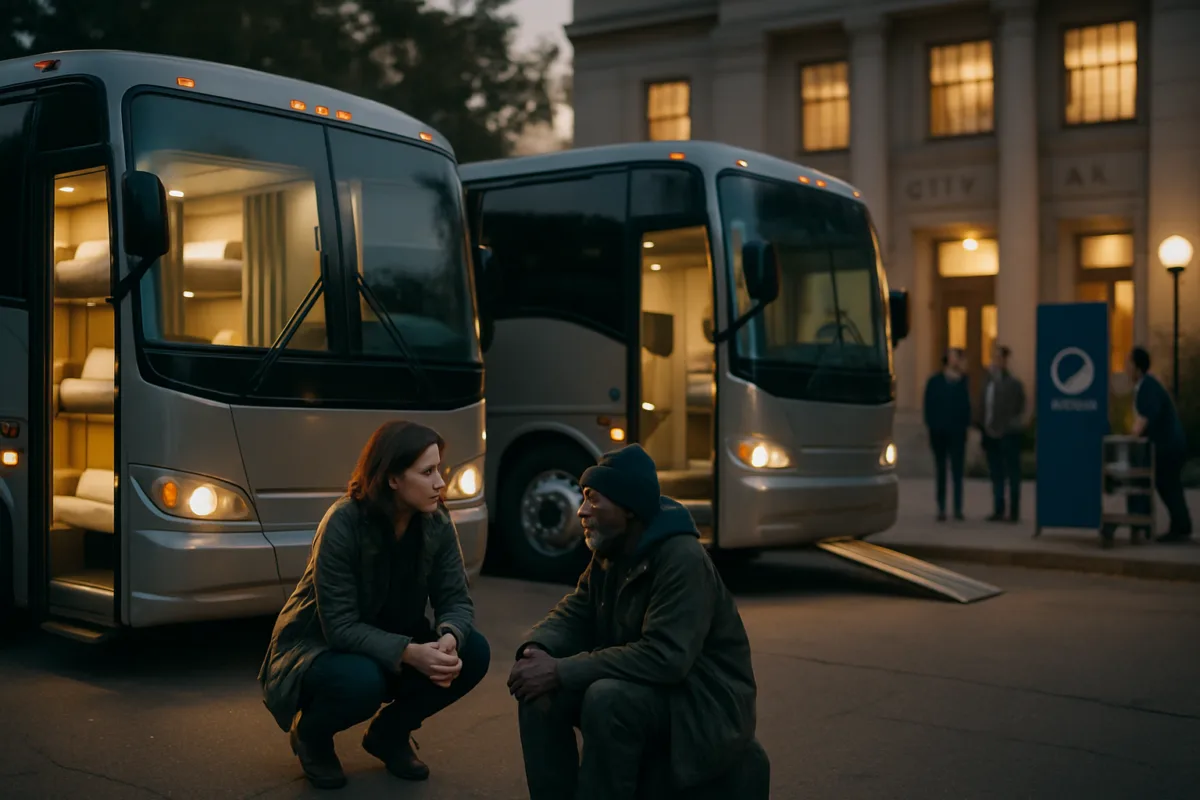
When Orlando rolled two 45-foot motor coaches into service as overnight shelters, the debate sharpened immediately: are shelter buses a pragmatic emergency tool or a photogenic distraction from building real housing? That question matters because the answer dictates whether these mobile shelters become a bridge to permanent homes or an excuse to delay the expensive, difficult work of housing construction.
What the shelter buses actually are and what they aim to do
The two coaches are purpose-built mobile shelters with 20 bunk sleeping pods each and a 21st accessible sleeping space, totaling 42 climate-controlled sleeping spots. Each pod includes a light, an outlet, and a privacy curtain; the buses also provide restrooms, storage, and on-site caseworker support.
Importantly, the buses operate under the 407 Connect program with a clear metric: move more than 407 people into permanent housing over three years. That intention matters, because a tool used to funnel people toward housing is different from one used merely to hide unsheltered residents from public view.
Why critics call shelter buses a gimmick
Critics were blunt: sleeping in buses is “not dignity,” as one local voice put it. The visceral claim is that a bus is not a home, and politically it feels like a low-cost substitute for a 300-bed permanent shelter that was canceled after neighborhood pushback.
Those concerns are legitimate. If municipal leaders point to two buses and declare the crisis solved, the buses become cover for inaction. In that scenario, mobile shelters function as public relations assets rather than as transitional housing tools.
Historical context and political incentives
The program followed a failed plan for a larger SoDo shelter, which helps explain the backlash. When elected officials face public opposition to permanent facilities, the temptation to deploy less controversial, more portable solutions grows. That shift can warp priorities unless strict accountability measures keep housing targets central.
Evidence so far: outcomes, numbers, and costs
Early program reporting showed 119 people enrolled and 50 housed by spring 2026, with an internal goal of housing someone within 60 days of joining. Those preliminary results are promising if they scale, but the small absolute numbers reveal the limits.
By the region’s count, 2,781 people were experiencing homelessness on a single night in 2025, with 1,090 unsheltered. Forty-two beds address only a sliver of need. The city spent $350,000 in federal pandemic-relief funds to buy the buses and estimates annual operating costs near $1 million. Evaluating value hinges on whether housing exits continue at pace.
Why design and services matter for mobile shelters
The buses are not just beds on wheels. They are modeled after Vero Beach’s Dignity Bus and include staffing, case management, and intentional design features that protect privacy and safety. A bed on the bus is paired with a caseworker who assists individuals in finding longer-term housing.
Such wraparound services are the difference between a temporary nap space and a focused pathway to housing. Evidence from similar programs suggests that intensive case management and connections to subsidies are critical to moving people from emergency shelter to leases.
Accessibility and human-centered design
Inclusion of an accessible sleeping pod and climate control are small but meaningful details. They indicate that the buses were conceived with more than optics in mind. Still, design choices cannot compensate for structural shortages of affordable units.
Arguments in favor: an emergency bridge to housing
Viewed argumentatively, shelter buses can be framed as emergency bridges—temporary platforms that keep people safe while targeted housing solutions are developed. If the buses truly funnel people to permanent homes, their novelty is irrelevant compared with outcomes.
Proponents argue that flexibility matters in contexts where siting fixed shelters meets organized resistance. Mobile shelters can be deployed quickly, adapted to shifting need, and embedded with outreach teams that locate and enroll people who otherwise slip through the system.
Operational benefits and speed
Mobile shelters can be stood up far faster than constructing a new building. That speed can reduce time spent unsheltered, prevent the acute harms of street homelessness, and create touchpoints for caseworkers to build trust and start housing plans.
Risks and trade-offs: when an expedient tool becomes policy complacency
However, using buses as a long-term remedy is a risky proposition. The core danger is political: temporary measures can calcify into permanent expectations, redirecting funds away from capital investment in affordable housing.
Moreover, operating costs per bed may be high compared with investments in housing vouchers or construction in the long run. The right comparison depends on the time horizon and the rate at which participants exit to permanent units.
Metrics that should determine success
To avoid complacency, success metrics must be explicit and public. Key indicators include: percentage of participants housed within target windows, average length of stay, cost per housing exit, and the proportion of program participants who access benefits and rental assistance.
Regular, transparent reporting forces policymakers to treat buses as interim steps rather than final answers.
How to integrate shelter buses into a broader housing strategy
Pragmatism demands a two-track approach: deploy mobile shelters to reduce immediate harm, while simultaneously advancing capital projects and voucher programs that produce permanent housing. This dual strategy weakens the argument that the buses will crowd out construction.
Crucially, funding streams must be ring-fenced. Federal and local funds used for mobile shelters should not cannibalize dedicated affordable housing development budgets without clear offsets and timelines.
Policy safeguards and governance
Municipal leaders should adopt safeguards: require publishable milestones for housing exits, set maximum program durations tied to housing commitments, and mandate independent evaluation after a defined pilot period. Community oversight committees can guard against mission drift.
Practical recommendations for city leaders and advocates
First, treat the buses as part of a continuum: emergency shelter, rapid rehousing, and permanent supportive housing. Align case management with rental assistance and landlord engagement to speed exits.
Second, be transparent about costs and outcomes. Public dashboards with up-to-date metrics make it harder for officials to declare success based on optics alone. Third, keep building: incentivize affordable development and defend projects against NIMBY opposition with clear community benefits and supports.
What residents and taxpayers should ask for
Civic stakeholders should demand targets and timelines. Ask how each bed maps to a housing exit, what supports accompany each resident, and how the city will sustain permanent housing investments alongside mobile shelter operations.
Such questions reframe the debate from whether a bus can be a home to whether the program helps people get one.
Whether Orlando’s shelter buses wind up as a case study in smart, humane crisis response or as a cautionary tale about substituting spectacle for structure depends on choices made now. If leaders and advocates insist on measurable housing outcomes, publish transparent data, and preserve capital funding for permanent units, mobile shelters can be a pragmatic bridge rather than a final stop. For residents, policymakers, and service providers, the actionable step is clear: demand accountability for housing exits, protect funding for long-term housing, and use mobile shelters precisely because they are temporary tools designed to shorten the time someone spends without a safe place to sleep.

Dr. Morgan directed the Archives Program from 2014 to 2017, gaining extensive experience in research documentation, information management, and the preservation of scholarly resources. Throughout her career, she has worked closely with academic publications and research materials, developing expertise in evaluating scientific sources and communicating complex topics to broad audiences.
Her primary areas of specialization include scientific publishing, research communication, editorial review, and the translation of technical research into accessible educational content. She has contributed to projects involving space science, astronomy, environmental science, history, archaeology, and emerging scientific discoveries, always emphasizing accuracy, transparency, and the responsible presentation of evidence.
As Editorial Director of Muskurahat.us, Dr. Morgan leads the editorial review process for scientific articles, ensuring that content is based on reputable sources, peer-reviewed research whenever available, and publications from recognized universities, research institutions, and international scientific organizations.
She is committed to promoting scientific literacy through clear, engaging, and well-documented articles that help readers better understand scientific discoveries and their impact on society. Her editorial philosophy is founded on accuracy, intellectual integrity, independent journalism, and continuous learning as scientific knowledge evolves.
Through her work at Muskurahat.us, Dr. Morgan supports the publication of trustworthy scientific content that makes complex research accessible to readers around the world while maintaining rigorous editorial standards.