The discovery of a three-lobed asteroid is not mere trivia; it undermines a core assumption about how small bodies assemble in our solar system. Within the first hundred words of this argument, the primary keyword “three-lobed asteroid” is intentionally used because Nysa’s newly imaged trilobate shape forces a reconsideration of long-standing models built around two-part contact binaries.
Discovery of a three-lobed asteroid: what was seen and why it matters
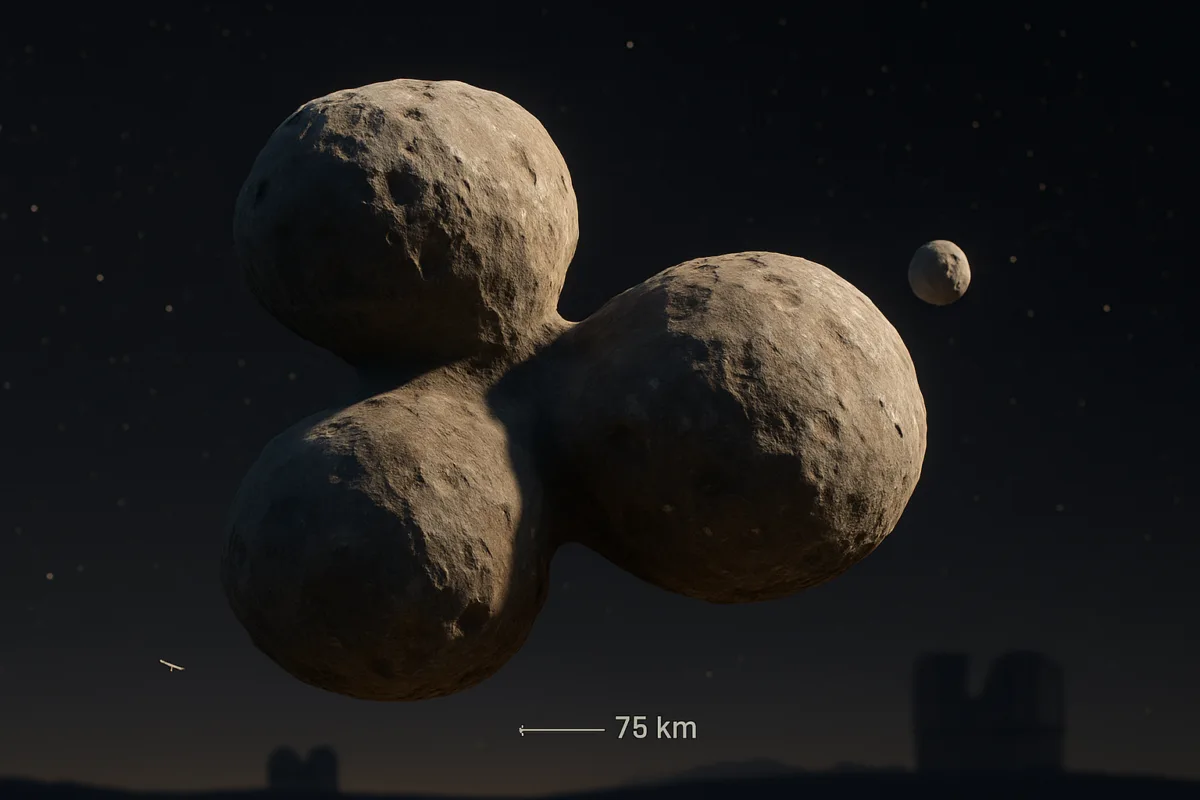
The images of asteroid (44) Nysa show two narrow waists, or “colli”, carving the body into three distinct lobes. Ground-based adaptive-optics observations from SHARK-VIS on the Large Binocular Telescope and SPHERE/ZIMPOL on the Very Large Telescope produced resolution approaching spacecraft quality and revealed a previously hidden morphology and a small moon.
That matters because every confirmed contact-binary until now matched a two-lobe pattern. The new evidence is not a minor exception; it is a counterexample that exposes a blind spot in formation models that assumed a natural stopping point at two connected fragments.
How ground-based imaging resolved Nysa’s trilobate structure
Adaptive optics systems corrected atmospheric blurring in real time, allowing astronomers to resolve valleys wrapping around Nysa’s circumference. Previously, light-curve analysis and lower-resolution imaging suggested elongation but blurred the details into a single elongated blob.
Moreover, the simultaneous use of instruments on two continents and multiple observing runs reinforced the result. Consequently, the imaging is robust enough to warrant serious theoretical response rather than being dismissed as an observational artifact.
Why prior methods missed the second neck
Light curves extract rotation and brightness changes but lack the spatial discrimination to separate subtle, adjacent waists unless geometry is fortuitous. In contrast, high-resolution imaging directly maps surface features and can reveal multiple necks where photometry cannot.
Therefore, Nysa reveals a methodological gap: classification based solely on indirect indicators may have systematically underestimated structural complexity in main-belt objects.
Formation hypotheses for a trilobate asteroid
Two leading explanations can account for Nysa’s trilobate appearance: contact trinary assembly and a hit-and-run reshaping of a larger parent body. Both scenarios are plausible, yet each implies different histories and constraints for collisional dynamics.
On the one hand, a contact trinary forms when three fragments re-accumulate gently after a disruptive event, suggesting a low-velocity environment or efficient dissipation. On the other hand, a glancing hit-and-run collision implies a more violent reshaping without full fragmentation, indicating a different collisional energy regime.
Evaluating the mechanisms
Distinguishing between these hypotheses requires more than shape. Internal density variations, compositional heterogeneity, and surface age markers would provide needed diagnostics. Ground-based imaging alone cannot deliver those constraints.
Thus, while morphology points us in promising directions, it does not settle the formation debate: additional observations are essential to arbitrate between contact trinary formation and hit-and-run modification.
Implications for asteroid formation models and planetary science
The existence of a three-lobed asteroid challenges the tacit assumption that contact binaries naturally stop at two components. If Nysa is not unique, theoretical frameworks must be updated to permit multi-lobed aggregates under realistic collisional and dynamical histories.
Furthermore, this finding has ripple effects: population statistics, collisional evolution models, and accretion simulations should be re-evaluated to account for a broader morphological spectrum among small bodies.
Why models must adapt now
Models calibrated on two-lobed examples risk missing key processes such as sequential re-accumulation of multiple fragments or complex tidal interactions during near-miss collisions. If simulation parameter spaces do not include conditions that produce trilobate forms, predictions about asteroid interior structure, spin state evolution, and satellite formation will be incomplete.
Consequently, updating models is not optional: it is necessary to maintain accurate interpretations of small-body dynamics and history.
Immediate observational and programmatic responses
Researchers should prioritize targeted follow-up observations to constrain Nysa’s mass distribution, composition, and internal structure. Radar delay-Doppler mapping, thermal infrared measurements, stellar occultations, and spectroscopic campaigns could each supply missing evidence.
Moreover, community coordination to search for additional multilobed asteroids using high-resolution ground-based facilities should be a near-term priority. Re-examining archived adaptive-optics datasets and arranging coordinated occultation campaigns will accelerate discoveries.
Specific techniques that will help
Radar observations can resolve surface roughness and provide independent shape data where geometry permits. Thermal infrared mapping reveals thermophysical properties that help infer porosity and internal structure. Stellar occultations can slice the silhouette at high precision and pin down dimensions.
Additionally, spectroscopic mapping across lobes can reveal compositional differences that discriminate between accreted fragments and re-shaped monoliths. Taken together, these methods offer a feasible roadmap to adjudicate formation hypotheses.
Why a moon matters for the story
The discovery of a roughly one-kilometre moon orbiting Nysa (S/2026 (44) 1) strengthens the case for a complex collisional past. Satellites often arise from low-velocity re-accumulation events or ejecta capture after collisions, which ties into the contact trinary scenario.
However, satellites can also be produced during high-speed impacts that launch debris into orbit. Therefore, the moon is a critical piece of evidence but not a smoking gun; it refines the problem rather than solves it.
Broader consequences: population surveys and mission planning
If more trilobate or multi-lobed bodies exist, the sample of targets for missions like Lucy or Hayabusa-class encounters becomes richer and more diverse. Mission planners should consider including potential multilobed objects as high-priority flyby or rendezvous targets.
Additionally, population surveys using adaptive optics-equipped telescopes, radar networks, and citizen-science occultation programs can reveal whether Nysa is an oddball or the first recognized member of a larger class of complex contact objects.
Practical next steps for scientists and interested observers
Scientists should prioritize joint campaigns combining spectroscopy, thermal mapping, radar, and occultation observations to collect the multi-modal data required for decisive interpretation. Funding agencies can support targeted proposals that exploit the unique synergy of ground-based facilities and forthcoming missions.
For amateur astronomers and citizen scientists, contributing to occultation networks and monitoring main-belt brightness variations remains valuable. High-cadence photometry can still provide context and may reveal rotational behaviors worth following up with adaptive optics imaging.
Ultimately, Nysa’s newly revealed three-lobed structure is more than a curiosity; it is a call to action. It urges theorists to broaden parameter spaces in formation models, observers to re-examine archival and new high-resolution data, and mission planners to recognize that unexpected complexity may await at seemingly well-known targets. By coordinating multi-wavelength observations, prioritizing radar and occultation campaigns, and expanding simulation inputs to include multi-body accretion and hit-and-run outcomes, the field can transform an isolated surprise into a systematic understanding of how small bodies assemble and evolve. Those tangible steps will let us move from wonder to explanation and ensure that our models match the true diversity of objects orbiting the Sun.

Dr. Morgan directed the Archives Program from 2014 to 2017, gaining extensive experience in research documentation, information management, and the preservation of scholarly resources. Throughout her career, she has worked closely with academic publications and research materials, developing expertise in evaluating scientific sources and communicating complex topics to broad audiences.
Her primary areas of specialization include scientific publishing, research communication, editorial review, and the translation of technical research into accessible educational content. She has contributed to projects involving space science, astronomy, environmental science, history, archaeology, and emerging scientific discoveries, always emphasizing accuracy, transparency, and the responsible presentation of evidence.
As Editorial Director of Muskurahat.us, Dr. Morgan leads the editorial review process for scientific articles, ensuring that content is based on reputable sources, peer-reviewed research whenever available, and publications from recognized universities, research institutions, and international scientific organizations.
She is committed to promoting scientific literacy through clear, engaging, and well-documented articles that help readers better understand scientific discoveries and their impact on society. Her editorial philosophy is founded on accuracy, intellectual integrity, independent journalism, and continuous learning as scientific knowledge evolves.
Through her work at Muskurahat.us, Dr. Morgan supports the publication of trustworthy scientific content that makes complex research accessible to readers around the world while maintaining rigorous editorial standards.