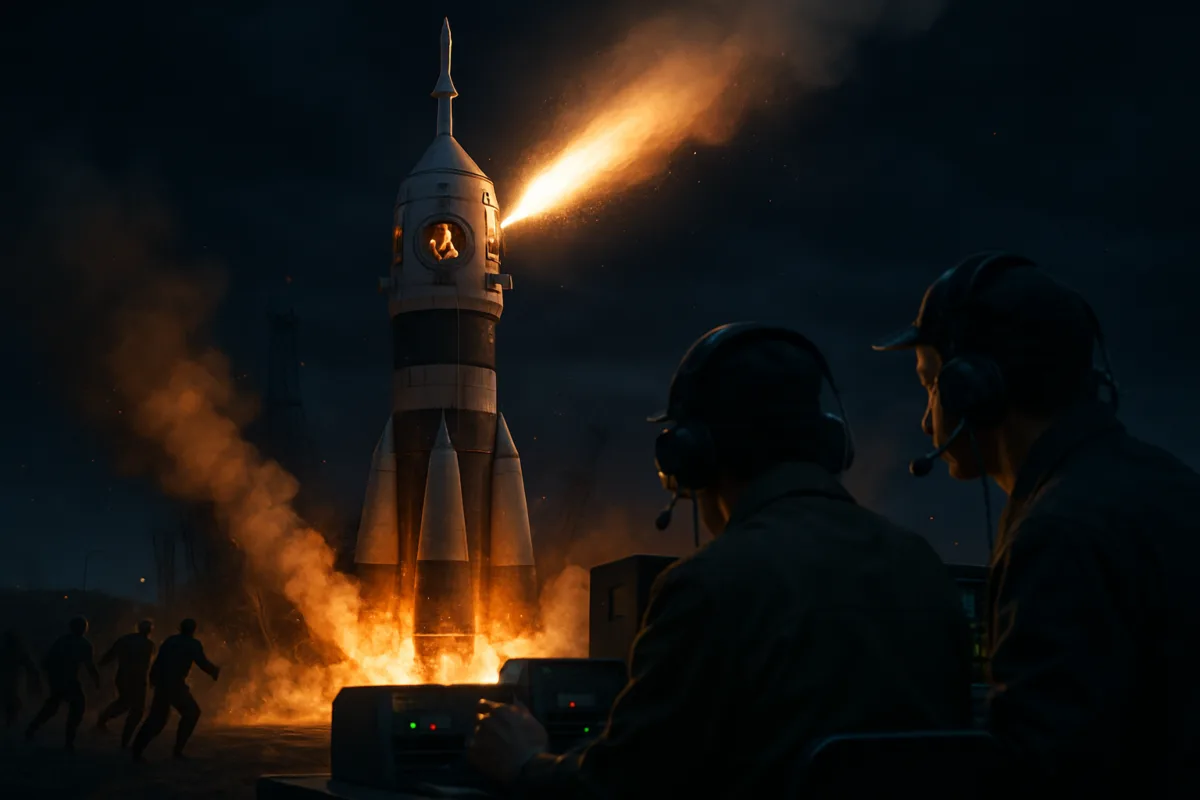
The Soyuz launch abort 1983 is often recounted as a miraculous escape, but that framing misses the central point: the survival of Vladimir Titov and Gennady Strekalov was the result of deliberate engineering choices and disciplined procedures, not sheer fortune. On 26 September 1983, flames licked the pad at Baikonur while two cosmonauts sat strapped inside a rocket. What followed was a demonstration of how redundancy, safeguards, and human coordination can combine to save lives under extreme time pressure.
Reframing the pad fire: why luck is a poor explanation
It is tempting to tell the story as a narrow escape, a pair of heroes and a handful of quick-thinking controllers defying the odds. Yet this narrative obscures a more important truth: the system was designed to protect the crew even when its primary path failed. Moreover, the backup that performed under pressure had been intentionally constrained to avoid accidental activation.
Consequently, the episode at Baikonur deserves to be read as an argument for engineered resilience. Rather than attributing the outcome to chance, we should analyze which design decisions made a successful rescue possible and what trade-offs were accepted to prevent worse outcomes.
What actually failed: the primary abort path and the fire
About ninety seconds before launch, a valve malfunction in a side booster allowed fuel to flood a turbopump, leading to overspeeding, a broken blade, and an ignition at the base of the vehicle. The flames moved swiftly and burned through the wired abort command that normally would have triggered the launch escape system.
Importantly, the controllers were not merely slow or panicked; their standard ability to fire the escape tower had been physically severed. The wire-based abort line, the system expected to work under most pad emergencies, succumbed to the very hazard it was intended to mitigate.
How the backup radio command functioned
When the wired path failed, the crew’s only realistic hope rested on a radio-based backup command. This alternative route was not a sloppy afterthought. Instead, it was an explicitly designed secondary control path, available precisely because engineers recognized that wiring at the pad could be compromised in some emergencies.
However, the backup was intentionally constrained. Activating it required two independent controllers to provide synchronized inputs within a narrow time window. That design choice matters; it shaped both the risk profile and the operational demands on personnel who would have to act under massive stress.
The two-controller requirement and the five-second window
To trigger the radio abort, the launch director and the rocket technical leader initiated the procedure by issuing the verbal code word. At a remote station, two operators then had to press their buttons within five seconds of each other. This double-input rule protected the system from false triggers, but it also required coordination under fire.
On that night, the two-button requirement was met with very little margin. One operator pressed with roughly a second to spare. The timing was razor-thin, but the protocol held, and the escape tower fired as the backup command arrived.
Why intentional difficulty is sometimes the right choice
At first glance, making an abort harder to trigger appears counterintuitive. Shouldn’t quick activation be the priority when lives are at stake? The answer is that unnecessary or false activations carry severe risks too. An inadvertent launch escape activation could destroy a vehicle, endanger ground personnel, and create cascading failures during a busy launch cadence.
Therefore, designers often accept a measure of operational friction to reduce the probability of catastrophic accidental triggers. The five-second, two-controller rule exemplifies a safety trade-off: tolerate additional coordination costs to prevent an erroneous, high-consequence event.
The human factor: training, discipline, and timing
Because engineers limited automation to avoid false positives, human operators became the decisive element. That made rigorous training, clear procedures, and practiced communication indispensable. The Baikonur incident shows how human competence and an established procedure can bridge the gap created when primary systems fail.
Still, relying on humans in emergencies introduces variability. In this case, the operators succeeded under pressure. But the episode should prompt careful reflection: are decision windows and required inputs realistic in worst-case scenarios, or do they assume circumstances that may not obtain?
What the escape demonstrated about redundancy and verification
The successful use of the launch escape system underlines three engineering principles: redundancy, independent verification, and fail-safe constraints. Redundancy provided an alternate path; independence minimized common-mode failures; and the deliberate constraint prevented accidental deployment.
These principles are not unique to rocketry. In domains ranging from nuclear control to medical devices, multiple independent inputs are used to ensure that a critical action is intentional. The Soyuz abort shows the same logic applied under real-world stress, where those disciplines saved lives.
Independent paths reduce correlated failure risk
If both primary and backup systems share the same vulnerability, redundancy is meaningless. The wired abort line and the radio command were intentionally dissimilar, so a fire that cut through cables did not automatically disable the radio path. That separation proved decisive at Baikonur.
Counterarguments and trade-offs: could the system have been better?
Critics may argue that requiring two controllers within five seconds was needlessly risky. They might suggest a one-button abort, pilot-initiated controls, or redundant wireless channels. Each alternative, however, brings its own drawbacks and risks.
For example, a single-button remote abort could reduce reaction time but increase the chance of accidental activation, with enormous costs. Giving manual abort controls to the crew would be useful only if the capsule had survivable interfaces and time to act; in many pad failures, crew intervention is impractical or unsafe.
Modern parallels and evolving design choices
New launch systems continue to wrestle with the same balance between automated speed and safeguards against false triggers. Modern architectures sometimes employ diverse redundant paths, more robust telemetry, and machine-assisted decision aids to reduce human burden without sacrificing protection against unintended activations.
Yet the core dilemma remains: the more automatic a system is, the greater the consequences of a false actuation; the more human-dependent it is, the greater the chance of delay or error. The Soyuz incident offers a rare real-world data point to inform that debate.
Practical lessons for engineers and mission planners
The night at Baikonur suggests several actionable takeaways. First, design backups that are independent in both medium and control logic to prevent common-cause failures. Second, include deliberate safeguards to avoid accidental activations, but validate that those safeguards are operable under extreme conditions.
Third, train operators on tight, realistic time windows and rehearse degraded-mode operations frequently. Finally, review whether crew-accessible overrides or alternative manual procedures are feasible and beneficial in specific mission profiles.
Concrete steps to implement today
For program managers, run failure-mode analyses that explicitly model the loss of primary control paths from environmental hazards like fire or blast. For system designers, adopt diverse communication channels with independent power and routing. For human-factors teams, simulate stress and sensory overload during rehearsals so that timing assumptions match human performance inputs.
These are not exotic prescriptions; they are practical changes that can materially increase survivability without sacrificing operational integrity.
Why the story matters beyond a single escape
The common retelling of the 1983 Soyuz pad abort as a near-miracle obscures the systemic competence that made survival possible. A more nuanced reading highlights how careful engineering, procedural rigor, and trained personnel interact to make redundancy meaningful. That framing matters because it shifts the lesson from folklore to replicable design strategy.
Moreover, as commercial and governmental launch rates increase, the trade-offs illustrated by this event will only become more relevant. Systems must be both robust to environmental damage and resilient to accidental activation, and the Baikonur incident provides empirical grounding for that balance.
Ultimately, Titov and Strekalov’s survival was not simply lucky; it was the outcome of intentional choices about how to protect crews when the unexpected becomes reality. Embracing that perspective leads to actionable improvements: build independent backups, validate constraints under stress, and invest in disciplined, realistic training so that when rare emergencies occur, the system performs as intended.
Actionable next steps for readers in aerospace roles
If you are an engineer or planner, review your abort logic for common-mode vulnerabilities and run degraded-path drills. If you manage operations, increase scenario complexity in rehearsals and validate human timing assumptions. If you are a policy maker, fund independent testing of backup channels and require documented failure-mode analyses for crewed launches.
Recognizing the role of design and procedure in the Soyuz escape turns an anecdote into a blueprint for safer launches. Implement these steps, and you change a story of narrow survival into a reproducible approach to protecting lives under worst-case conditions.

Dr. Morgan directed the Archives Program from 2014 to 2017, gaining extensive experience in research documentation, information management, and the preservation of scholarly resources. Throughout her career, she has worked closely with academic publications and research materials, developing expertise in evaluating scientific sources and communicating complex topics to broad audiences.
Her primary areas of specialization include scientific publishing, research communication, editorial review, and the translation of technical research into accessible educational content. She has contributed to projects involving space science, astronomy, environmental science, history, archaeology, and emerging scientific discoveries, always emphasizing accuracy, transparency, and the responsible presentation of evidence.
As Editorial Director of Muskurahat.us, Dr. Morgan leads the editorial review process for scientific articles, ensuring that content is based on reputable sources, peer-reviewed research whenever available, and publications from recognized universities, research institutions, and international scientific organizations.
She is committed to promoting scientific literacy through clear, engaging, and well-documented articles that help readers better understand scientific discoveries and their impact on society. Her editorial philosophy is founded on accuracy, intellectual integrity, independent journalism, and continuous learning as scientific knowledge evolves.
Through her work at Muskurahat.us, Dr. Morgan supports the publication of trustworthy scientific content that makes complex research accessible to readers around the world while maintaining rigorous editorial standards.