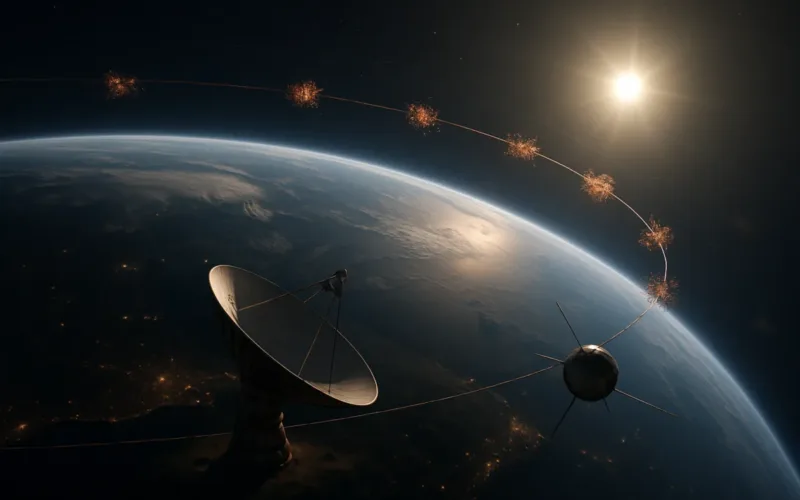
Echo 1A was a provocative demonstration: a 30-metre aluminized balloon that reflected radio signals between ground stations without a single onboard electronic component. That striking image—an almost empty sphere becoming a transcontinental voice link through pure geometry—serves as the hook and the heart of a larger argument about how engineering proof can be conflated with a viable architecture. The Echo experiment proved a possibility, but it did not—and could not—prove that passive reflectors were the right path for scalable global communications.
Why Echo 1A mattered for communications satellites and engineering thinking
First, Echo 1A forced a reassessment of what a satellite could be. Before active repeaters became routine, the idea of using a simple reflective object to bridge signals was credible, especially in an era when power, mass and reliability in orbit were precious commodities. The satellite’s success showed that an orbital reflector could enable voice and even television trials across continental distances.
Moreover, the project delivered surprising secondary value. Because Echo 1A had an exceptionally high area-to-mass ratio, it became a sensitive probe for upper-atmosphere density, solar radiation pressure and the behaviour of thin materials in space. Thus, Echo’s designers got communications experiments and meaningful scientific data in a single platform.
Passive reflector vs active transponder: technical trade-offs
To argue effectively that passive reflectors were never destined to be the dominant architecture, one must examine clear technical trade-offs. A passive satellite like Echo intercepts only a fraction of the transmitted beam; the return path suffers additional spreading and attenuation. The round-trip path loss is multiplicative, not additive—so the received signal is orders of magnitude weaker than what an active repeater could generate.
Consequently, ground systems have to compensate. High-power uplinks, massive tracking antennas, intricate orbital prediction and ultra-low-noise receivers are all required to recover intelligible signals. This shifts complexity from the spacecraft to the ground segment, which may be tolerable for experiments but is poor economics for a scalable network.
Signal loss, fading and the limits of a radio mirror
Another technical reality is that Echo’s reflective surface introduced time-varying scattering. As the thin Mylar skin leaked gas and micrometeoroid punctures accumulated, the sphere wrinkled and the received power fluctuated. Phase coherence degraded and fading increased, making the link reliability poor compared with active systems that can regenerate and stabilise a signal on board.
Therefore, while a passive reflector can demonstrate feasibility, it cannot ensure the consistent channel quality required by telephone or television networks, especially under varying atmospheric and orbital conditions.
Ground infrastructure: who really did the work?
It is tempting to credit Echo 1A with doing the heavy lifting, but the truth is that the ground infrastructure did most of the work. Large antennas, careful pointing, and precise timing at both ends reproduced a usable downlink. In short, the intelligence and power stayed on Earth.
Thus, the Echo model exposes a transfer of complexity: design simplicity of the satellite came at the cost of much larger investments and operational burden on terrestrial facilities. Economies of scale favour architectures that minimise per-link ground costs while allowing satellites to carry more of the processing and amplification burdens.
Engineering lessons from the Echo inflatable satellite
Despite its limitations as a communications architecture, Echo 1A left a durable engineering legacy. Packing a 100-foot reflective membrane into a small canister required advanced materials engineering, reliable inflation mechanisms and a deep understanding of thin-film behaviour in vacuum and thermal cycling. Those are nontrivial achievements that continue to inform modern inflatable structures.
Furthermore, Echo highlighted that low mass and large area can be deliberate design choices. Inflatable habitats, deployable antennas and solar sails all inherit lessons from Echo: launch stowage efficiency, deployment reliability and susceptibility to environmental degradation must be designed for from the start.
Material resilience and orbital longevity
Echo’s thin aluminium-coated Mylar performed well enough to validate the experiment, but it also demonstrated the fragility of such membranes in orbit. The membrane thinned to about 12.7 micrometres and eventually developed leaks and wrinkles that compromised function. Modern applications must prioritise puncture resistance, self-sealing capabilities and redundancy when they seek operational lifetimes beyond months.
Consequently, contemporary engineers should view Echo as a cautionary success: it worked spectacularly well for a time but required upgrades in materials and design to be durable for long-term service.
Why active satellites made the balloon obsolete for mainstream communications
Active repeaters like Telstar, Relay and Syncom changed the playing field by bringing power, amplification and selective retransmission into orbit. These satellites could produce a regenerated downlink with far stronger signal-to-noise ratios and predictable performance, enabling continuous coverage and higher capacity than a passive mirror could ever provide.
Therefore, while Echo answered an early test question, active satellites answered the market’s demands. Scalability, capacity and reliability are not marginal conveniences; they define whether a technology becomes infrastructure or a museum piece.
Legacy and modern applications: when to choose passive reflectors today
Yet it would be a mistake to dismiss passive reflectors entirely. Echo-style concepts remain relevant where the economics or physics favour a simple reflector. Laser ranging, radar calibration, certain types of scientific probes, and low-cost tracking targets still leverage passive surfaces effectively. Inflatable reflectors can be attractive for short-duration experiments or as testbeds for materials and deployment mechanisms.
Moreover, passive concepts could re-emerge in hybrid roles: for instance, as emergency reflectors to extend reach temporarily, or as ultra-lightweight beacons for initial rendezvous and inspection missions. The decision remains contextual: choose passive when the ground segment can absorb complexity and when temporal or capacity constraints are modest.
Policy and environmental considerations
Echo’s successors included experiments such as Project West Ford, which raised ethical and environmental questions by populating orbit with many small dipoles. That episode ended as active systems proved superior and concerns about debris grew. Today, any proposal to deploy passive reflectors must be weighed against orbital debris risk, long-term trackability and international norms.
Consequently, responsible design now demands lifecycle planning: retrieval, deorbiting, or sufficiently low area-to-mass ratios to ensure rapid decay. The Echo story teaches that novelty without stewardship can create problems that outlast the demonstration.
What engineers and decision-makers should take away
The strongest takeaway is a methodological one: an elegant proof does not equal a sound architecture. Echo 1A was a brilliant demonstration for its time, and it should be celebrated for its ingenuity and the knowledge it produced. Yet engineers and policymakers must distinguish between what a single experiment proves and what a global network requires.
In practice, that distinction leads to clear actions. When evaluating an orbital communications concept, quantify the end-to-end link budget, include ground-segment costs, model degradation modes such as material aging and punctures, and compare scalability metrics like throughput per dollar and operational availability. These steps move debate from rhetoric to measurable trade-offs.
Actionable checklist for applying Echo lessons
1. Evaluate where to allocate complexity: on-board or on the ground? Model costs over expected operational life. 2. Prioritise material resilience for inflatables: include puncture testing and thermal cycling early. 3. Consider hybrid architectures that combine passive deployables with minimal active electronics. 4. Incorporate end-of-life plans to minimise debris risk and comply with modern space environmental standards.
By following these steps, teams can harness the ingenuity of Echo-like experiments while avoiding the architectural pitfalls that kept passive reflectors from becoming mainstream infrastructure.
Echo 1A remains a landmark because it reframed what a satellite could mean: a piece of geometry made to work by people and ground systems, not by electronics in orbit. Its legacy is twofold—an inspiring proof of concept and a cautionary tale about conflating demonstration with design. Engineers and decision-makers should therefore treat Echo as both a source of techniques for inflatables and a benchmark for rigorous trade-off analysis; doing so preserves its lessons and applies them where passive solutions make real economic and scientific sense.

Dr. Morgan directed the Archives Program from 2014 to 2017, gaining extensive experience in research documentation, information management, and the preservation of scholarly resources. Throughout her career, she has worked closely with academic publications and research materials, developing expertise in evaluating scientific sources and communicating complex topics to broad audiences.
Her primary areas of specialization include scientific publishing, research communication, editorial review, and the translation of technical research into accessible educational content. She has contributed to projects involving space science, astronomy, environmental science, history, archaeology, and emerging scientific discoveries, always emphasizing accuracy, transparency, and the responsible presentation of evidence.
As Editorial Director of Muskurahat.us, Dr. Morgan leads the editorial review process for scientific articles, ensuring that content is based on reputable sources, peer-reviewed research whenever available, and publications from recognized universities, research institutions, and international scientific organizations.
She is committed to promoting scientific literacy through clear, engaging, and well-documented articles that help readers better understand scientific discoveries and their impact on society. Her editorial philosophy is founded on accuracy, intellectual integrity, independent journalism, and continuous learning as scientific knowledge evolves.
Through her work at Muskurahat.us, Dr. Morgan supports the publication of trustworthy scientific content that makes complex research accessible to readers around the world while maintaining rigorous editorial standards.