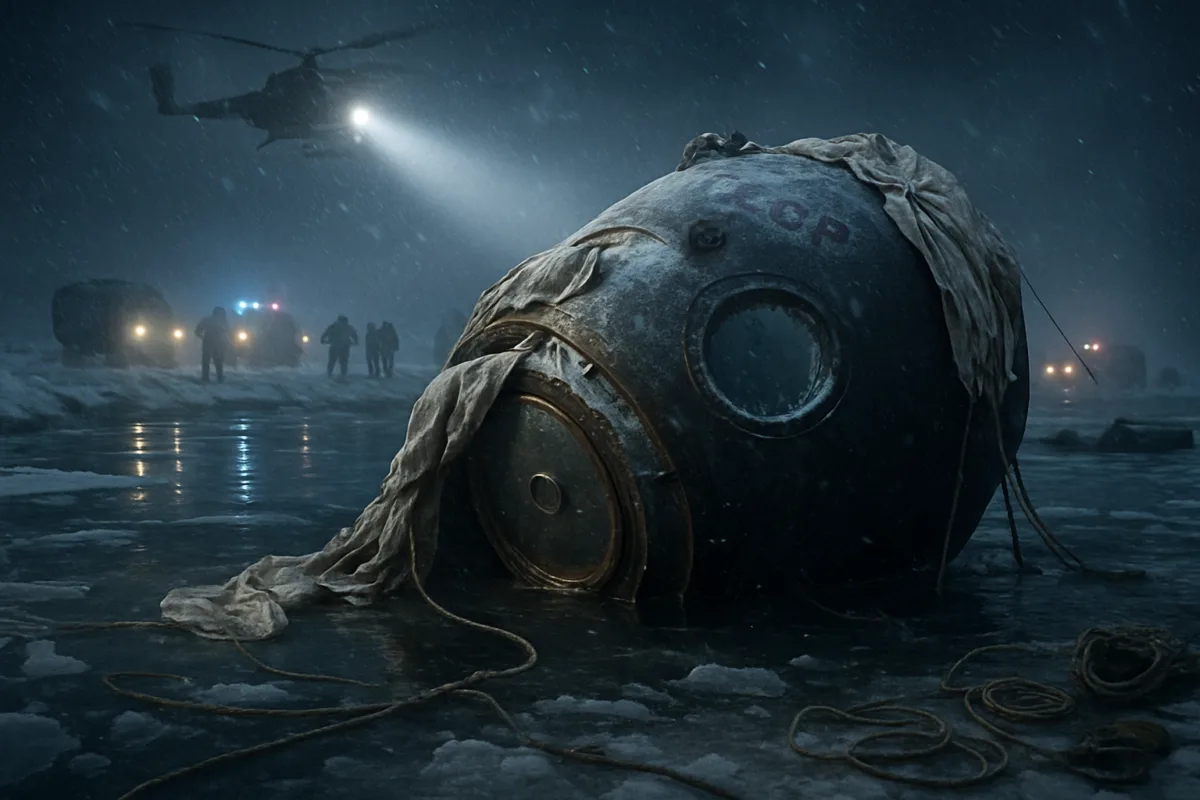
In the dark of an October night in 1976, two Soviet cosmonauts found themselves not on the spacious deck of a space station or the controlled land of a prepared recovery zone, but inside a tilted metal capsule floating in black, freezing water. The mission had already been aborted in orbit; what followed was a chain of compounding failures and an improvised rescue that tested the assumptions built into spacecraft, crews and recovery plans.
From launch to abrupt return: the mission in brief
Soyuz 23 lifted on 14 October 1976 with commander Vyacheslav Zudov and flight engineer Valeri Rozhdestvensky aboard, bound for Salyut 5, a military space station associated with the Almaz programme. The rendezvous ended without a visit. A docking-system anomaly, recorded as an apparent lateral velocity error that led to unintended thruster firings and a lost fuel margin for a safe manual approach, forced mission controllers to abort the docking attempt and plan an early return.
The spacecraft re-entered and descended on 16 October, touching down at 17:45:53 UTC. But descent and touchdown did not mean safety. What began as a standard end-of-mission sequence became a prolonged, life-threatening episode once the capsule met the harsh realities of weather, geography and the limits of recovery technology.
When the final kilometres go wrong
Spacecraft are the product of layered engineering assumptions. Launch, orbital operations and re-entry are planned and redundantly protected. Recovery, by contrast, depends not only on hardware but also on the readiness and accessibility of human teams on the ground. In the case of Soyuz 23 the final kilometres turned on a stack of fragile contingencies: a night landing, a blizzard, missed coordinates and a return area that was not settled sea but a shallow salt lake named Tengiz already starting to seize over for winter.
Lake Tengiz, ice and a capsule on its side
Lake Tengiz in Kazakhstan is shallow and seasonal. In mid-October it had already begun to ice, and a snowstorm reduced visibility to almost nothing. Accounts converge on how the descent module interacted with these conditions: after touchdown the main parachute became saturated and heavy; aboard, the spacecraft cooled as battery management measures reduced heater output to conserve energy. A subsequent electrical short, recorded in several later reports, deployed the reserve parachute. The combined effect reportedly pulled and rolled the capsule so that its hatch and air vent were below the waterline.
Different sources vary on the precise mechanics and timeline, and historians caution against overstating any single propagating detail. What matters is the practical result: a descent module designed and certified primarily for solid-land recovery was now a floating, tilting metal room in freezing water with compromised communications and compromised access. In daylight and with a prepared recovery team the problem would have been challenging but manageable. At night, during a blizzard and with fog over the lake, it became a race against cooling batteries, dwindling cabin heat and the slowed tempo of a rescue operation hampered by weather and terrain.
The practical rescue problems
Rescue teams confronted several interacting obstacles. The capsule’s radio beacons and visual markers were hard to spot through heavy fog and blowing snow. Amphibious vehicles that might have bridged land and water could not reach the site because surrounding ground was boggy, preventing ground crews from approaching to haul the capsule ashore. Rubber rafts were blocked by ice chunks and sludge. Helicopters could locate the capsule with searchlights but could not simply lift the descent module out: the module was heavy, the wet parachute added drag and complex dynamics made an airborne lift unsafe.
Those looking from outside also lacked reliable information about the state inside. Some variants of the story say recovery personnel feared the crew were dead. Archived Russian-language rescue accounts describe long, grim hours during which rescuers worried they were too late. Official mission tables and later compiled flight data present a firmer, shorter picture: the recovery operation is sometimes summarized as lasting nine hours, in other accounts as eleven. Whatever the precise interval, the core fact is that the cosmonauts remained inside the capsule through a long night of uncertain rescue.
Why a floating capsule amplifies risk
Engineering margins on spacecraft are built around assumptions: that the landing site is within a recoverable radius, that visibility, weather and terrain will allow a relatively swift approach, and that the vehicle itself will remain upright and intact. When those assumptions break together, several protective layers are lost. A descent module can float, but it is not a survival shelter for many hours in subzero water. Thermal systems that operate in orbit or during controlled descent are not sized to fight hypothermia in a half-submerged cabin. Communications and beaconing depend on orientation and line-of-sight. Recovery systems on the ground assume a predictable set of places the capsule might be; when those patterns change, it is the human teams and improvisation that fill the gap.
Inside the capsule: endurance and containment
Inside the tilted module, the human story is compact and stark. Zudov and Rozhdestvensky had to shift from active flight procedures to a survival posture. They preserved battery power and air, reduced nonessential systems and waited. Waiting might sound passive, but under those conditions it was an active, trained decision set. Crews practice for contingencies; they train for manual approaching and emergency protocols, though not every conceivable combination of failures can be rehearsed.
The cosmonauts’ endurance was not miraculous so much as a product of training and an engineering design that, while not intended to support a night-long stay in freezing water, nonetheless offered a sealed, pressurized volume with minimal environmental control that could be stretched into a survival enclosure. That margin bought time for rescue teams to continue working under dangerous and deteriorating conditions.
Rescuers, improvisation and the fog of recovery
Recovery personnel had to balance two competing risks: acting aggressively enough to reach and recover the crew, and not making the situation worse by damaging the capsule or risking the lives of rescuers. They worked in near-zero visibility toward a target that could not be simply lifted or dragged without preparation. That led to a slow, painstaking operation in which teams tried different approaches, kept search patterns active and ultimately managed to get the capsule to shore where, various reports say, rescuers were surprised to find the cosmonauts alive.
Some versions of the story say the cosmonauts themselves opened the hatch after eleven hours; other accounts emphasize that the capsule was dragged ashore and rescue personnel discovered them alive. The differences matter for narrative drama but not for the essential lesson: a mission that seemed, on paper, to have concluded in a safe landing became an open-ended rescue challenge, and the survival of the crew hinged on endurance, persistence and a vehicle that retained enough life-support capacity to span a much longer interval than planned.
Memory, reporting and the shape of the story
The Soviet public heard that Soyuz 23 had landed and that the cosmonauts were safe. The fuller, messier story — the lake, the ice, the fog, the failed approaches and the long hour-by-hour rescue — emerged later in recollections from recovery personnel, archived Russian-language reports and historians who pieced the episode together. That latency in reporting is part of the incident’s power. On paper, the mission becomes a clean aborted visit with a safe return. On the ground, it was a study of how procedures meet the unpredictable.
History often prizes the technical orbits and docking successes, but incidents like Soyuz 23 show how the most dangerous phase can be the transition back to Earth. Launches and orbits are spectacular and well studied, but recovery depends on a wide cast of human and environmental factors that are harder to fully control. The episode sits in the uncomfortable space between official success and lived danger, a reminder that rescue operations and the men and women who carry them out matter as much as the hardware that goes into space.
Design lessons for modern missions
There are clear takeaways for contemporary spacecraft design and mission planning. Designers and mission planners must consider the entire mission lifecycle, including the last kilometre and the contingencies of geography and weather. Redundant and robust beaconing, improved flotation stability for sea or ice landings, and rescue equipment that is usable in marginal terrain and poor visibility are all part of reducing risk. Equally important are training and communication protocols that keep rescue teams informed and equipped to adapt when multiple systems fail at once.
Beyond hardware, the Soyuz 23 episode is a lesson in humility. The more tightly a space program ties its sense of success to mission checklists, the more it risks overlooking the rough edges of failure. Human teams can bridge many gaps between engineering assumptions and reality, but only if they are prepared to do so and if the system gives them the space and information to act.
When engineers and planners write the final line of a mission report, it is tempting to treat touchdown as the end. The long night on Lake Tengiz reminds us that a mission is not complete until the crew is safe on firm ground and the last variables have been turned from unknowns into facts. That requires rigorous planning, resilient design and the quiet tenacity of people who keep searching when circumstances look bleak, because survival often depends on small margins held together by persistence and courage.

Dr. Morgan directed the Archives Program from 2014 to 2017, gaining extensive experience in research documentation, information management, and the preservation of scholarly resources. Throughout her career, she has worked closely with academic publications and research materials, developing expertise in evaluating scientific sources and communicating complex topics to broad audiences.
Her primary areas of specialization include scientific publishing, research communication, editorial review, and the translation of technical research into accessible educational content. She has contributed to projects involving space science, astronomy, environmental science, history, archaeology, and emerging scientific discoveries, always emphasizing accuracy, transparency, and the responsible presentation of evidence.
As Editorial Director of Muskurahat.us, Dr. Morgan leads the editorial review process for scientific articles, ensuring that content is based on reputable sources, peer-reviewed research whenever available, and publications from recognized universities, research institutions, and international scientific organizations.
She is committed to promoting scientific literacy through clear, engaging, and well-documented articles that help readers better understand scientific discoveries and their impact on society. Her editorial philosophy is founded on accuracy, intellectual integrity, independent journalism, and continuous learning as scientific knowledge evolves.
Through her work at Muskurahat.us, Dr. Morgan supports the publication of trustworthy scientific content that makes complex research accessible to readers around the world while maintaining rigorous editorial standards.