In the shadow of one of humanity’s loudest triumphs, another attempt at lunar glory unfolded in quiet, mechanical perseverance. While Neil Armstrong and Buzz Aldrin were leaving footprints on the Sea of Tranquility, a Soviet robotic craft named Luna 15 was making its own bid for firsts — not with boots but with a scoop. It would complete 52 orbits, gather data, attempt a pinpoint descent toward Mare Crisium, and then, in a matter of minutes, disappear into the lunar surface. The story of Luna 15 reframes the Moon race as something that kept going above the astronauts’ heads, a parallel effort that matters for how we remember space history.
The logic of a quieter victory
By mid-1969 the Apollo program had captured global attention with crewed launches, televised launches, and the promise of men standing on another world. The Soviet response was never a single strategy; it was a suite of approaches that emphasized robotics, automation, and incremental achievements. Luna 15 was born of that approach: an uncrewed, fully automated sample-return mission designed to land, collect a small amount of lunar regolith, and launch a return capsule back to Earth. For the Soviets, returning lunar soil before or around the same time as Apollo’s splashdown would have offered a tangible, headline-grabbing achievement even if it could not rival the spectacle of astronauts on the surface.
Timing, gambits and the mechanics of a race
The timing of Luna 15 was deliberate. Launched on 13 July 1969 — three days before Apollo 11 — the mission had a narrow but real chance of beating the Americans to the first lunar samples. The mathematics of an uncrewed mission made the gambit plausible: a small capsule could, in principle, quickly descend, secure a handful of soil, and execute a return trajectory with less mass and fewer life-support demands than a crewed ascent would require. That speed offered a tactical opening, a second kind of ‘first’ that the Soviet program could have celebrated.
Sharing the sky: two nations above the Moon
For several days in July 1969, the United States and the Soviet Union had machines at the Moon simultaneously. Luna 15 entered lunar orbit and spent its time studying potential landing sites, completing dozens of communications sessions and dozens of orbits at varying altitudes and inclinations as ground teams analyzed the terrain below. Meanwhile, Apollo 11 descended, landed, and allowed two humans to stroll the Sea of Tranquility.
A rare exchange of data amid Cold War tensions
The proximity of the two missions generated anxiety in Washington. There was a nontrivial fear that an errant descent or a miscalculated orbit could create dangerous intersections with Apollo 11’s flight path. In a revealing and unusual act for the era, the Soviets transmitted Luna 15’s orbital elements to NASA via astronaut Frank Borman, an informal channel that helped reassure U.S. mission planners. The exchange highlights a paradox of the Cold War: even at peak competition, spacefaring nations sometimes found common-sense routes to avoid collision and confusion in the shared realm of lunar orbit.
Descent, silence, and a cratered end
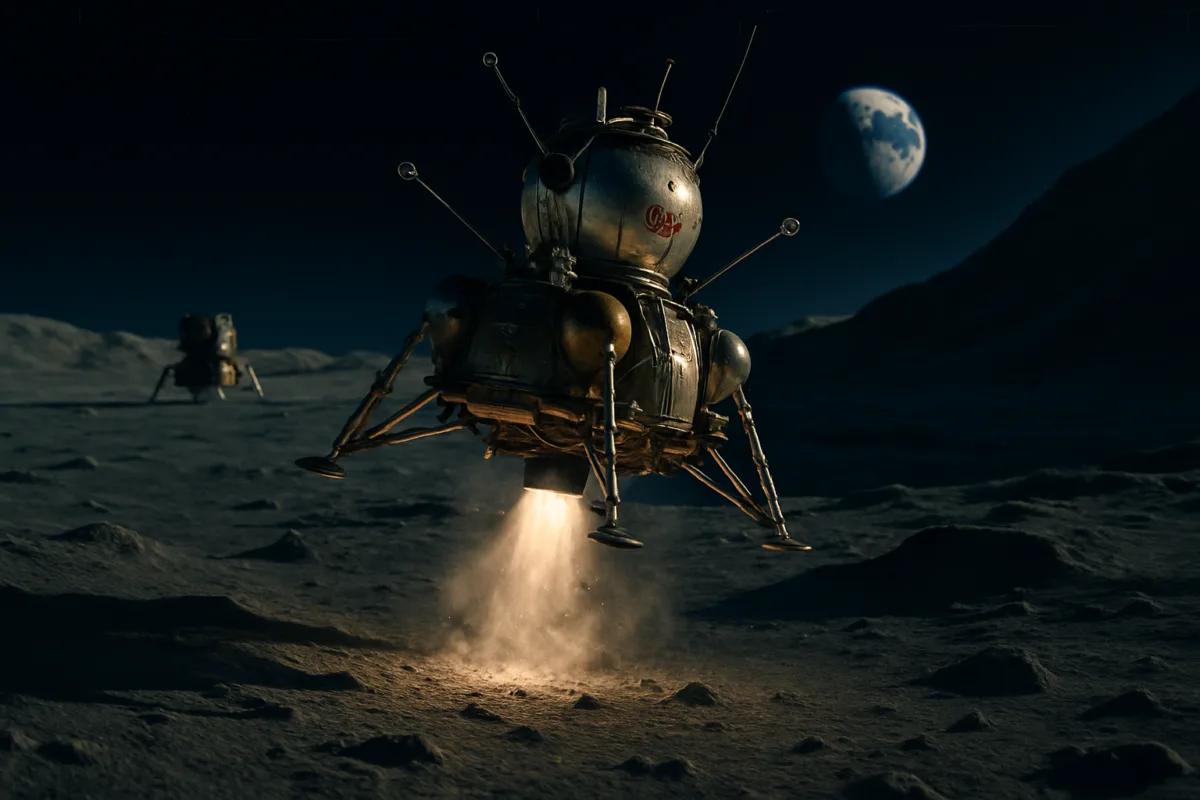
After Armstrong and Aldrin had walked and rested, as they prepared to lift from the Moon, Luna 15 began its final maneuvers. At 15:47 Universal Time on 21 July 1969 the craft fired its retrorocket to slow and drop from orbit toward a site in Mare Crisium. Four minutes later the transmissions ceased. Radio silence suggested a sudden, catastrophic end; subsequent reconstructions indicate the craft likely flew into uneven terrain and struck the slope of a mountain at an altitude of roughly three kilometers. The impact occurred about 15:50 UT, some 550 kilometers from where the Apollo 11 lander sat. Luna 15 had exhausted its chance at a quiet triumph at the final, riskiest moment.
What the crash meant operationally and symbolically
Operationally, the failure was a reminder of how unforgiving lunar landings are. The Moon’s surface is a mix of smooth mare plains and jagged highlands, and remote sensing and orbital photography in 1969 lacked the resolution and context modern missions enjoy. A technique that works in simulation can fail utterly when confronted with a boulder-strewn slope or an unanticipated elevation change. Symbolically, Luna 15’s crash complicated the simple narrative of a single winner: the Moon race did not end when the Eagle landed. It continued in orbits and telemetry, in automated engines and programmed descents, and Luna 15’s demise is a footnote that asks to be read more carefully.
Lessons learned and a succeeding program
It would be simplistic to consider Luna 15 a mere failure without redemption. The very concept of robotic sample return proved sound; a year later, Luna 16 achieved what Luna 15 could not. In September 1970 Luna 16 touched down, drilled a short core of lunar soil, and returned it safely to Earth, marking the first fully automated retrieval of lunar samples. The sequence — Luna 15’s crash followed by Luna 16’s success — reveals an essential truth about engineering in extreme environments: iterative learning, rapid redesign, and stubborn persistence often convert near-misses into breakthroughs.
Robotics versus human presence
The contrast between the human drama of Apollo and the technical triumphs of robotic missions raises a recurrent debate in space exploration: is value measured in spectacle, science, or both? A handful of returned lunar grams does not carry the same cultural weight as live television of a human stepping off a ladder onto alien soil, yet material samples provide unparalleled scientific clarity about the Moon’s composition, age, and history. Luna 15 and its successors remind us that multiple pathways can be valuable simultaneously: humans inspire and perform unpredictable work, while robots can access high-cadence, repeatable, and sometimes riskier operations with lower immediate political cost.
Engineering heritage and modern echoes
The technological lessons from Luna 15’s failure and Luna 16’s success have ripples that extend to today’s missions. Precision landing, hazard detection, autonomous sampling, and reliable ascent from low-gravity bodies are central to current plans for the Moon, Mars, and near-Earth asteroids. Contemporary missions benefit from decades of incremental advances — in guidance algorithms, imaging resolution, and propulsion control — but the fundamental challenges remain. Modern architectures that combine crewed presence with robotic support owe part of their lineage to the choices and trade-offs of the 1960s and 1970s.
Memory, narrative, and why some stories recede
History is selective. The image of Armstrong’s bootprint is seared into public consciousness; Luna 15 is not. That discrepancy is not only about success and failure. It is also about storytelling, media spectacle, and the human preference for person-centered narratives. Robots that orbit, study, and crash make poor television compared to men walking in slow motion across a world that had previously existed only in dreams. Yet when historians want nuance — to understand programs, strategies, and technological diversity — Luna 15 becomes essential. It is a case study in how national programs hedged their bets, pursued parallel goals, and accepted different kinds of risk.
Remembering Luna 15 also helps recalibrate our sense of the space race as a multifaceted contest. It was not a single sprint with one finish line; it was a constellation of efforts in propulsion, crew systems, automation, and scientific return. The Soviet emphasis on robotic returns, even while pursuing crewed milestones in other realms, reflects a sophisticated strategy that valued sustained capability as much as headline victories.
More than a failed mission, Luna 15 is a reminder that exploration is rarely linear. The image of two nations sharing lunar skies, exchanging orbital data in an act of cautious deconfliction, and running different playbooks for achieving prestige and science, speaks to the complex choreography behind every milestone. The Sea of Crises that took a small, determined machine still holds the imprint of that contest — and in that imprint is the story of human curiosity extending beyond spectacle into methodical, sometimes stubborn, progress.

Dr. Morgan directed the Archives Program from 2014 to 2017, gaining extensive experience in research documentation, information management, and the preservation of scholarly resources. Throughout her career, she has worked closely with academic publications and research materials, developing expertise in evaluating scientific sources and communicating complex topics to broad audiences.
Her primary areas of specialization include scientific publishing, research communication, editorial review, and the translation of technical research into accessible educational content. She has contributed to projects involving space science, astronomy, environmental science, history, archaeology, and emerging scientific discoveries, always emphasizing accuracy, transparency, and the responsible presentation of evidence.
As Editorial Director of Muskurahat.us, Dr. Morgan leads the editorial review process for scientific articles, ensuring that content is based on reputable sources, peer-reviewed research whenever available, and publications from recognized universities, research institutions, and international scientific organizations.
She is committed to promoting scientific literacy through clear, engaging, and well-documented articles that help readers better understand scientific discoveries and their impact on society. Her editorial philosophy is founded on accuracy, intellectual integrity, independent journalism, and continuous learning as scientific knowledge evolves.
Through her work at Muskurahat.us, Dr. Morgan supports the publication of trustworthy scientific content that makes complex research accessible to readers around the world while maintaining rigorous editorial standards.