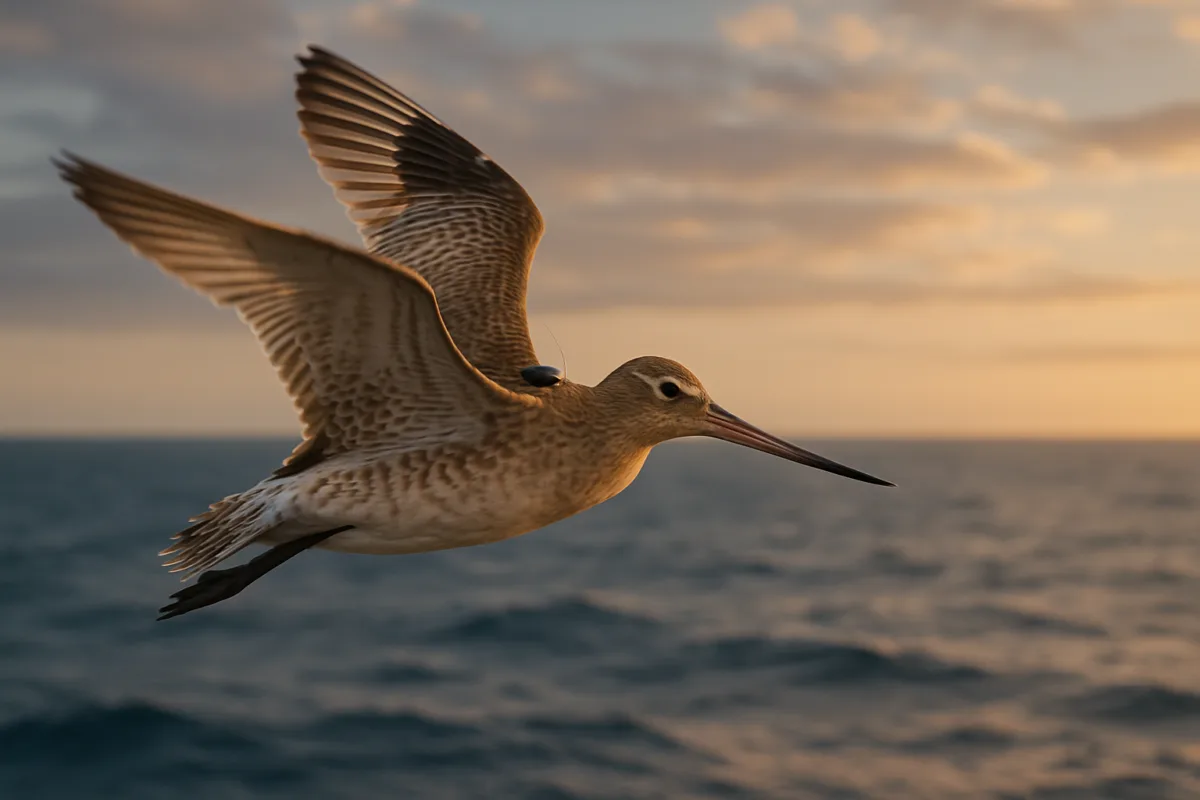
In a world where endurance records are measured in human terms—marathons, ocean crossings, nonstop flights by jets—it is easy to forget that nature has long been staging feats that eclipse our imagination. One of the most extraordinary of these is the bar-tailed godwit, a medium-sized shorebird that, as researchers discovered, can fly nonstop from western Alaska to New Zealand, covering thousands of miles and spending more than a week in uninterrupted flight. The discovery forced scientists to rethink what is physiologically possible for a bird that weighs less than a pound, and it opened new questions about navigation, sleep, and survival in some of the planet’s most empty airspaces.
The flight that rewrote the record books
In 2009, satellite tracking revealed that a female bar-tailed godwit left the Yukon-Kuskokwim Delta in western Alaska and flew all the way to the North Island of New Zealand in a single continuous flight. The bird traversed roughly 11,680 kilometers—about 7,250 miles—over the open Pacific Ocean, staying aloft for 8.1 days without landing, eating, or drinking. That flight was the longest nonstop journey ever recorded for a land bird at the time. It was not an anomaly; in the same study, seven tagged females made similar nonstop ocean crossings, each spending between six and more than nine days in the air and following a remarkably straight corridor across one of the emptiest stretches of ocean on Earth.
Remodeling the body for the journey
A godwit cannot simply decide to undertake such a journey at a moment’s notice. The bird undergoes a striking physiological transformation in the weeks before departure. Feeding intensely on the rich clams and worms of the Yukon-Kuskokwim Delta, godwits pack on enormous fat reserves. In juveniles leaving Alaska, lipids can account for about 55 percent of total body mass. When more than half of an animal’s weight is fuel, it presses the limits of what can still take off and remain airborne.
Trading guts for wings
But fat accumulation is only half the strategy. To economize on weight and free up energy for sustained flight, godwits reduce the size of organs they will not need while airborne. Studies show a substantial shrinkage of digestive organs around the time of migration. The heart and flight muscles remain robust, while the gut size is pared down, effectively converting organ mass into lower-maintenance fuel stores. This dramatic body remodeling is reversed after arrival, when the birds rebuild their guts before resuming normal feeding. It is a double transformation: bulk up, strip down, then rebuild—an extraordinary physiological choreography that cycles with each transoceanic migration.
Riding the winds: timing and route selection
Distance might be the headline of these migrations, but timing is equally crucial. Godwits do not leave on a whim; they wait for favorable meteorological conditions. The birds time departures to coincide with the southward tailwinds associated with Aleutian low-pressure systems sweeping into the Gulf of Alaska in autumn. When the tagged birds left, their departure headings nearly matched the direction of the strong tailwinds, giving them a free push for much of the journey and saving precious fuel that they cannot afford to expend unnecessarily.
A corridor across the Pacific
The route the godwits use across the central Pacific is both strikingly direct and protective. The birds typically hold a heading close to due south and remain inside a corridor only about 1,800 kilometers wide. This lane is surprisingly empty of predators and parasites that plague coastal migration routes with repeated stopovers. Flying nonstop across open ocean reduces the risk of falcon attacks and exposure to accumulated disease. The ocean’s empty expanse, paradoxically, becomes a cleaner corridor for achieving a single, prolonged thrust from one safe staging ground to another.
Speed, stamina, and the unknowns
During these crossings, godwits sustain a high metabolic output, estimated at roughly eight to ten times their resting metabolic rate, held steady for days. Tracked speeds averaged about 16.7 meters per second, or roughly 37 miles per hour, with peak speeds soon after departure when tailwinds were strongest and a slowdown nearer the equator where winds often slacken. Even with satellites providing location fixes at intervals, these data paint a clear picture of a continuous, high-intensity effort that challenges existing ideas about endurance physiology.
Sleep, dehydration, and physiology
One of the most unsettling questions is how these birds manage rest and conserve bodily function while flapping continuously for days. Unlike albatrosses, which can glide and rest on the wind, godwits must flap nearly the entire time. Whether they engage in unihemispheric sleep—sleeping with one half of the brain at a time, as some birds do while on the wing—or find another way to rest, remains unresolved. Equally puzzling is how they stave off dehydration and maintain organ function when their digestive systems are intentionally downsized. The movements recorded by transmitters are robust enough to rule out plausible stopovers for most birds; yet the underlying physiological mechanisms that allow survival through such intense and sustained exertion are still being explored.
Return journeys and risk management
Interestingly, godwits do not use the same oceanic corridor on their return to Alaska in the spring. Instead they hug the coast of Asia and break the trip into shorter legs. Scientists believe the asymmetry is a matter of risk management. The southbound flight offers islands and potential fallback spots for exhausted birds near the end of the route, whereas a direct northbound ocean crossing could leave birds with thousands of kilometers and no land to reach if things go wrong. The seasonal difference in routes reveals a nuanced strategy that balances efficiency with safety.
Juvenile voyagers and navigation mysteries
More recent tracking has added new layers to the mystery. In 2022, a juvenile godwit fitted with a tiny solar-powered tag flew from Alaska to Tasmania, a distance of roughly 13,560 kilometers, taking about 11 days to complete the journey. That a four-month-old bird, on its first migration and without experienced adults to follow, could navigate such an expanse is astonishing. Over the equator, magnetic cues shift and landmarks vanish; the bird seems to hold a remarkably straight course with no visible guidance. How juveniles calibrate such journeys and how adult birds combine environmental cues, innate maps, and perhaps wind and star patterns to maintain a route are open questions that tracking data continue to raise.
Why this matters beyond the record
Beyond the awe-inspiring headline, these migrations have broader scientific and conservation implications. Understanding the physiological limits of migration informs ecology, evolution, and animal energetics. It challenges models of sleep and metabolic regulation and prompts new experiments about organ plasticity and long-duration exertion. From a conservation standpoint, the dependence of godwits on critical staging grounds like the Yukon-Kuskokwim Delta underscores how fragile long-distance migration networks are. Loss or degradation of feeding wetlands, along with climate-driven changes in wind patterns, could disrupt the finely timed window these birds use to catch favorable winds and amass fuel.
Technological advances and future research
Advances in miniaturized satellite transmitters and solar-powered tags have made it possible to reconstruct these astonishing flights. While the location fixes are intermittent and require careful interpolation to infer nonstop behavior, they are precise enough to demonstrate that most of these godwits do not pause en route. Future improvements in sensor technology—lighter tags, continuous physiological monitors, and high-frequency tracking—may finally reveal whether godwits sleep on the wing, how they manage hydration, and the precise timing of gut shrinkage and regrowth. Such insights will deepen our understanding of migration as an integrated suite of behaviors, morphologies, and physiological states.
Seeing a bar-tailed godwit as more than a small shorebird means appreciating it as a living experiment in endurance. These journeys compress questions about energetic limits, navigation, risk, and adaptation into a single, repeatable act: fly now or perish. The godwit’s repeated success across generations suggests evolution has sculpted not just a set of traits but a migration system that synchronizes feeding, fattening, organ remodeling, weather, and route choice. As tracking gets finer and biology more integrated, these birds will keep teaching us how life pushes past perceived boundaries. The image of a tiny bird, laden with fuel and a microtransmitter, crossing an endless blue expanse for days on end is a powerful reminder of the hidden extremes of the natural world and of how much remains to be learned about the strategies that allow such extremes to exist.

Dr. Morgan directed the Archives Program from 2014 to 2017, gaining extensive experience in research documentation, information management, and the preservation of scholarly resources. Throughout her career, she has worked closely with academic publications and research materials, developing expertise in evaluating scientific sources and communicating complex topics to broad audiences.
Her primary areas of specialization include scientific publishing, research communication, editorial review, and the translation of technical research into accessible educational content. She has contributed to projects involving space science, astronomy, environmental science, history, archaeology, and emerging scientific discoveries, always emphasizing accuracy, transparency, and the responsible presentation of evidence.
As Editorial Director of Muskurahat.us, Dr. Morgan leads the editorial review process for scientific articles, ensuring that content is based on reputable sources, peer-reviewed research whenever available, and publications from recognized universities, research institutions, and international scientific organizations.
She is committed to promoting scientific literacy through clear, engaging, and well-documented articles that help readers better understand scientific discoveries and their impact on society. Her editorial philosophy is founded on accuracy, intellectual integrity, independent journalism, and continuous learning as scientific knowledge evolves.
Through her work at Muskurahat.us, Dr. Morgan supports the publication of trustworthy scientific content that makes complex research accessible to readers around the world while maintaining rigorous editorial standards.