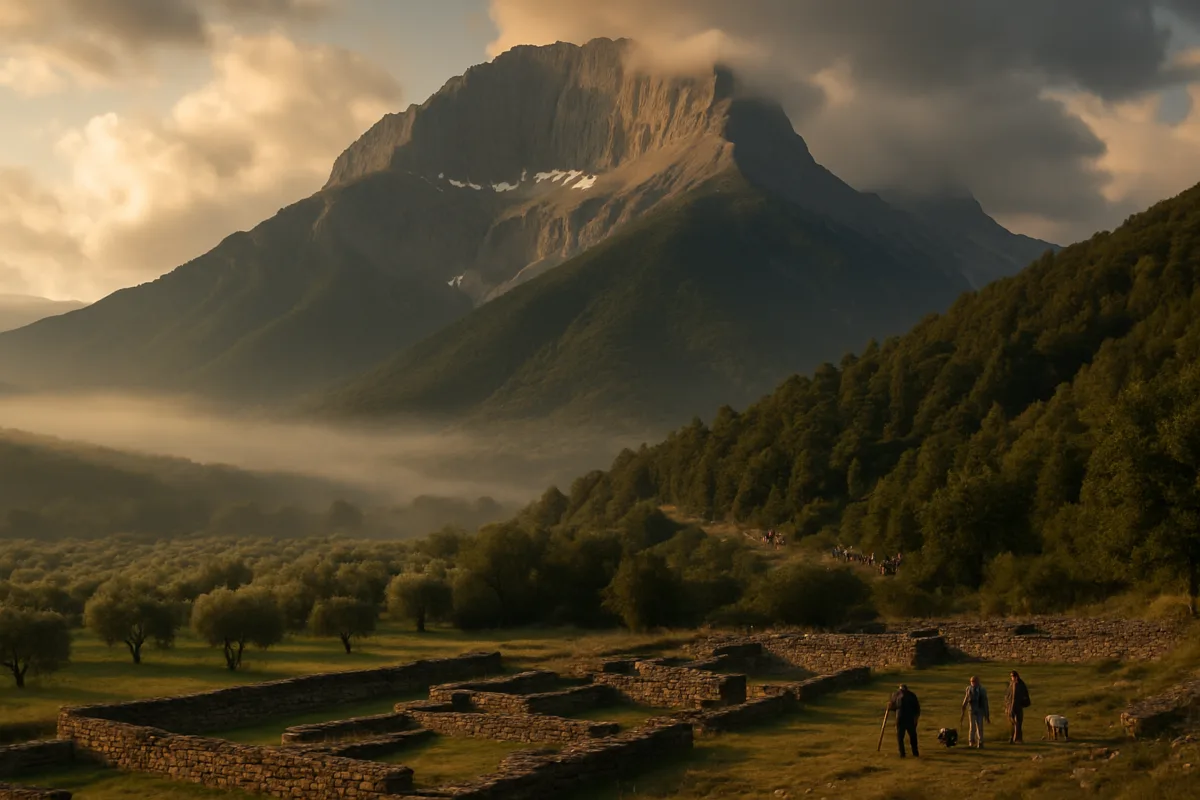
Mount Olympus has sat at the intersection of geology, ecology, myth and modern conservation policy for decades. Declared Greece’s first national park in 1938 and a UNESCO Biosphere Reserve in 1981, the massif has been on a quieter, slower journey toward World Heritage inscription since its tentative-list submission in January 2014. What looks like a single dossier on a UNESCO table is in fact a layered process that exposes how international recognition is negotiated, evidenced, and ultimately decided. This article unpacks that process in analytic detail: the steps a nomination travels, the particular difficulties of a mixed natural-and-cultural case built around mythology, what a referral by advisory bodies practically means, and the kinds of additional work that can turn an aspirational file into an acceptable nomination.
Timeline and milestones: mapping the nomination journey
Understanding where Mount Olympus stands requires tracing the administrative and evidentiary milestones that together form a nomination’s lifecycle. The basic stages are straightforward: inclusion on a national tentative list, preparation of a nomination dossier, review by UNESCO advisory bodies (primarily IUCN for natural values and ICOMOS for cultural values), and a Committee decision at a World Heritage Committee session. Greece placed Olympus on its tentative list and formally submitted the mixed nomination on 16 January 2014. The advisory bodies then began the slow, technical work of evaluating the dossier against World Heritage criteria and management standards. More than twelve years later — and during the 48th Committee session in Busan (19–29 July 2026) — those evaluations culminated in a recommendation that the case be referred back for more information rather than being inscribed or rejected.
Why the wait matters
Being on a tentative list is not a queue to a definitive decision; it is an expression of intent and the starting point for rigorous scrutiny. The long interlude in Olympus’s case reflects both the complexity of mixed nominations and the practical need to mount new data and arguments that meet World Heritage evidence standards. The advisory bodies’ referral recommendation signals specific gaps rather than a categorical rejection. Practically speaking, however, referral extends the timeline — often by years — because it requires additional fieldwork, tightened management planning, and re-articulation of cultural significance in forms the Committee can adjudicate.
The mixed nomination challenge: myth meets measurable science
Most World Heritage nominations are framed around either cultural or natural values. Mixed nominations, which must satisfy both sets of criteria simultaneously, are comparatively rare and therefore invite a particularly exacting review. For Olympus the natural case draws on long-established facts: the massif’s highest summit, Mytikas, reaches approximately 2,917–2,918 metres; the area has been protected as a national park since 1938 and a Biosphere Reserve since 1981; and it hosts a range of habitats and species characteristic of Mediterranean montane ecosystems. These are tangible claims that can be supported with ecological surveys, geological mapping and ecosystem process studies.
The cultural argument for Olympus, however, leans heavily on associative value: its identity as the mythological seat of the twelve Olympian gods and its prominence in Greek literature, religion and art. Associations of this kind fall into a complex evidentiary terrain. Cultural World Heritage criteria can and do accommodate associative values (for instance criterion vi), but the nomination must demonstrate how those associations are manifested materially, have authenticity and integrity, and are relevant within the framework of the World Heritage Convention. For a mountain that is more idea than built monument, that requires bridging intangible cultural heritage, landscape values and archaeological anchors in ways advisory bodies can evaluate.
Natural criteria: what advisory bodies are looking for
The recent advisory recommendation reportedly asked for more evidence on geological features, biodiversity and ecological processes. Practically, that translates into several types of deliverables: high-resolution geological mapping that identifies unique formations and processes; up-to-date, peer-reviewed biodiversity inventories, including population trends for key species and habitat connectivity analyses; and long-term ecological monitoring data demonstrating processes such as altitudinal migration of species, fire ecology, or hydrological regimes. A dossier that leans on decades-old or generalized biosphere reserve reports will struggle; the Committee expects recent, site-specific scientific documentation tied to arguments about Outstanding Universal Value.
Cultural criteria: converting myth into a nomination
For the cultural side, reviewers have reportedly asked Greece to clarify the argument and even suggested adding the archaeological site of Dion at the mountain’s foot. This advice points to a core methodological problem: a mythic association is powerful in public imagination but diffuse in technical heritage language. A convincing cultural case often requires tangible correlates: archaeological landscapes, ritual places, iconography, inscriptions, or persistent cultural practices that link the myth to a physical setting. Incorporating Dion—or other material sites—would anchor Olympus’s associative claim to specific cultural layers and demonstrate continuity and authenticity in ways advisory panels can assess.
What a referral actually does
‘Referral’ is one of several procedural outcomes available to the Committee. It sits between outright inscription and outright rejection: the Committee can defer, refer, inscribe, or occasionally decide against inscription. A referral requests further documentation addressing targeted shortcomings. It is not an immediate change in protection or management: the national park and biosphere reserve designations remain the legal framework on the ground, and visitor access and governance arrangements are unaffected by the Committee’s procedural posture. But referral means the nomination will re-enter the preparation queue with new requirements, and that takes institutional capacity, funding and time.
In practical terms, referral translates into additional tasks for the Greek authorities and stakeholders: commissioning studies, tightening management plans, expanding boundary justifications, preparing buffer zones, deploying monitoring protocols, and reconciling competing land uses where necessary. It also creates an opportunity: the referral letter typically spells out specific gaps. That makes the path forward clearer than an opaque rejection would. The catch is that responding effectively requires investment and coordination across ministries, universities, local communities and conservation agencies.
Stakeholders and politics: the decision network
World Heritage decisions are technical but sit inside a geopolitical and diplomatic network. Advisory bodies provide expert assessments (IUCN for natural issues, ICOMOS for cultural issues), but final decisions are political acts by member states on the Committee. That dynamic means a nomination’s success is shaped not only by evidence quality but by strategic diplomacy, coalition-building among Committee members, and national capacity to respond to technical queries. Public attention — such as renewed interest fueled by Christopher Nolan’s cinematic adaptation of the Odyssey, released on 17 July 2026 — can help galvanize domestic support and funding for strengthened dossiers, but it does not alter the technical standards the advisory bodies apply.
Turning referral into inscription: a practical blueprint
What would it take, in process terms, for Greece to convert referral into a successful nomination? The answer is both scientific and curatorial. On the natural side, new targeted studies should be commissioned to fill identified data gaps: systematic biodiversity surveys using consistent methodologies, mapped ecological corridors and habitats, and geoscientific reports that demonstrate unique or exemplary processes. These studies should be peer-reviewed and integrated into a strengthened management framework with quantified conservation outcomes and monitoring indicators tied to the dossier.
On the cultural side, the dossier needs clearer material anchors for the associative myth argument. That may mean formally incorporating archaeological sites like Dion, documenting long-term ritual landscapes, or presenting a corpus of material culture and historic practices that demonstrate a sustained relationship between human communities and the mountain. Multidisciplinary scholarship that weaves oral histories, classical sources, archaeological evidence, and landscape archaeology will help translate myth into measurable cultural value.
Management, governance and community buy-in
World Heritage evaluation increasingly emphasizes not just values but their protection. A strengthened Olympus dossier should present a robust management plan that clarifies governance roles, financing mechanisms, tourism management strategies, and community participation frameworks. Buffer zone rationales and legal protections against extractive threats must be explicit. Demonstrable community support — from local municipalities, conservation NGOs and the scientific community — is a practical asset during Committee deliberations and a precondition for long-term stewardship.
Monitoring, metrics and the next steps
Even after a successful inscription, the work does not stop. Maintaining Outstanding Universal Value requires monitoring regimes, adaptive management, and transparent reporting to UNESCO. Indicators tied to species population trends, habitat condition, erosion or fire incidence, visitor impacts and cultural practice vitality should be specified and linked to remedial actions. Building that monitoring capacity in advance makes a nomination stronger and more resilient once it is on the List.
The 48th session of the World Heritage Committee will conclude on 29 July 2026. Given the mixed nomination’s complexity and the advisory recommendation for referral, an inscription decision at this session was always a long shot. What follows — whether a structured resubmission incorporating additional geological, ecological and cultural documentation or a further delay — will depend on how quickly Greece can marshal the interdisciplinary evidence and the institutional resources to address the advisory bodies’ concerns. In that sense, Olympus’s twelve-year wait is not a passive stalling but a hinge in a procedural storyline: the nomination’s future will be written in new field studies, new cultural mappings, and renewed local and international engagement.
Mount Olympus has never needed World Heritage status to be a center of scientific inquiry, cultural imagination, or national pride. But a successful World Heritage inscription would reframe the mountain’s protection, funding and global recognition. The process now underway — referral, revision, and potential resubmission — is typical of how the Convention balances aspirational values with the imperative for rigorous, demonstrable stewardship. Whether the mountain’s myths are translated into material evidence and whether its ecological narratives are documented with the granularity the Committee expects will determine if Olympus moves from tentative promise to internationally recognized heritage. The work ahead is exacting, but it is precisely the sort of interdisciplinary, locally anchored, and scientifically robust effort that converts reputation into long-term conservation outcomes.
Dr. Morgan directed the Archives Program from 2014 to 2017, gaining extensive experience in research documentation, information management, and the preservation of scholarly resources. Throughout her career, she has worked closely with academic publications and research materials, developing expertise in evaluating scientific sources and communicating complex topics to broad audiences.
Her primary areas of specialization include scientific publishing, research communication, editorial review, and the translation of technical research into accessible educational content. She has contributed to projects involving space science, astronomy, environmental science, history, archaeology, and emerging scientific discoveries, always emphasizing accuracy, transparency, and the responsible presentation of evidence.
As Editorial Director of Muskurahat.us, Dr. Morgan leads the editorial review process for scientific articles, ensuring that content is based on reputable sources, peer-reviewed research whenever available, and publications from recognized universities, research institutions, and international scientific organizations.
She is committed to promoting scientific literacy through clear, engaging, and well-documented articles that help readers better understand scientific discoveries and their impact on society. Her editorial philosophy is founded on accuracy, intellectual integrity, independent journalism, and continuous learning as scientific knowledge evolves.
Through her work at Muskurahat.us, Dr. Morgan supports the publication of trustworthy scientific content that makes complex research accessible to readers around the world while maintaining rigorous editorial standards.