Diplomacy often masquerades as progress when photo opportunities and press releases multiply. But substance matters more than optics in conflicts where armed actors exploit pauses to entrench themselves. Recent rounds of shuttle diplomacy around Gaza — from high-profile meetings in Cairo to marathon talks in Jerusalem — have produced gestures and promises that can anesthetize international outrage without changing the underlying facts on the ground. The core strategic truth remains stubborn: as long as Hamas retains its weapons, command infrastructure, and ability to exploit ceasefires for rearmament, any settlement will be fragile and vulnerable to reversal.
Hamas as the principal spoiler: evidence beyond rhetoric
To evaluate culpability in the Gaza impasse we must move past competing narratives and focus on observable behavior. Hamas has a decades-long record of using diplomacy to extract concessions while keeping its military capacity intact. That pattern is not a matter of interpretation; it is the operational history of every ceasefire and reconstruction cycle. The group’s habitual sequence is predictable: accept or ambiguously endorse international roadmaps, extract humanitarian and political concessions, and then use the breathing room to rebuild tunnel networks, rearm, and refine tactics. If an actor consistently acts in a way that undermines agreements, it is reasonable to treat that actor as the limiting factor to durable peace.
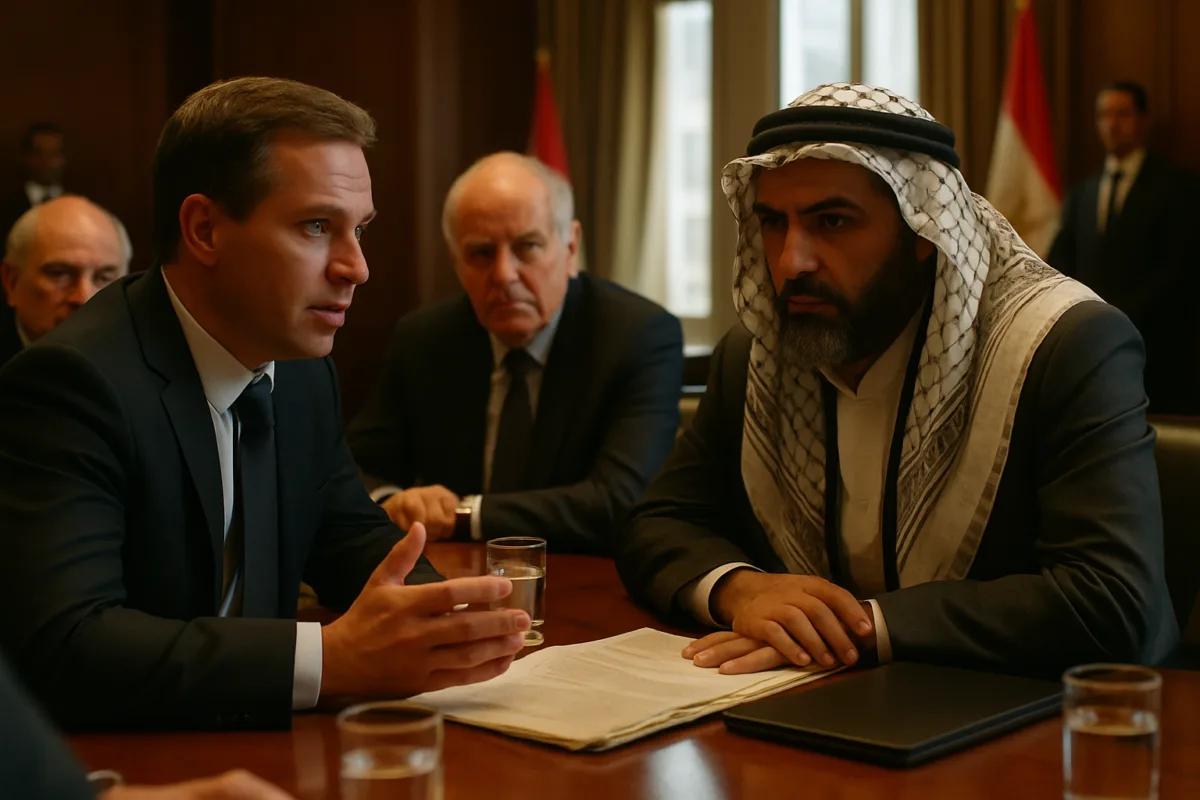
Recent diplomacy — including the high-profile engagement in Cairo involving Jared Kushner, the Board of Peace delegation, and a Hamas team led by Khalil al-Hayya — raises the same question: was the meeting a step toward enforcement, or a media-friendly waypoint that papered over unresolved verification problems? The answer hinges on whether Hamas will accept the intrusive, real-time monitoring and enforcement mechanisms necessary to convert promises into cessation of belligerence. To date, Hamas has refused or subverted those mechanisms when they threaten its military autonomy.
The disarmament dilemma and the verification imperative
Israel’s refusal to withdraw troops or cede control without disarmament is not mere obstinacy; it is a response to repeated lessons learned on the battlefield and in ceasefire rooms. Disarmament, in this context, is not a rhetorical concession but a verifiable elimination or neutralization of the group’s ability to wage sustained terror operations against Israel. That requires three non-negotiable elements: the physical removal or destruction of weaponry, credible custody of former combatants, and an independent verification apparatus with enforcement authority.
International intermediaries routinely propose technocratic solutions — a National Committee for the Administration of Gaza (NCAG), an International Stabilization Force (ISF), or similar constructs — to mediate the transition from combatant rule to civilian administration. Those models have merit on paper, but their success depends on buy-in from the party that currently wields coercive power. If Hamas can continue to command weapons from behind a civilian facade, any purported ‘disarmament’ will be cosmetic. The history of prior Gaza arrangements shows that ambiguous agreements are exploited; weapons are smuggled back, militants reconstitute units, and tunnels are rebuilt. Effective verification must be intrusive, persistent, and backed by quick, credible consequences for violations, not merely by statements of concern.
Regional politics: why some partners prefer blaming Israel
The political calculus of regional states complicates the enforcement conversation. Several Muslim-majority governments have publicly criticized Israeli recalcitrance and framed the recent impasse as Israel obstructing a Trump-backed roadmap. That framing serves multiple purposes: it channels domestic political pressures, preserves diplomatic leverage with Western capitals, and avoids confronting the more painful option of pressuring Hamas to disarm. For those governments, it is easier to cast Israel as the obstacle than to head off Hamas’ capacity to inflame public opinion by claiming victimhood.
This tendency to externalize blame obscures the truth that actors on all sides behave strategically. Gulf states, Egypt, Turkey, and others have their own interests — stability, domestic legitimacy, and regional influence — that sometimes align with pushing Hamas to cooperate and sometimes align with protecting Hamas as a useful foil. The result is a fragmented pressure environment: enough public condemnation of Israel to make leverage look skewed, but not enough unified, coercive pressure on Hamas to ensure meaningful disarmament. That gap allows Hamas to continue playing spoiler while regional actors point fingers at Jerusalem.
Electoral clocks and the incentives for obstruction
Timing is not incidental. The Israeli electoral calendar, Palestinian legislative scheduling, and broader regional political timetables create incentives for delay and obstruction. Leaders facing electoral pressures will posture in ways that signal uncompromising security credentials. For Israeli politicians, appearing weak on Hamas is electorally costly; for Hamas, delaying meaningful concessions until political configurations shift can preserve its leverage. The tactical decisions each side makes under electoral stress often have outsized strategic consequences.
Moreover, Hamas benefits from delegitimizing Palestinian elections that are likely to exclude its candidates under conditions that require recognition of Israel’s existence. By positioning itself as the guardian of resistance and the sole actor unwilling to renounce armed struggle, Hamas seeks to undermine the credibility of the Palestinian Authority and the electoral process. If it succeeds in portraying post-election outcomes as illegitimate or externally imposed, the group retains political relevance even if it is sidelined administratively. That is classic spoiler behavior: maintain indispensability by being the most disruptive actor.
Gaza’s status and the broader Iran confrontation
The Gaza question cannot be isolated from the wider regional confrontation with Iran. Tehran’s proxy networks and ideological alignment with Hamas make Gaza an amplifying node for Iranian influence. As long as Gaza remains a grievance-ridden, unstable enclave, it fuels recruitment narratives for Iran and provides propaganda ammunition that hampers U.S. and Israeli efforts. The strategic prize of Gulf normalization with Israel — particularly Saudi cooperation — becomes far harder to secure if the Palestinian issue remains unresolved and visible. Thus, Hamas’ ability to keep Gaza in perpetual crisis is not just a local problem; it is an asymmetric lever that affects the entire regional order.
From Washington’s perspective, a credible Gaza settlement clears diplomatic bandwidth to focus on constraining Iran’s nuclear ambitions and rolling back its regional proxies. For Israel, the calculus is existential: any deal that leaves Hamas militarily capable is simply a postponement of the next war. That explains why Israeli demands for disarmament are absolute in tone, even if they are negotiable in technical detail. The question is not whether some deal is possible, but whether the deal can be enforced in a way that prevents Gaza from reverting to a launchpad for terrorism.
What meaningful enforcement would require
If diplomacy is to move beyond performative gestures, it must incorporate enforcement mechanisms that alter Hamas’ cost-benefit calculations. Practically, that means international monitors with immediate-access rights, intrusive inspections, custody arrangements for weapons, and a credible rapid-response capability to punish violations. Enforcement does not necessarily require large occupation forces; it requires a political willingness by guarantor states to act decisively when red lines are crossed. That can involve sanctions, targeted military follow-up, or cutting off reconstruction resources to entities that divert materials to military ends.
Equally important is resolving the accountability question. Reconstruction funds, humanitarian aid, and state-building assistance must flow to verifiable civilian entities, not to networks that can siphon resources into militant rearmament. Donor conditionality and careful monitoring of supply chains for dual-use materials can reduce the opportunities for diversion. The real test of any roadmap is not whether it fills in governance checkboxes but whether it changes the incentives that allow Hamas to profit from instability.
Diplomacy will remain necessary and useful; no durable solution can be imposed purely by force. But diplomacy without enforcement is merely a pause that rewards the spoiler. If international actors are serious about a stable Gaza, they must stop conflating good intentions with effective strategies. This requires clarity: naming the spoiler, aligning pressure where it can effect behavioral change, and designing institutions that can verify and enforce disarmament. Anything less will preserve the status quo under a veneer of negotiation.
The political and moral urgency of shortening Gaza’s cycle of violence is real, but urgency alone cannot substitute for strategy. A roadmap that lacks teeth will create the illusion of progress while enabling Hamas to retain its leverage. If the international community genuinely wants to make Gaza governable and reduce the risk of renewed conflict, it must align diplomatic offers with steps that eliminate a militant group’s capacity to game the system. Only then can words be turned into durable security and a plausible pathway toward a legitimate, civilian-led administration — and only then can regional normalization processes proceed without being held hostage by unresolved violence.

Dr. Morgan directed the Archives Program from 2014 to 2017, gaining extensive experience in research documentation, information management, and the preservation of scholarly resources. Throughout her career, she has worked closely with academic publications and research materials, developing expertise in evaluating scientific sources and communicating complex topics to broad audiences.
Her primary areas of specialization include scientific publishing, research communication, editorial review, and the translation of technical research into accessible educational content. She has contributed to projects involving space science, astronomy, environmental science, history, archaeology, and emerging scientific discoveries, always emphasizing accuracy, transparency, and the responsible presentation of evidence.
As Editorial Director of Muskurahat.us, Dr. Morgan leads the editorial review process for scientific articles, ensuring that content is based on reputable sources, peer-reviewed research whenever available, and publications from recognized universities, research institutions, and international scientific organizations.
She is committed to promoting scientific literacy through clear, engaging, and well-documented articles that help readers better understand scientific discoveries and their impact on society. Her editorial philosophy is founded on accuracy, intellectual integrity, independent journalism, and continuous learning as scientific knowledge evolves.
Through her work at Muskurahat.us, Dr. Morgan supports the publication of trustworthy scientific content that makes complex research accessible to readers around the world while maintaining rigorous editorial standards.