For much of the 20th century a deceptively neat story held sway: human ancestors grew large brains first, and only later did their bodies change to support the unique behaviors that defined the genus Homo. That narrative suited our vanity. It flattered the idea that the mind drove the march of human progress. But paleontology is a discipline built on fragments and inference, and charm does not equal truth. The discovery in Ethiopia in 1974 of a partial skeleton now known affectionately as ‘Lucy’ forced an uncomfortable, evidence-driven correction. The fossil record began to say something different: upright posture, not encephalization, was the early hallmark of our lineage.
How a single skeleton unsettled a comfortable myth
The history of scientific ideas is not only the history of data; it is the history of assumptions. The Piltdown hoax, first publicized in 1912, fused a modern-sized braincase with an ape-like jaw and reinvigorated a brain-first worldview that many researchers already favored. Piltdown endured because it matched what people wanted to see: proof that cognitive superiority led the way. When the hoax collapsed in 1953 it did not instantly dislodge the assumption. The fossil record was sparse and ambiguous, and explanations that fitted the preferred narrative persisted.
Lucy at Hadar: what the bones revealed
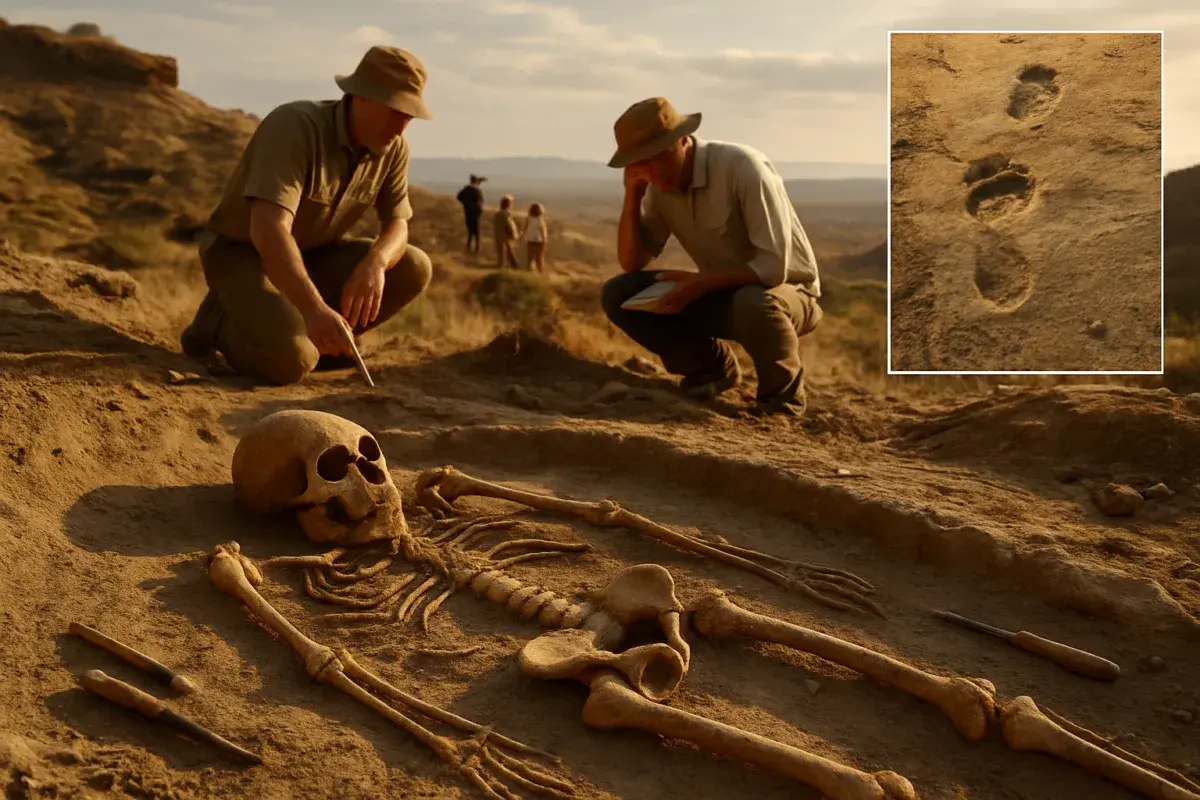
When Donald Johanson and Tom Gray uncovered skeletal fragments at Hadar in November 1974, they did not merely find a curiosity; they recovered roughly 40 percent of a single individual, an extraordinary completeness for something more than three million years old. The assemblage included parts of the skull, jaw, pelvis, spine, ribs and long bones. The species Australopithecus afarensis, named in 1978, presented a paradox: a small braincase, about 388 cubic centimeters, alongside pelvic and leg anatomy unmistakably adapted for bipedal locomotion. In short, Lucy walked upright long before she acquired a human-sized brain.
Corroboration beyond bone: footprints and context
Lucy did not stand alone for long. Footprints preserved in volcanic ash at Laetoli in Tanzania dated to 3.66 million years ago showed clearly bipedal tracks, probably left by members of the same species or close relatives. Where bones can be ambiguous, trace fossils can be decisive; the Laetoli trails are unambiguous records of two-legged locomotion. Together, skeleton and footprints reconstruct a sequence: locomotor changes preceded the dramatic encephalization that characterizes later Homo.
Why overturning the brain-first story matters
This is not merely an academic rearrangement of dates. The sequence in which traits evolved shapes the causal stories we tell about what made us human. If large brains came first, the implication is that mental innovations—tool use, social complexity, planning—drove anatomical adaptations. But if upright walking came before brain expansion, then the narrative pivots: changes in posture and locomotion may have set new selective pressures that later favored cognitive growth. That forces us to interrogate our teleologies. Human exceptionalism founded on intelligence alone collapses into a more nuanced picture of interacting anatomical, ecological, and social forces.
Questions of function and fitness
Bipedalism is not just a posture; it restructures feeding, thermoregulation, energy expenditure, and the way an organism navigates its environment. Walking on two legs frees the hands, alters foraging strategies, and changes predator avoidance. These functional shifts could have created new niches in which enhanced cognitive flexibility became advantageous. The implication is not a simple causal chain but a feedback loop: anatomy opens possibilities that select for cognitive traits, which in turn enable further anatomical specialization. Accepting this complexity is intellectually honest and scientifically productive.
Why skepticism toward single fossils makes good science
It would be a mistake to idolize Lucy as if a single skeleton could rewrite the entire narrative without caveat. Scientists themselves emphasize the cautionary note: one specimen can be pivotal yet precarious as the foundation for sweeping claims. The legitimate concern is sampling bias. The fossil record is patchy, preservation is capricious, and morphological variation within and between species can mislead. That is precisely why Lucy’s discovery is powerful: it provided unusually complete data at a crucial temporal window. But scientific robustness emerges when a compelling find invites further testing and refines rather than concludes the debate.
The thicket, not the ladder
Subsequent discoveries have complicated the tidy linear progression from ape to human. Multiple hominin species coexisted, some with different modes of locomotion and varying brain sizes. The image of a single, unbroken ladder leading inevitably to Homo sapiens has given way to that of a branching thicket with intertwined lineages, dead ends, and convergences. Lucy remains central to the discussion because she anchors a pattern: bipedalism has deep roots. But her placement within the hominin bush is open to interpretation, and that openness is the point. The thicket metaphor is not a failure; it is a model that better fits messy empirical realities.
What Lucy teaches us about bias, evidence, and public understanding
Lucy is a corrective to more than scientific misconceptions; she is a cautionary tale about the interplay of cultural expectations and scientific practice. The Piltdown episode exposed how national pride, confirmation bias, and weak peer review can warp scientific consensus. Lucy’s triumph is evidence-based correction in action. Yet the wider public conversation about human origins often lags behind the careful caution of the field, favoring triumphant narratives and hero fossils. That mismatch matters because public appetite shapes funding priorities and policy decisions about site protection, museum curation, and education.
Policy implications and the value of continued exploration
Investing in paleoanthropology is investing in a better grasp of who we are and how we came to be. The discovery of Lucy and the Laetoli footprints did not arrive through serendipity alone; decades of fieldwork, dating technologies, and comparative anatomy made the reinterpretation possible. Preserving fossil sites, supporting interdisciplinary research, and maintaining rigorous standards for publication and peer review are not luxuries. They are necessary steps to ensure that future finds can correct current certainties and refine our narratives. Moreover, protecting sites respects the cultural and scientific patrimony of countries like Ethiopia and Tanzania, which steward some of our most valuable evidence of human origins.
Scientific humility is not merely a rhetorical virtue; it is a practical stance that enables progress. The history of ideas about human evolution shows how quickly compelling stories can calcify into dogma if not continually tested. Lucy’s legacy is methodological as much as it is empirical: she exemplifies how a single well-documented discovery, placed in geological and cultural context, can force the reexamination of long-held beliefs. That process—of challenge, refinement, and sometimes reversal—is how knowledge advances.
So the claim that humans are uniquely defined by big brains needs tempering. If upright walking was established millions of years before substantial brain growth, then human identity emerges from a mosaic of changes rather than from a single, defining leap. Celebrating cognitive achievements remains appropriate, but it should come with an appreciation for the less glamorous, anatomical shifts that set the stage. In defending a richer, more complicated human story, we also defend a more honest science—one that accepts provisional answers and prizes the capacity to revise them in light of new evidence.
Lucy teaches an enduring lesson: discoveries that unsettle our self-image are not defeats but opportunities. They force us to examine the assumptions that frame our questions and to build explanations that accommodate complexity rather than comfort. The story of human origins, like the hominin landscape it studies, is not a straight climb but a rugged terrain of divergent paths. Accepting that complexity does not diminish human uniqueness; it deepens our appreciation of the contingencies and adaptations that made us possible, reminding us that the most profound insights often arrive when we let evidence, rather than narrative preference, lead the way.

Dr. Morgan directed the Archives Program from 2014 to 2017, gaining extensive experience in research documentation, information management, and the preservation of scholarly resources. Throughout her career, she has worked closely with academic publications and research materials, developing expertise in evaluating scientific sources and communicating complex topics to broad audiences.
Her primary areas of specialization include scientific publishing, research communication, editorial review, and the translation of technical research into accessible educational content. She has contributed to projects involving space science, astronomy, environmental science, history, archaeology, and emerging scientific discoveries, always emphasizing accuracy, transparency, and the responsible presentation of evidence.
As Editorial Director of Muskurahat.us, Dr. Morgan leads the editorial review process for scientific articles, ensuring that content is based on reputable sources, peer-reviewed research whenever available, and publications from recognized universities, research institutions, and international scientific organizations.
She is committed to promoting scientific literacy through clear, engaging, and well-documented articles that help readers better understand scientific discoveries and their impact on society. Her editorial philosophy is founded on accuracy, intellectual integrity, independent journalism, and continuous learning as scientific knowledge evolves.
Through her work at Muskurahat.us, Dr. Morgan supports the publication of trustworthy scientific content that makes complex research accessible to readers around the world while maintaining rigorous editorial standards.