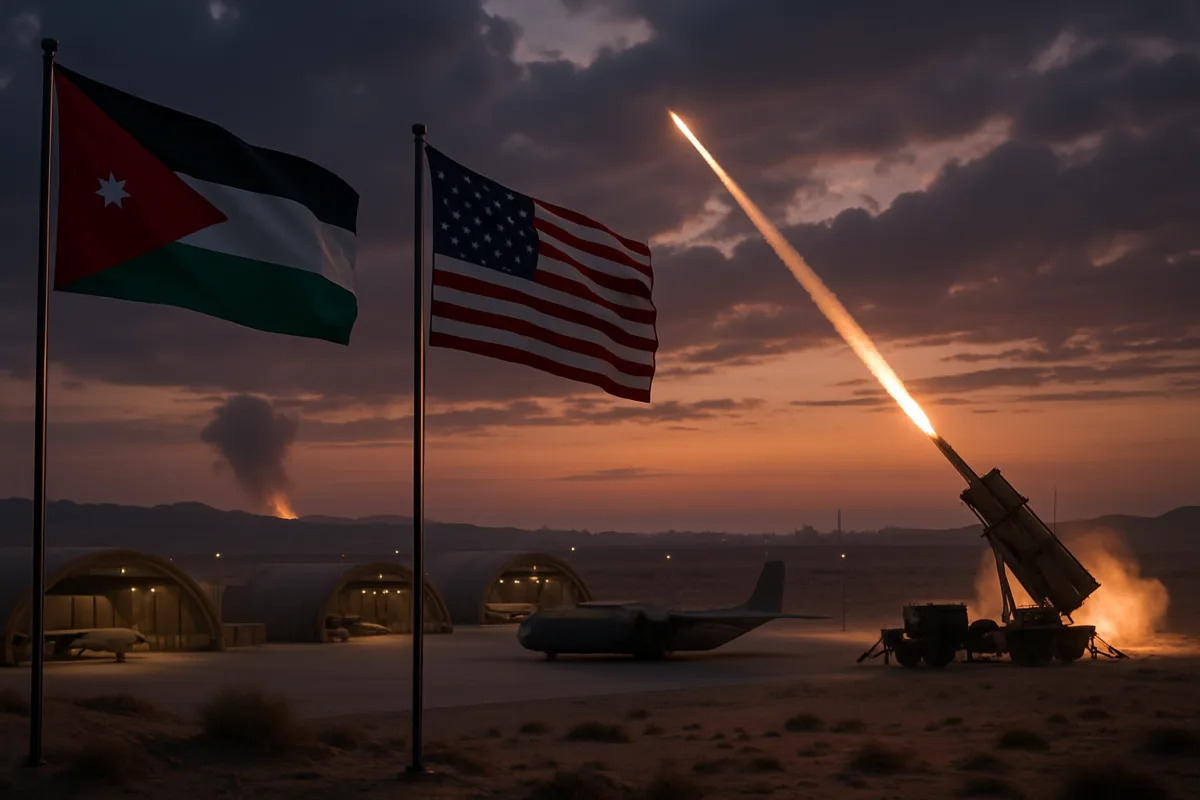
Air Warfare has become an increasingly visible instrument of geopolitical pressure in the Middle East, and recent strikes on American facilities in Jordan have forced a stubborn question: is Jordan the United States’ weakest link in the regional security architecture? This piece argues that the answer is yes in practical terms, not because Jordan lacks strategic value, but because domestic politics, demographic realities, and the optics of US military presence make Jordan uniquely vulnerable to both kinetic and narrative attacks.
Air Warfare and America’s Strategic Position in Jordan
Iranian missile and drone strikes on US bases in Jordan in recent months illustrate how air campaigns and stand-off attacks can be calibrated to produce political fallout rather than decisive battlefield outcomes. Tehran’s message was not solely about physical damage; it was about demonstrating the limits of Washington’s ability to shield allies from indirect costs.
Moreover, air operations and the basing of US air assets on Jordanian soil are highly visible symbols of alignment with Washington. Consequently, these deployments become focal points for domestic opposition and international messaging campaigns. Thus, air warfare in this context is both military tactic and political theatre.
Historical Roots of Jordan’s Structural Fragility
To understand why Jordan is particularly exposed, one must look beyond hardware to history. Jordan emerged as a modern polity through imperial decisions rather than organic nation-building, and the Hashemite monarchy’s survival has depended on external patronage and carefully managed domestic coalitions.
Therefore, the state’s legitimacy rests on fragile balancing acts: maintaining security ties with the US while preserving domestic support from tribal networks and a large Palestinian-origin population. This structural fragility amplifies the political impact of any airstrike perceived as tied to American strategy.
Public Opinion, the Palestinian Question, and the Perception of US Air Power
Public sentiment in Jordan toward US policy cannot be separated from the intensifying Israeli military campaign in Gaza and rising violence in the West Bank. Many Jordanians interpret American military support for Israel as complicity in Palestinian suffering, and US air presence is often visual shorthand for that alliance.
Accordingly, when US aircraft or facilities in Jordan are linked—rightly or wrongly—to operations that enable Israeli military objectives, the monarchy pays a domestic political price. Thus, air warfare amplifies a narrative that Washington is not a neutral security partner but a partisan actor in a local conflict.
Transition: From physical strikes to narrative strikes
In short, kinetic attacks are only half the weapon; the rest is the story they tell. Tehran understands that targeting US air assets or bases will ricochet through Jordanian media and public discourse, increasing pressure on Amman to distance itself from Washington.
Iran’s Strategy: Targeting Vulnerabilities, Not Territory
Iran’s recent attacks on American bases in Jordan were calibrated to highlight vulnerability rather than to seize territory. By striking bases that symbolize the US security presence, Tehran aims to widen the gulf between Jordanian rulers and their population without engaging in full-scale invasion or regime change.
Consequently, the strategy extracts political costs for Washington while exposing the limits of American deterrence. Iran does not need to topple the monarchy; it merely needs to raise the domestic political temperature so that Amman must choose between its security dependency and its domestic legitimacy.
Air Bases as Political Liabilities
Bases that host US air assets in Jordan are not only military hubs but also lightning rods for protest and propaganda. They are physical reminders that the kingdom’s security calculus is aligned with a power that many Jordanians view skeptically.
Therefore, these installations become political liabilities for the Hashemite regime. If air warfare escalates or if civilian casualties are attributed—accurately or not—to coalition operations that use Jordanian facilities, the monarchy’s domestic standing erodes quickly.
Transition: From liability to strategy
Given these liabilities, policymakers must reassess how air power is projected in a way that preserves operational effectiveness while minimizing political blowback.
Why Jordan Matters to US Air Operations in the Middle East
Despite these vulnerabilities, Jordan is strategically indispensable. Its airfields and bases provide critical reach for surveillance, force projection, and logistics across the Levant. In a region where basing access is limited, Jordan’s cooperation enables rapid air operations and contingency responses.
However, this strategic utility does not negate the political costs. It means that Washington must be more sophisticated in how it employs air power through and over Jordanian territory, balancing immediate military advantages with long-term strategic resilience.
Policy Recommendations: Recalibrating US Air Strategy and Regional Diplomacy
First, the United States should diversify basing and operational footprints to reduce the symbolic concentration of air assets in Jordan. Rotational deployments, temporary facilities, and increased use of allied airfields in the Gulf would lower the domestic visibility of US air power within Jordan.
Second, Washington must prioritize missile defense and hardened infrastructure investments for Jordanian hosts. Providing discreet, high-quality air-defense systems and technical assistance would lower the physical and political costs of strikes while giving Amman plausible deniability.
Third, diplomatic engagement should be intensified. The United States needs a robust public diplomacy campaign that addresses Jordanian concerns directly, emphasizes humanitarian support for Palestinians, and separates legitimate self-defense actions from perceived complicity in civilian harm.
Fourth, economic and governance support must be targeted to strengthen domestic resilience. Aid that bolsters public services, employment, and political inclusion will reduce the social space for narratives that portray the monarchy as merely an American proxy.
Transition: Tactical changes, strategic consequences
Implementing these measures would not eliminate the risks tied to air warfare, but they would reduce the probability that domestic backlash in Jordan spills over into a strategic break with Washington.
Legal, Ethical, and Operational Considerations for Air Campaigns
Any recalibration of air strategy must adhere to international law and best practices to avoid further delegitimizing US presence. Transparent rules of engagement, accountability for civilian harm, and clearer lines of communication with host-nation authorities are essential.
Furthermore, investing in precision strike capabilities and intelligence-sharing with Jordanian counterparts can reduce unintended damage and build trust. These operational shifts would reinforce the argument that US air power is a stabilizing force rather than a reckless instrument of escalation.
Implications for MENA Security and Air Warfare Doctrine
Jordan’s predicament is a cautionary tale for air warfare doctrine across the MENA region. Air power cannot be divorced from politics; basing and operations on allied soil require a holistic strategy that integrates public diplomacy, economic policy, and legal safeguards.
As a result, military planners and diplomats must collaborate closely when designing air campaigns. Otherwise, tactical successes in the sky will be outweighed by strategic failures on the ground.
Transition: Toward a resilient partnership
In practice, a resilient US–Jordan partnership will combine military prudence with political sensitivity, ensuring that air operations do not undercut the very alliances they aim to protect.
Jordan is not weak because it lacks resolve; it is vulnerable because its social composition and political survival are entangled with a deeply unpopular regional dispute. Air Warfare intensifies that entanglement by making the costs of alignment both visible and immediate. Therefore, protecting American interests in the Levant requires more than hardware: it demands a strategy that reduces the domestic political costs borne by partners and that treats basing agreements as political contracts as much as military ones.
Policymakers who appreciate this interplay can act: diversify basing, invest in local defenses, improve public diplomacy, and link aid to reforms that expand internal legitimacy. By doing so, Washington can maintain operational reach while minimizing the risk that Jordan becomes a liability. This approach turns air power from a blunt instrument into a calibrated tool that supports both security objectives and durable alliances, offering tangible steps that leaders can take now to stabilize the region and preserve essential cooperation.

Dr. Morgan directed the Archives Program from 2014 to 2017, gaining extensive experience in research documentation, information management, and the preservation of scholarly resources. Throughout her career, she has worked closely with academic publications and research materials, developing expertise in evaluating scientific sources and communicating complex topics to broad audiences.
Her primary areas of specialization include scientific publishing, research communication, editorial review, and the translation of technical research into accessible educational content. She has contributed to projects involving space science, astronomy, environmental science, history, archaeology, and emerging scientific discoveries, always emphasizing accuracy, transparency, and the responsible presentation of evidence.
As Editorial Director of Muskurahat.us, Dr. Morgan leads the editorial review process for scientific articles, ensuring that content is based on reputable sources, peer-reviewed research whenever available, and publications from recognized universities, research institutions, and international scientific organizations.
She is committed to promoting scientific literacy through clear, engaging, and well-documented articles that help readers better understand scientific discoveries and their impact on society. Her editorial philosophy is founded on accuracy, intellectual integrity, independent journalism, and continuous learning as scientific knowledge evolves.
Through her work at Muskurahat.us, Dr. Morgan supports the publication of trustworthy scientific content that makes complex research accessible to readers around the world while maintaining rigorous editorial standards.