The first images of Io’s glowing, crater-free surface did more than surprise a generation of planetary scientists — they provoked a fundamental argument about how planets are heated, reshaped and even connected to their parent worlds. From Linda Morabito’s contrast-enhanced discovery of a plume in 1979 to Juno’s gravity measurements decades later, Io has repeatedly forced researchers to revise simple models and confront uncomfortable complexity. The central claim I defend here is that Io is not merely an astronomical curiosity; it is a natural laboratory whose extreme volcanism obliges us to rethink internal planetary processes, observational biases, and the priorities of future missions.
The Voyager revelation and why first impressions mislead
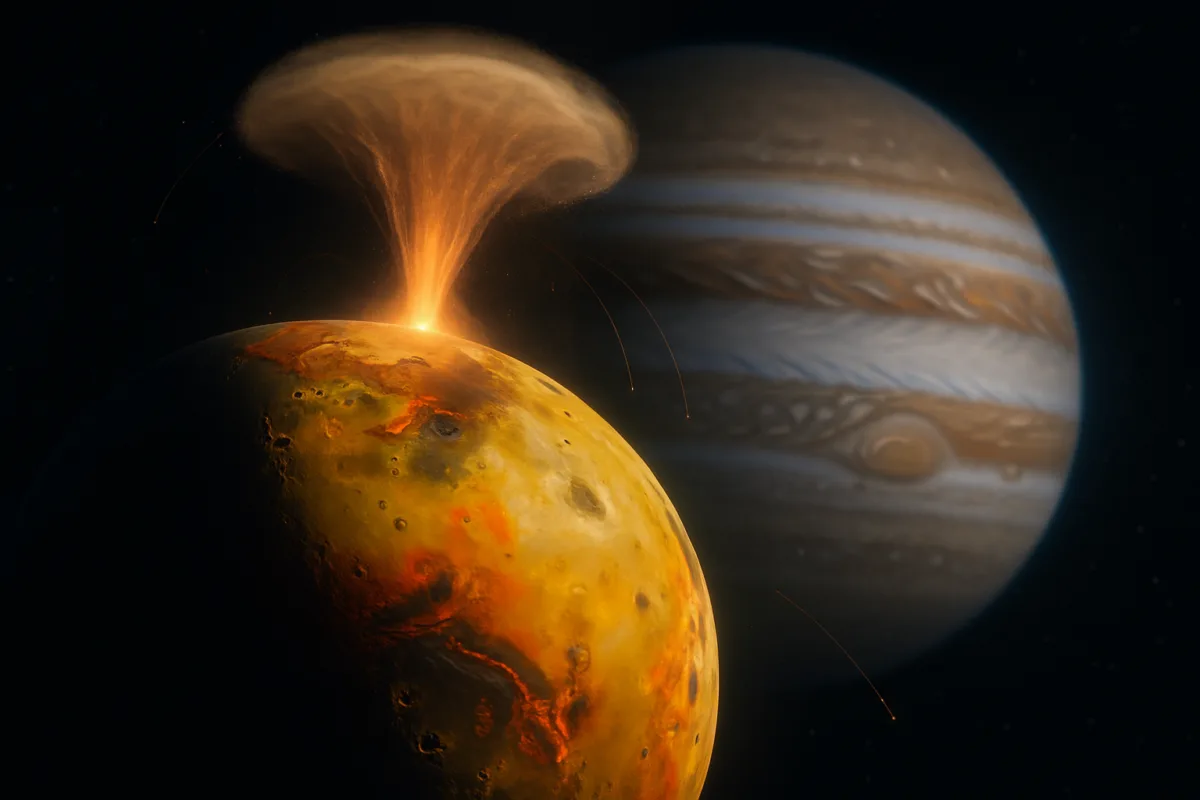
Voyager 1’s post-encounter optical-navigation image is a textbook example of how surprise can catalyze discovery. When Linda Morabito boosted the contrast to reveal background stars, she exposed an umbrella-shaped plume rising hundreds of kilometres beyond Io’s limb — a feature so unexpected that early investigators treated it as a probable imaging artifact. That hesitancy was reasonable: scientists are trained to distrust anomalies until they survive careful scrutiny. But the refusal to accept the surprising as impossible must be balanced by openness to new physics. The Voyager images did precisely that. What began as an apparent anomaly became the first direct evidence of active volcanism beyond Earth, and a powerful corrective to the assumption that small moons are geologically dead.
Why the misidentification matters
Arguing that the initial skepticism matters is not pedantry. Scientific progress depends on correctly interpreting anomalous data. Mistaking a volcanic plume for a camera artifact would have silenced the most dramatic window into tidal heating for decades. Instead, the discovery reoriented planetary science toward tidal processes and away from a strictly radiogenic-heating paradigm. The lesson is clear: methodologies that too eagerly dismiss anomalies risk blinding us to the phenomena that demand new theory.
Tidal flexing: a different kind of internal engine
The accepted mechanism that explains Io’s extreme activity is tidal heating: Io’s slightly elliptical orbit, sustained by resonance with Europa and Ganymede, causes Jupiter’s gravity to periodically squeeze and stretch the moon. The mechanical deformation — Io’s surface rising and falling by up to about 100 metres — produces frictional heating that melts rock and powers hundreds of volcanic centers. This mechanism is not exotic in concept, but the scale at which it operates on Io is extraordinary. Rather than relying predominantly on internal radioactive decay like Earth, Io demonstrates how gravitational interactions can dominate a body’s thermal budget.
Implications for geologic youth and surface renewal
Io’s continuous resurfacing erases impact craters and maintains an appearance of perpetual geological youth. Sulphur and sulphur dioxide fallout, combined with silicate lava flows, repaint the landscape in vivid yellows, oranges and blacks. The presence of roughly 400 volcanoes — with some capable of launching material hundreds of kilometres above the surface — means Io is not a geologic exception, it is a different class of world. Recognizing this invites a reframing of planetary evolution for tidally influenced bodies across the solar system and beyond.
Plumes as agents of planetary-scale interaction
Those gargantuan plumes do more than make for spectacular images. Low gravity and a thin atmosphere allow erupted material to arc ballistically and fall back as deposits spanning hundreds or thousands of kilometres. Some ejecta escapes Io entirely and becomes part of a torus of charged particles that couples Io directly to Jupiter’s magnetosphere. This is not a local phenomenon; Io influences the electromagnetic environment of the entire Jovian system. To downplay that interaction is to ignore how intimately a moon and its parent planet can be linked through volcanic activity.
Comparative scale: terrestrial eruptions versus Io
To appreciate the difference, consider that plumes on Io have been documented to reach outer material visible at roughly 500 kilometres — higher than the International Space Station orbits Earth. Terrestrial eruptions rarely accomplish anywhere near that scale because Earth’s stronger gravity and denser atmosphere collapse plumes quickly. Io’s plumes therefore not only testify to energetic eruptions but also to an environment that allows matter to stray far from its source, reshaping the moon and contributing mass and charged particles to Jupiter’s magnetospheric system.
The interior debate: global magma ocean or many smaller reservoirs?
For years a dominant interpretation held that Io’s volcanism was fed by a shallow global magma ocean, a nearly continuous layer of molten rock beneath the crust. That model offered a tidy explanation for the extensive volcanic output: a well-mixed, global source distributing heat and melt. Yet Juno’s more recent gravity measurements suggest Io behaves more like a mostly solid body with local or regional magma sources. This matters because the scale and connectivity of melt reservoirs fundamentally change how heat is stored and released.
Why the distinction shapes scientific priorities
If Io hosts a global magma ocean, it becomes a natural analogue for bodies where long-lived, planet-encircling melts can play a major role in evolution. If instead Io comprises hundreds of semi-independent volcanic systems, it becomes a mosaic of localized dynamics, each with its own plumbing, episodicity and thermal timescale. The correct model affects predictions about eruption frequency, volatility of gas release, surface renewal rates, and how volcanism feeds the magnetosphere. It even changes how we design instruments and mission trajectories to study Io effectively.
What Io teaches us about exoplanets and habitability
Understanding Io is not an exercise in trivia. Tidal heating is a powerful engine in many systems, including exoplanets orbiting close to their stars or giant planets. The realization that gravitational interactions can dominate a world’s internal energy budget broadens the palette of planetary behaviors we must consider. Worlds that are volcanic beyond expectation may be common, and in some contexts tidal heating could create subsurface oceans that increase the prospects for habitability in otherwise frigid regions. Conversely, Io warns that tidal heating can also sterilize surfaces with relentless volcanism. We must therefore refine models not just for Io but for the interpretation of distant worlds where limited data can easily mislead.
Observation, theory and mission design: an integrated approach
Io’s history of discovery underscores that observation and theory must iterate. Voyager provided images that demanded theoretical reorientation; later missions like Galileo, Cassini, New Horizons and Juno refined that theory and forced further revisions. The pattern is instructive: each new dataset has the potential to overturn neat paradigms. Investing in a diverse suite of instruments — high-resolution imaging, thermal mapping, gravity science, magnetometry and in situ sampling of ejected material — is necessary to resolve the question of Io’s internal architecture and its broader implications.
Why we should prioritize returning to Io
Arguments against expensive missions often emphasize risk and cost. Yet Io presents a uniquely high scientific return on those investments. It is a natural laboratory for tidal heating, volcanic processes, magnetospheric coupling and surface-atmosphere interactions under extreme conditions. The diversity of active volcanic centers in a moon only slightly larger than our own offers a sampling advantage: study one body and you can observe hundreds of analogues of terrestrial volcanic styles, scaled by unfamiliar pressures and chemistries. That richness justifies targeted missions with focused objectives rather than broad, unfocused reconnaissance alone.
Io’s dramatic plumes — the same feature that nearly fooled Voyager engineers into thinking the images were faulty — are a reminder that anomaly is often the herald of deeper understanding. Whether the moon’s interior is dominated by a continuous magma ocean or a tapestry of local melts, whether its volcanoes feed Jupiter’s magnetosphere enough to alter planetary-scale dynamics, and whether tidal heating on other worlds produces life-friendly niches or crucibles of destruction, these are questions with direct consequences for planetary science. The lesson Io offers is both methodological and philosophical: embrace surprises, iterate between data and model, and build missions that target the most provocative anomalies. If we do, Io will continue to reshape not just its surface but our theories about how worlds are made and remade.

Dr. Morgan directed the Archives Program from 2014 to 2017, gaining extensive experience in research documentation, information management, and the preservation of scholarly resources. Throughout her career, she has worked closely with academic publications and research materials, developing expertise in evaluating scientific sources and communicating complex topics to broad audiences.
Her primary areas of specialization include scientific publishing, research communication, editorial review, and the translation of technical research into accessible educational content. She has contributed to projects involving space science, astronomy, environmental science, history, archaeology, and emerging scientific discoveries, always emphasizing accuracy, transparency, and the responsible presentation of evidence.
As Editorial Director of Muskurahat.us, Dr. Morgan leads the editorial review process for scientific articles, ensuring that content is based on reputable sources, peer-reviewed research whenever available, and publications from recognized universities, research institutions, and international scientific organizations.
She is committed to promoting scientific literacy through clear, engaging, and well-documented articles that help readers better understand scientific discoveries and their impact on society. Her editorial philosophy is founded on accuracy, intellectual integrity, independent journalism, and continuous learning as scientific knowledge evolves.
Through her work at Muskurahat.us, Dr. Morgan supports the publication of trustworthy scientific content that makes complex research accessible to readers around the world while maintaining rigorous editorial standards.