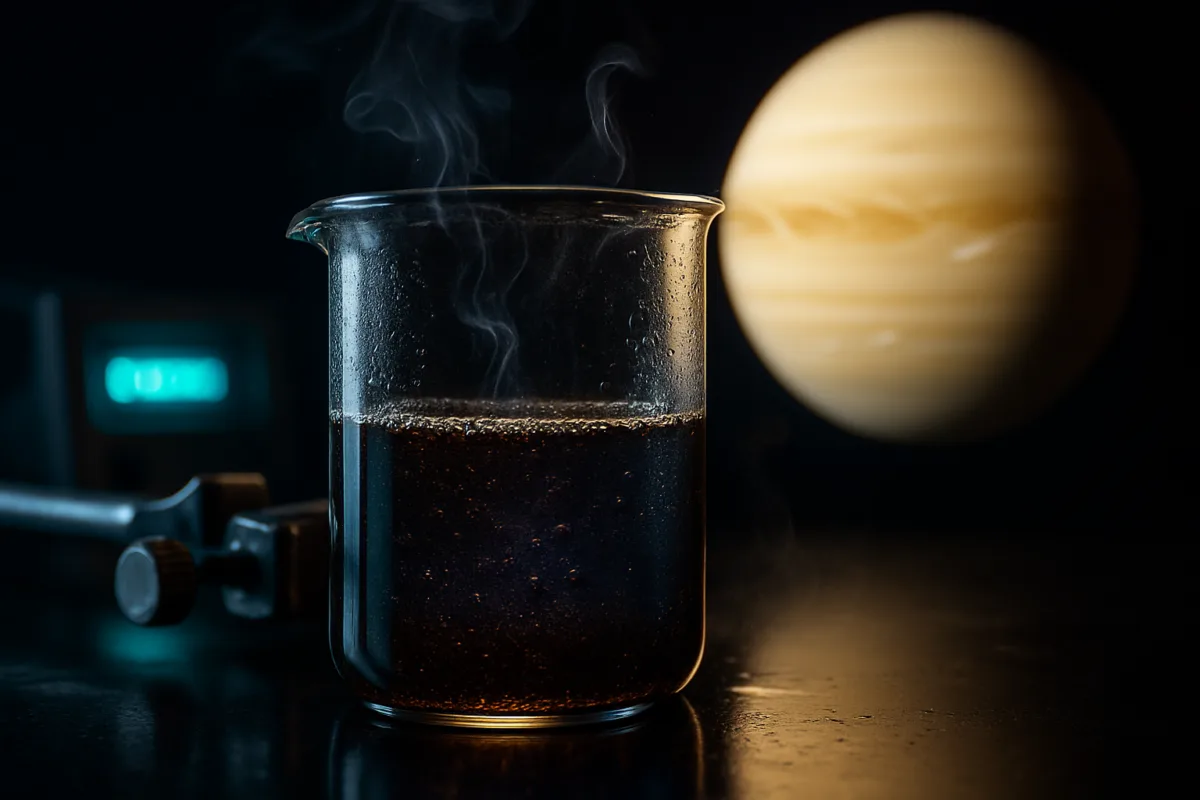
Venus unknown absorber is not just a curious phrase — it is the focal point of a striking new argument: the liquid inside Venusian cloud droplets, if gathered into a container, could appear almost black. That counterintuitive possibility challenges how we translate remote spectra into real chemistry and forces us to ask whether current observational and laboratory approaches are sufficient to identify the culprit.
What the new Venus absorption model actually demonstrates
Spacek and colleagues converted reflected-light measurements from 2020 into an absolute requirement for how strongly the cloud liquid must absorb near-ultraviolet and blue light. In practical terms, they reported a decadic absorption coefficient that peaks near 1,278 cm^-1 at 375 nanometres — a number that implies a one-centimetre sample of the inferred liquid would be essentially opaque at that wavelength.
Consequently, this modelling turns a qualitative mystery into a quantitative filter. Rather than asking only which chemicals have roughly the right spectral shape, scientists can now demand that any candidate meet four linked constraints: spectral shape, absolute strength, feasible concentration, and realistic vertical or particle-size location in the atmosphere.
Why a dark liquid can still make bright Venusian clouds
At first glance, it seems paradoxical: how can clouds that look pale yellow or creamy at visible wavelengths be composed of droplets that, as a bulk liquid, are nearly black? The resolution is scattering. Tiny droplets scatter light many times before it escapes the cloud, and that multiple scattering can dominate over internal absorption.
Put differently, particle size and number density change the emergent colour. Earth analogies help: river water with tannins is dark as a deep pool, yet breaking the same water into spray yields a white mist. Thus, scattering by mode 1 and mode 2 aerosols on Venus can mask extraordinarily strong molecular absorption inside droplets.
The number behind ‘almost black’ and why it matters
To be specific, absorbance equals the absorption coefficient multiplied by path length. A coefficient of 1,278 cm^-1 gives an absorbance of 1,278 for a 1-cm path, which under the Beer–Lambert law leaves essentially zero transmitted light at 375 nm. Even coefficients orders of magnitude smaller produce large extinguishing effects in small samples.
This is important for two reasons. First, it gives laboratory chemists a concrete target to reproduce and falsify. Second, it forces a trade-off: a intrinsically weak absorber must exist in huge abundance, while a strongly absorbing species can be rare but must be chemically plausible in Venus’s acidic, high-temperature clouds.
Organic versus inorganic candidates: the unavoidable trade-offs
Concrete examples sharpen the argument. Conjugated organic molecules can be spectacularly strong absorbers; a molar absorption coefficient around 100,000 L mol^-1 cm^-1 would demand concentrations on the order of 0.5–7% weight/volume to meet the model, roughly tens of grams per litre for certain porphyrin-like pigments. That is large but not physically impossible under laboratory conditions.
On the other hand, many inorganic candidates are far less efficient. Ferric chloride, for instance, shows an absorption coefficient near 1 cm^-1 at 375 nm at 1 g/L — implying impossibly high concentrations (hundreds to thousands of grams per litre) to reach the modelled value unless additional mechanisms or phases amplify absorption.
Therefore, any plausible solution must reconcile both optical strength and abundance, and account for chemical survival in concentrated sulfuric acid at altitudes around 59–65 kilometres. That narrows the field dramatically but does not produce a unique answer.
Why the model’s assumptions widen the range of plausible colours
Crucially, the model covers only 365–455 nm. Most of what a human eye perceives lies outside that window, so the “almost black” headline is a defensible thought experiment, not a definitive colour measurement. If absorption remains strong into longer wavelengths, the liquid would look dark even to human vision; if absorption falls off rapidly beyond 455 nm, the liquid could present as anything from yellow to brown.
Moreover, model inputs — the aerosol size distributions, the six-kilometre layer placement, and the assumption of a single, uniform absorber — are choices balancing realism with simplicity. If absorbing material is spread into the upper haze, for instance, required per-liquid absorption drops. If the absorber is concentrated in just one particle mode, per-particle strength must increase. Hence, the model defines a family of possibilities rather than a single fate.
Where observation and laboratory work must focus next
Given the trade-offs, targeted laboratory spectroscopy becomes a priority. Scientists should measure decadic absorption coefficients for candidate molecules and inorganic complexes in concentrated sulfuric acid across an extended UV–visible range, especially at 283 nm and below as well as beyond 455 nm.
Likewise, microdroplet scattering experiments can test how mixtures behave when partitioned into mode-sized droplets. Combining aerosol optics with realistic chemistry is essential: spectroscopy of bulk solutions alone is necessary but insufficient because scattering can dramatically alter emergent spectra.
Why in situ measurements and mission design matter
Ultimately, remote inference hits limits. No model, however sophisticated, can fully remove ambiguity created by unknown vertical distributions and mixed populations. Therefore, mission planners should prioritize instruments that directly characterize aerosol particles and droplets in situ.
Practical steps include adding aerosol collectors capable of stabilizing reactive samples, high-resolution UV–visible spectrometers, fluorescence detectors, and mass spectrometers tuned to detect both organics and metal–sulfur complexes. The planned DAVINCI probe is a step in this direction, but its payload and sampling strategy must reflect the new constraints to maximize discriminatory power.
Revisiting remote techniques: what can telescopes still do?
Ground- and space-based campaigns remain valuable. High-cadence ultraviolet phase curves can reveal temporal variability tied to chemical lifecycles. Polarimetry can constrain particle sizes and shapes, while spectroscopy extending into the near-UV and deeper into the visible will better define the required spectral slope beyond the current window.
Consequently, coordinated observing campaigns timed with spacecraft flybys or descent missions would multiply their value. In the meantime, revisiting archive data with models that allow mixed absorbers and layered vertical distributions can expose whether current datasets already prefer particular classes of chemistry.
What scientists, laboratory teams, and mission designers should prioritize
First, laboratory groups should systematically measure absorption coefficients for a prioritized list of candidates under Venus cloud conditions: concentrated sulfuric acid, elevated temperatures, and within mixtures that mimic possible atmospheric chemistry. Second, optical physicists should replicate scattering by mode-sized droplets containing those absorbers to translate bulk spectra into emergent cloud signatures.
Third, mission engineers should design aerosol collectors and stabilization pathways so reactive components are not altered before analysis. Finally, observers should expand spectral coverage into shorter and longer wavelengths with high temporal resolution to capture the absorber’s variability.
Why this modelling paper changes how we test hypotheses
Until now, proposals often satisfied only one or two constraints: a molecule might match the shape of the UV-dark features, or it might plausibly form in sulfuric acid. The new decadic absorption targets force candidates to satisfy a quartet of tests simultaneously. This methodological tightening matters because it reduces the plausible solution space and creates specific experimental pathways to falsify or confirm candidates.
Moreover, it reframes the question away from aesthetic descriptors — ‘‘what colour is Venus’s cloud liquid?’’ — and toward measurable properties that laboratories can reproduce and that missions can quantify in situ. That is progress even if the identity remains unknown for years.
Venus’s clouds teach a broader lesson: appearance can mislead. A planet that looks pale and placid from space may hide extreme chemistry in microscopic droplets. Therefore, the next steps are clear — targeted lab measurements, improved remote spectral coverage, and in situ aerosol sampling with instruments designed around explicit absorption targets. Those actions will convert a fascinating modelling constraint into an empirical identification, and potentially reveal new chemistry driven by conditions unlike anything we work with on Earth.

Dr. Morgan directed the Archives Program from 2014 to 2017, gaining extensive experience in research documentation, information management, and the preservation of scholarly resources. Throughout her career, she has worked closely with academic publications and research materials, developing expertise in evaluating scientific sources and communicating complex topics to broad audiences.
Her primary areas of specialization include scientific publishing, research communication, editorial review, and the translation of technical research into accessible educational content. She has contributed to projects involving space science, astronomy, environmental science, history, archaeology, and emerging scientific discoveries, always emphasizing accuracy, transparency, and the responsible presentation of evidence.
As Editorial Director of Muskurahat.us, Dr. Morgan leads the editorial review process for scientific articles, ensuring that content is based on reputable sources, peer-reviewed research whenever available, and publications from recognized universities, research institutions, and international scientific organizations.
She is committed to promoting scientific literacy through clear, engaging, and well-documented articles that help readers better understand scientific discoveries and their impact on society. Her editorial philosophy is founded on accuracy, intellectual integrity, independent journalism, and continuous learning as scientific knowledge evolves.
Through her work at Muskurahat.us, Dr. Morgan supports the publication of trustworthy scientific content that makes complex research accessible to readers around the world while maintaining rigorous editorial standards.