Ham the chimpanzee rode a Mercury-Redstone 2 rocket in January 1961 and became an inflection point for both engineering and ethics in human spaceflight. Within the first 100 words, this fact highlights the fundamental tension: was the risk taken with an animal subject justified by the safety it later provided to humans? The mission’s raw data, medical readings, and dramatic recovery tell a story that still forces us to argue about necessity, responsibility, and scientific rigor.
Mission profile and the suborbital test that almost didn’t go to plan
The Mercury-Redstone 2 flight deviated from its planned suborbital arc, ultimately reaching an apogee near 252 kilometres and overshooting the landing zone by roughly 241 kilometres. The escape rocket’s premature cutoff produced a short-lived peak of about 17 g during ascent, followed by roughly six and a half minutes of weightlessness and a re-entry deceleration peak near 14.6 g.
Notably, the cabin suffered pressure loss when a valve opened unexpectedly. Yet the sealed couch design and environmental controls protected Ham, demonstrating that the hardware could shield a biological occupant from multiple simultaneous failures. Taken together, these technical outcomes formed the empirical basis for arguing that primate tests were operationally necessary for the upcoming human missions.
Training, tasks, and physiological monitoring: evidence that a trained primate could perform
Before the flight Ham had completed 219 hours of behavioural training over roughly 15 months, simulating Redstone launch profiles in a centrifuge and learning a task panel of coloured lights and levers. During the mission the blue light cue appeared nine times; Ham’s average reaction time of 0.82 seconds matched his preflight 0.80 seconds, demonstrating task fidelity during extreme acceleration and weightlessness.
NASA recorded his electrocardiogram, respiration, and core temperature. Heart rate rose predictably during launch and re-entry, but respiration and temperature stayed within expected ranges. Even two electrical shocks—one caused by a malfunction—did not break his performance, which bolsters the technical claim that a trained primate could validate control systems and mission timelines.
Recovery operation and the human drama that followed
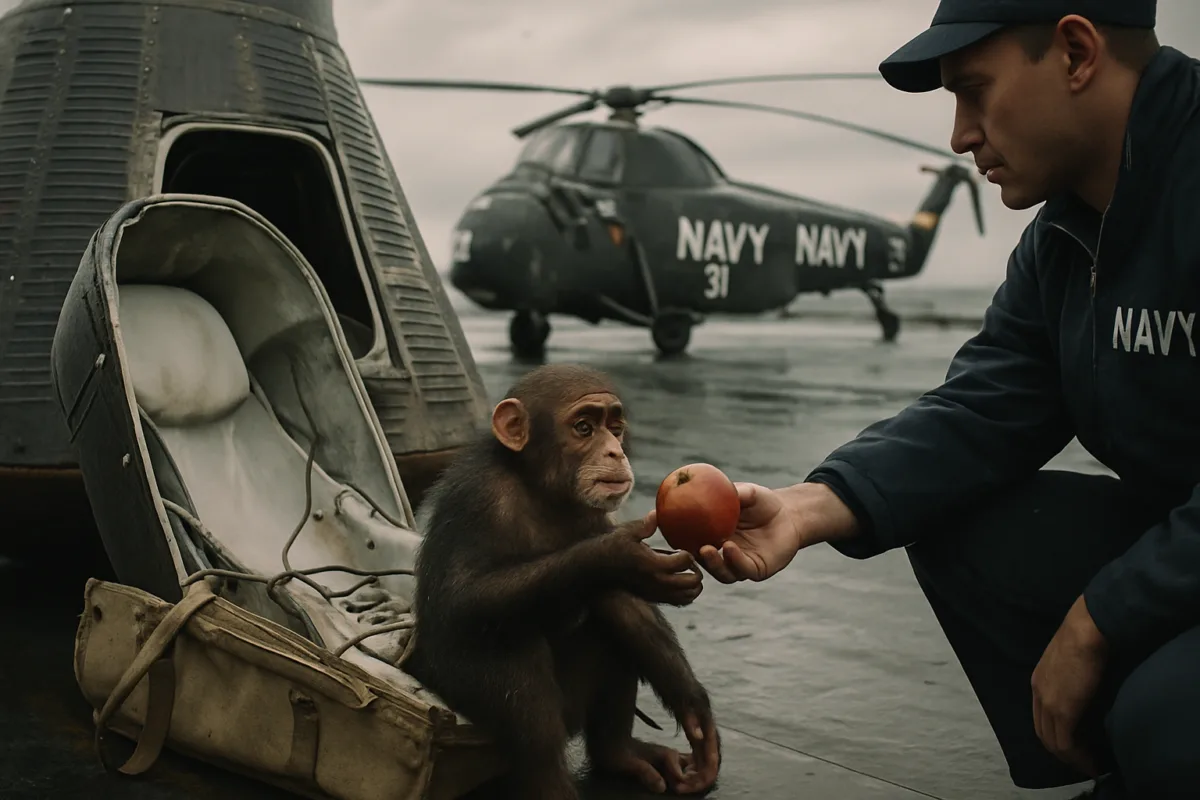
Eight ships had been positioned along the predicted corridor, yet the overshoot forced a lengthy recovery effort that highlighted the operational risks of long-range splashdowns. When a Navy helicopter lifted the damaged capsule and brought it aboard the USS Donner, crew opened the hatch to find Ham alive, vocalising, slightly dehydrated, and carrying a small abrasion across the bridge of his nose.
Handlers gave him fruit and water, and photographs show him accepting an apple and half an orange. Still, subsequent behaviour—visible distress and refusal to enter a training couch—indicates psychological and physical aftereffects that complicate any tidy defense that the mission was purely benign.
What the flight proved for Project Mercury and human passengers
From a strict engineering vantage point, Ham’s flight validated crucial systems: environmental controls, the couch seal, and the capacity of a living occupant to continue tasking through g-loads and weightlessness. NASA used these outcomes to argue that human passengers could be protected and monitored, and that the spacecraft architecture had operational resilience.
However, Ham’s flight did not immediately clear the way for Alan Shepard. A separate uncrewed booster test was required because of an electrical relay issue in the Redstone, and only after further testing was Shepard launched. Still, the data from Ham contributed to a risk calculus that human missions could be undertaken with acceptable safety margins.
Parallel developments and the quickening pace of space milestones
Seventy-one days after Ham’s mission, Yuri Gagarin completed the first orbital flight, and 94 days after Ham, Alan Shepard flew suborbital Freedom 7. Later that year Enos orbited the Earth, enduring significant instrumentation problems but continuing to perform tasks—evidence that chimpanzee missions contributed directly to the operational readiness of Mercury spacecraft for human crews.
These rapid milestones create a causal narrative: data from primate flights reduced unknowns and accelerated timetables. Yet that same rush forced hurried ethical choices that are the focus of modern scrutiny.
Ethical critique: animal welfare, transparency, and the limits of instrumental justification
Arguing that Ham’s mission was indispensable does not erase legitimate ethical concerns. The chimpanzee experienced dehydration, exhaustion, vomit in the couch, and a nose abrasion; he also endured shocks and a stressful recovery. Critics rightly ask whether a non-human primate’s suffering can be morally traded for technological progress.
Furthermore, early programs lacked the modern standards of oversight, informed public dialogue, and alternative method development that are expected today. That gap weakens any absolute claim that the mission was ethically unimpeachable, even if its technical outcomes were vital.
Contextual defense and the counterargument
Defenders point out that in 1961 there were few practical alternatives for validating human survivability: computers, models, and simulations of the era could not replicate complex physiological responses to combined extremes of g, vacuum leakage, and task performance. The sealed couch and environmental systems were untested under real biological loads until a live occupant was present.
In this frame, Ham’s flight becomes a tragic necessity: ethically problematic but functionally crucial. The counterpoint remains that necessity does not absolve responsibility; it obligates rigorous post hoc care, transparency, and institutional learning—areas where the historic record is mixed.
Legacy: science, museums, and the public memory of Ham and the astrochimps
Ham retired from research in 1963 and lived at the National Zoo and later the North Carolina Zoological Park, dying in 1983 at age 26. A necropsy found no long-term damage traceable to the flight, and his skeleton resides in the National Museum of Health and Medicine, while his soft tissues were buried at the International Space Hall of Fame.
This material legacy—strip charts, reaction-time tables, medical logs, and photographs of Ham accepting an apple on the USS Donner deck—shapes public memory. Those artifacts invite us to interrogate what was gained, what was lost, and how institutional narratives influence public consent for risky research.
How the mission changed research ethics and procedural rigor
Over the decades since Ham’s flight, standards for animal research and human-subject safety have improved significantly. Institutional review boards, refined animal welfare protocols, and advances in simulation and non-invasive testing change the calculus that justified primate flights in the early 1960s.
Therefore, while Ham’s mission may have been a functional shortcut at the time, the scientific community has largely moved toward strategies that prioritize alternatives wherever feasible. This evolution is evidence that the program’s ethical shortcomings had lasting influence on policy and practice.
Practical lessons for advocates, historians, and engineers
For engineers and mission planners, Ham’s flight underscores the imperative of redundancy, robust environmental design, and contingency planning for recovery operations. Technical teams should treat live-test data as invaluable but proceed only when non-animal alternatives are demonstrably insufficient.
For historians and ethicists, the event is a case study in how public urgency and geopolitical competition shape experimental ethics. Transparency, archival preservation, and open debate help prevent future decisions from being driven solely by deadlines and prestige.
Ultimately, Ham the chimpanzee’s mission presents a stubbornly mixed legacy: operationally decisive and ethically contested. The flight provided crucial validation for life-support systems and human performance under extremes, while also exposing gaps in oversight and animal welfare that later reforms sought to close. Readers can take away two clear, actionable points: support and demand rigorous ethical review for any research involving sentient animals, and champion investment in high-fidelity alternatives—simulations, human analog studies, and non-invasive sensors—that reduce the need for such tests in future programs. By focusing on both technical rigor and moral responsibility, the space community can honor the historical lessons while preventing repetition of ethically fraught shortcuts.

Dr. Morgan directed the Archives Program from 2014 to 2017, gaining extensive experience in research documentation, information management, and the preservation of scholarly resources. Throughout her career, she has worked closely with academic publications and research materials, developing expertise in evaluating scientific sources and communicating complex topics to broad audiences.
Her primary areas of specialization include scientific publishing, research communication, editorial review, and the translation of technical research into accessible educational content. She has contributed to projects involving space science, astronomy, environmental science, history, archaeology, and emerging scientific discoveries, always emphasizing accuracy, transparency, and the responsible presentation of evidence.
As Editorial Director of Muskurahat.us, Dr. Morgan leads the editorial review process for scientific articles, ensuring that content is based on reputable sources, peer-reviewed research whenever available, and publications from recognized universities, research institutions, and international scientific organizations.
She is committed to promoting scientific literacy through clear, engaging, and well-documented articles that help readers better understand scientific discoveries and their impact on society. Her editorial philosophy is founded on accuracy, intellectual integrity, independent journalism, and continuous learning as scientific knowledge evolves.
Through her work at Muskurahat.us, Dr. Morgan supports the publication of trustworthy scientific content that makes complex research accessible to readers around the world while maintaining rigorous editorial standards.