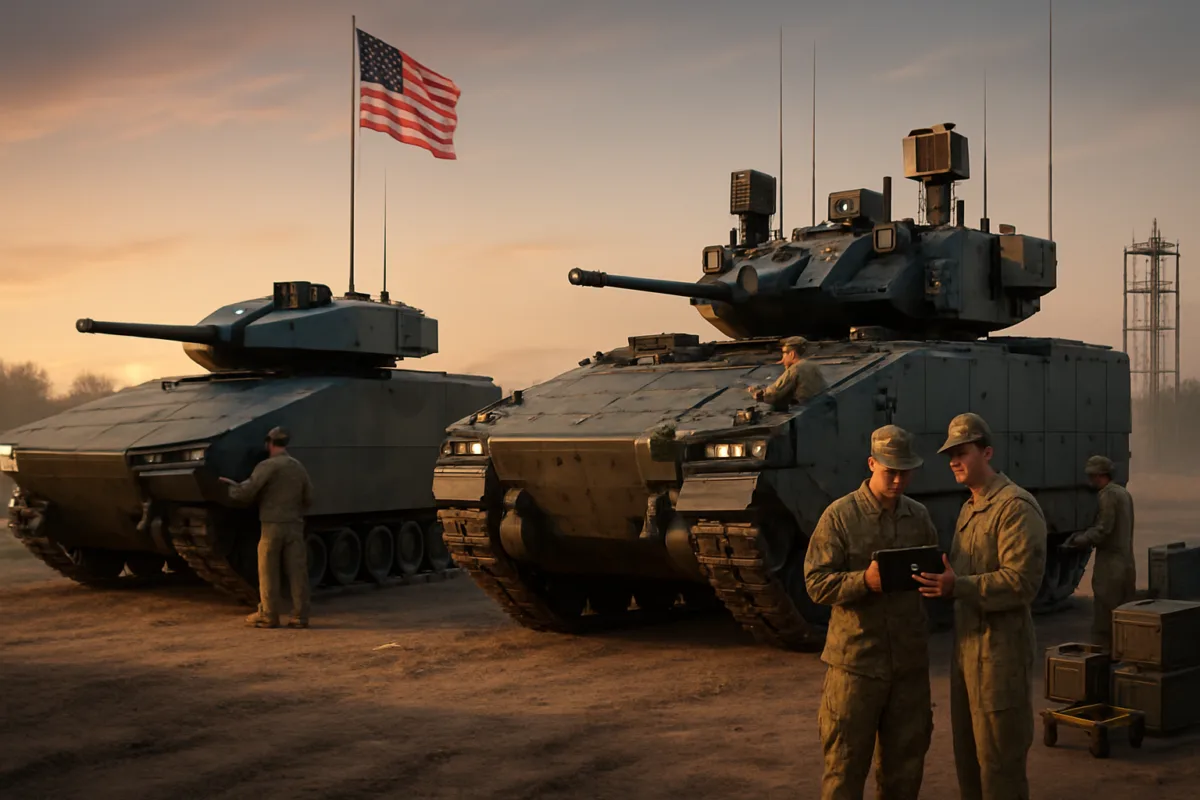
The arrival of prototype replacements marks a pivotal moment for anyone tracking the M2 Bradley and the future of American infantry fighting vehicles. The Bradley Fighting Vehicle replacement debate has long been mired in programmatic overreach, shifting requirements, and procurement missteps, but the recent deliveries of the Lynx XM30 and Wolf XM30 prototypes to the US Army force a necessary re-evaluation of assumptions about speed, capability, and risk.
Why the Bradley Fighting Vehicle replacement matters now
First, the stakes are higher than they were when the Bradley was designed. Modern battlefields are saturated with drones, loitering munitions, and electronic warfare threats that a 1980s-era design could never have anticipated. Consequently, replacing the M2 Bradley is not merely an exercise in modernization; it is a strategic necessity to keep armored infantry relevant.
Second, the procurement history of Bradley replacements shows that rushed programs or ill-defined requirements produce costly failures. Therefore, the current prototype phase—if managed correctly—can provide both rapid learning and measurable risk reduction before full-rate production.
What the Lynx XM30 and Wolf XM30 actually bring to the table
American Rheinmetall’s Lynx XM30 and General Dynamics Land Systems’ Wolf XM30 are not incremental upgrades. They represent a generational shift toward optionally manned platforms, modular open systems, and sensors-first design. These traits are essential to counter modern threats and to enable future upgrades without wholesale platform replacement.
For example, the Lynx XM30’s hybrid-electric powertrain and unmanned turret with a 50mm cannon reflect a deliberate move toward greater onboard power generation and reduced acoustic signature. Similarly, the Wolf XM30’s born-digital architecture and modular open systems approach (MOSA) promise faster software updates and hardware swaps in theater.
Counter-drone and active protection capabilities
Both prototypes emphasize anti-drone capabilities, fusing radar, electro-optical sensors, laser warning receivers, and active protection systems (APS). Given the proliferation of small drones and loitering munitions, prioritizing detection, classification, and defeat mechanisms is not optional—it is a mission imperative.
Consequently, the Army’s evaluation should prioritize sensor fusion, latency from detection to interception, and the ability to operate in contested electromagnetic environments. These are the metrics that will determine survivability in peer and near-peer conflicts.
Why past delays may actually be beneficial
At first blush, repeated delays in replacing the Bradley seem like bureaucratic failure. But on closer inspection, those delays have allowed the defense industry to mature critical technologies: AI-enabled target recognition, unmanned teaming, hybrid powertrains, and robust APS solutions. These capabilities simply were not mature a decade ago.
As a result, a hurried acquisition a decade earlier could have locked the Army into platforms unsuited to future fight dynamics. By contrast, the current competition yields platforms designed specifically to counter drones, loitering munitions, and integrated multi-domain threats.
Procurement reform: what must change for the XM30 program to succeed
Procurement lessons learned should guide the XM30 phase. First, keep requirements stable and outcome-focused rather than fetishizing specific technologies. Second, structure contracts that incentivize rapid iterative testing and software updates, especially under MOSA frameworks.
Third, maintain competition through low-rate initial production and parallel engineering and manufacturing development. Competition not only drives innovation but also serves as insurance against single-vendor failures or systemic supply-chain disruptions.
Implementing rigorous soldier-centered testing
Testing must be soldier-centric. That means deploying prototypes into realistic unit training exercises and not limiting trials to controlled test ranges. The Army’s Transformation in Contact (TiC) initiatives that place advanced systems into operational units are a step in the right direction.
Furthermore, transitional deployment—including live-fire maneuvers, urban operations, and contested-EMS scenarios—will reveal integration challenges that lab testing cannot. Soldiers’ feedback should directly inform software and hardware iterations.
Balancing ambitious technology with logistical realism
There is a tension between packing the XM30 with cutting-edge systems and ensuring maintainability in austere conditions. Modular design helps reconcile these demands, but realistic limits must be acknowledged. Too much complexity can undermine readiness if sustainment and repair chains are not resourced accordingly.
Therefore, the Army must certify not only combat performance but also sustainment models. Spare parts inventories, training pipelines for maintainers, and digital diagnostics all should be evaluated before committing to full-rate production.
Energy and mobility trade-offs
Hybrid-electric powertrains promise quieter movement, rapid power for directed-energy defenses, and improved fuel logistics. However, they introduce new vulnerabilities—thermal management, battery supply chains, and maintenance expertise.
Decision-makers should weigh these trade-offs methodically by testing hybrid systems across seasons and terrains. Only through operational exposure can commanders understand the true benefits and failure modes.
Why optional manning is a pragmatic choice
Optionally manned operation—allowing vehicles to operate with or without crew—provides tactical flexibility. It reduces soldier exposure during high-risk missions and enables unmanned scouting or overwatch roles. At the same time, the Army avoids committing entirely to driverless operations while doctrine and rules of engagement evolve.
Hence, the XM30 effort should integrate unmanned operations gradually and focus on autonomy that augments, rather than replaces, human decision-making in the loop.
Actionable priorities for Army leadership and industry partners
To turn prototypes into fielded capabilities, both the Army and industry must act decisively. First, maintain dual-track testing that evaluates lethality, survivability, and logistics concurrently. Second, enforce MOSA compliance to reduce costly interoperability bottlenecks later on.
Third, fund embedded cybersecurity testing to ensure the platforms can withstand sophisticated information warfare attacks. Lastly, prioritize training for sustainers and crew on the new digital toolchain to minimize downtime once platforms enter service.
What Congress and the DoD should monitor closely
Oversight bodies should insist on transparency in cost estimates, testing outcomes, and schedule baselines. Moreover, they should encourage low-rate production runs that produce spare parts and build a sustainment base without prematurely committing to full-rate production.
These steps mitigate programmatic risk and create a pathway for continuous improvement as battlefield requirements evolve.
What the competition between Lynx XM30 and Wolf XM30 teaches us
Competition fosters innovation but also clarifies trade-offs. Lynx’s focus on hybrid propulsion and a larger main gun suggests an emphasis on standoff lethality and onboard power generation. Wolf’s born-digital, MOSA-first approach highlights rapid upgradeability and software-defined capabilities.
Rather than declaring a single “winner” prematurely, the Army should retain both technological lessons and, where feasible, hybridize the best attributes of each design into the final selection or subsequent increments.
Transitioning from prototypes to operational squads
As prototypes move into unit exercises, transitional logistics, training, and doctrine must evolve in parallel. Platoons will need new tactics for drone deployments, counter-drone maneuvers, and optionally manned operations. Doctrine writers should shadow trials to translate lessons into tactics, techniques, and procedures swiftly.
Doing so will prevent capability gaps between the platforms delivered and the units employing them.
The delivery of the Lynx XM30 and Wolf XM30 prototypes represents more than a milestone; it is an opportunity to correct past procurement mistakes and deliver combat-relevant capability to infantry brigades. By emphasizing soldier-centric testing, MOSA-driven upgradeability, realistic sustainment planning, and measured adoption of autonomy and hybrid propulsion, the Army can turn these prototypes into resilient platforms built for future contested battlefields. Stakeholders on both sides of the aisle should focus on disciplined requirements, iterative competition, and logistical realism to ensure that the next-generation infantry fighting vehicle truly replaces the Bradley in capability, not just in name.

Dr. Morgan directed the Archives Program from 2014 to 2017, gaining extensive experience in research documentation, information management, and the preservation of scholarly resources. Throughout her career, she has worked closely with academic publications and research materials, developing expertise in evaluating scientific sources and communicating complex topics to broad audiences.
Her primary areas of specialization include scientific publishing, research communication, editorial review, and the translation of technical research into accessible educational content. She has contributed to projects involving space science, astronomy, environmental science, history, archaeology, and emerging scientific discoveries, always emphasizing accuracy, transparency, and the responsible presentation of evidence.
As Editorial Director of Muskurahat.us, Dr. Morgan leads the editorial review process for scientific articles, ensuring that content is based on reputable sources, peer-reviewed research whenever available, and publications from recognized universities, research institutions, and international scientific organizations.
She is committed to promoting scientific literacy through clear, engaging, and well-documented articles that help readers better understand scientific discoveries and their impact on society. Her editorial philosophy is founded on accuracy, intellectual integrity, independent journalism, and continuous learning as scientific knowledge evolves.
Through her work at Muskurahat.us, Dr. Morgan supports the publication of trustworthy scientific content that makes complex research accessible to readers around the world while maintaining rigorous editorial standards.