We flatter ourselves when we call fear weakness: the cultural shorthand that frames dread as an obstacle to ambition ignores what decades of neuroscience and one extreme clinical case make plain. Far from a mere nuisance, fear is a multifunctional signal woven into perception, memory and social understanding. The story of a woman known in the literature only as SM—whose rare Urbach-Wiethe disease calcified both amygdalae and virtually erased her capacity for fear—provides a compelling counterargument to the romantic idea that removing fear would be an unalloyed advantage.
The clinical oddity and its lessons
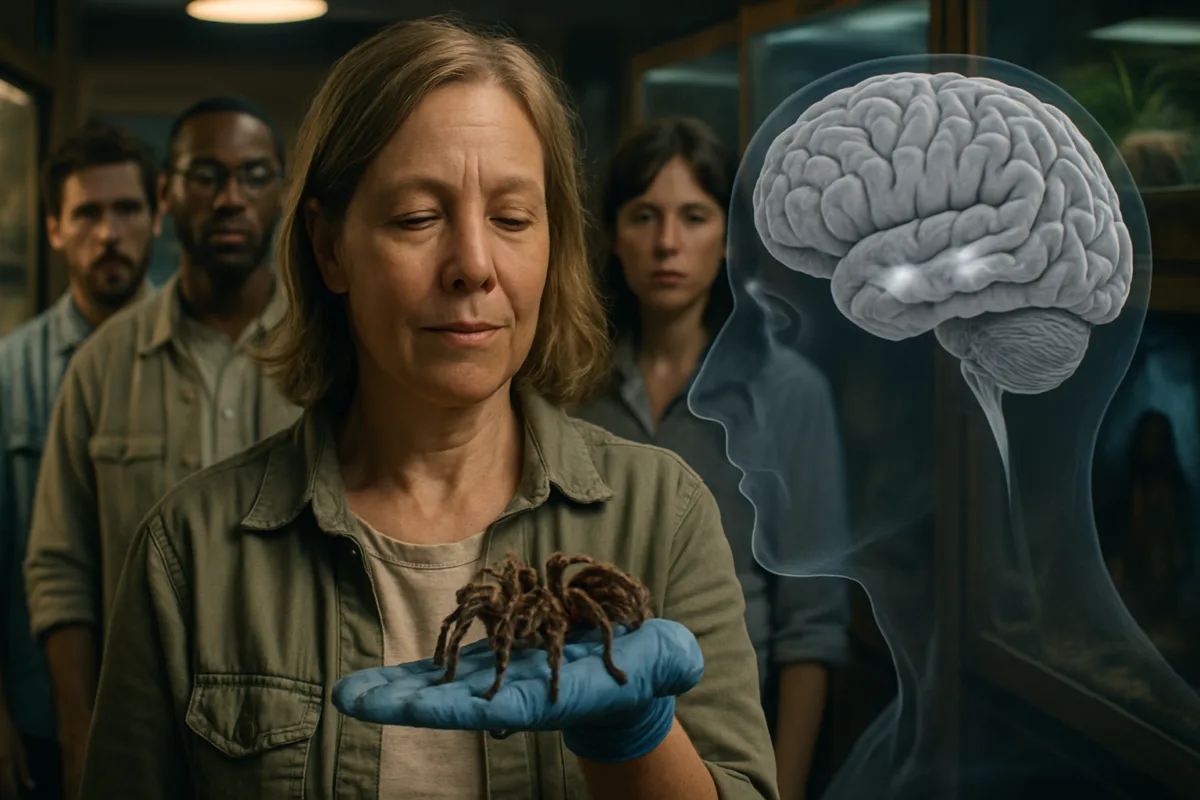
SM’s behavior reads like a thought experiment. In a 2011 Current Biology study led by Justin Feinstein and Daniel Tranel at the University of Iowa, with Ralph Adolphs and Antonio Damasio, she handled snakes calmly in an exotic pet shop and laughed her way through a haunted hospital attraction, leading strangers around and poking costumed actors. Her self-reported fear never rose above a two on a zero-to-ten scale. Yet the more prosaic record—police reports of repeated assaults, a near-fatal domestic attack, threats to her life—reveals a darker counterpoint: a person who frequently failed to perceive or respond to danger before it became immediate.
What the amygdala does, and what was lost
Urbach-Wiethe disease deposits calcium in soft tissues; in SM’s case the deposits concentrated in both amygdalae. The rest of her brain—hippocampus, cortex, insula and brainstem—tested normal, and she retained normal intelligence, language and most memory. The missing function was specific yet profound: the instinctive apprehension that normally recruits attention, heightens sensory processing and biases behavior away from harm. Her inability to draw an afraid face from memory in Ralph Adolphs’ 1995 Journal of Neuroscience work—she could draw joy, sadness and anger but not fear—captures the cognitive dimension of the deficit. Fear in SM wasn’t merely an absent emotion; it was a missing template for interpreting the world.
Fear as a protective engine, not theatrical flourish
The romantic notion of fearlessness imagines a life of fewer constraints and bolder choices. But SM’s case undermines that fantasy. The first argument against equating fearlessness with advantage is pragmatic: fear is a predictive signal. It biases attention to cues that correlate with harm, accelerating decisions such as fleeing, freezing or calling for help. SM’s history of being repeatedly threatened, beaten and nearly killed underscores the cost of lacking that early warning. She did not respond urgently while danger was unfolding; she often recognized its significance only after the fact. The supposed upside of unflappability—risk-taking freedom—appears in practice to be traded for a reduced ability to avoid peril.
Fear scaffolds imagination and social cognition
Beyond bodily safety, fear is cognitive infrastructure. The inability to reconstruct what a frightened face looks like suggests that fear shades our ability to simulate other minds, to imagine consequences and to anticipate scenarios we have not yet directly experienced. This is not an abstract claim. In social environments fear signals danger and solicits help; it communicates urgency. If you cannot imagine your own fear, you may also be less likely to recognize it in others or to take preemptive social steps that avert harm. SM’s amused curiosity—asking to handle larger snakes repeatedly—looked like brave eccentricity until you consider it as impaired simulation, not a virtue.
The amygdala’s twin role: alarm and governor
SM’s paradoxical response to respiratory distress complicates the story further. In a 2013 paper in Nature Neuroscience, Feinstein, Wemmie and colleagues found that inhaling a single breath of 35% carbon dioxide produced a rapid, intense panic in SM—the first genuine fear she had experienced since childhood. Two other patients with similar lesions (identical twins) also panicked, and in later work by Sahib Khalsa and Feinstein a peripheral adrenaline mimic (isoproterenol) provoked anxiety and panic in patients with amygdala damage. These results show a crucial point: the brain contains multiple alarm systems. CO2 activates acid-sensitive chemoreceptors and routing through the brainstem and insula, pathways intact in SM. In other words, the amygdala is not the sole seat of fear; other circuits can generate panic when they detect physiological threat.
But the pattern suggests something even more provocative. The patients with amygdala lesions were more likely to panic under these manipulations than healthy volunteers, hinting that an intact amygdala may normally restrain or contextualize panic-producing signals ascending from the body. Rather than being a simple on-switch for fear, the amygdala may also be a governor: amplifying learned, contextual signals while dampening raw physiological alarms that would otherwise flood awareness. If this tentative inference holds, it reshapes how we think about the amygdala’s function—from a single-purpose fear generator to a regulator balancing multiple inputs.
Why the ‘no fear’ hypothesis fails as a life hack
People often imagine eliminating fear as a shortcut to courage. SM’s life exposes why that is a fallacy. Courage is not absence of fear; it is action taken in the presence of fear, informed by prediction and calibrated risk assessment. Remove the predictive, anticipatory aspect of fear and you remove the engine that supplies the data courage requires. Moreover, the amygdala’s potential role in modulating panic cautions against simplistic interventions: bluntly suppressing amygdala activity to treat anxiety might leave patients vulnerable to overwhelming bodily alarms or impair social cognition.
Implications for treatment, law and ethics
The clinical insights from SM and similar patients carry urgent translational implications. In psychiatry, targeting specific circuits rather than globally damping emotional centers becomes a clearer goal. Treatments that blunt amygdala reactivity—whether pharmacological, neurosurgical, or via neuromodulation—must reckon with the amygdala’s contribution to both anticipatory fear and to the fine-tuning of panic thresholds. Conversely, understanding brainstem and insular pathways that mediate interoceptive alarms could open avenues for treating panic disorder that do not rely on suppressing cortical or limbic functions.
There are also legal and ethical ramifications. If certain lesions impair threat recognition, how should the law treat decisions made by someone with such deficits? SM’s history of repeated victimization raises questions about culpability and protection: a person who does not respond to danger in the way others expect may need safeguards rather than judgment. Similarly, research that manipulates fear circuits—either to reduce pathological anxiety or to enhance performance—must navigate the trade-offs between reduced aversion and potential loss of anticipatory capacity.
Research directions and responsible translation
Going forward, the work on SM compels neuroscience to map fear as a distributed computation. Studies should parse the amygdala’s internal circuitry to determine which subnuclei contribute to anticipatory versus panic-related functions, and they should chart how upstream body-state signals from chemoreceptors and other interoceptors are integrated across cortex and brainstem. Longitudinal studies of patients with selective lesions can reveal how behavior adapts, what social supports mitigate risk, and how compensatory learning might be harnessed therapeutically. Ethically, experimental manipulations must prioritize participants’ safety—SM’s initial curiosity with potentially dangerous animals illuminates how real-world risks can exceed laboratory predictions.
Finally, the narrative of SM reminds us to distrust caricatures. Neither hero nor superhero, she is a precise biological experiment for questions that matter: how do we predict harm, how do we imagine others’ states, and how do different brain systems collaborate or conflict to produce what we call fear? The results warn against simplistic promises that neuroscience can deliver fearless efficiency without cost.
It is tempting to celebrate the woman who smiles at spiders and strolls through haunted corridors as proof that fear is optional. But her life, and the experiments it enabled, argue for a more nuanced conclusion: fear is not merely a visceral reaction to be excised but a cognitive tool and social language that protects, informs and shapes imagination. Understanding the architecture of fear offers the real prospect of relieving pathological suffering while preserving the anticipatory and regulatory functions that make us resilient and socially attuned.

Dr. Morgan directed the Archives Program from 2014 to 2017, gaining extensive experience in research documentation, information management, and the preservation of scholarly resources. Throughout her career, she has worked closely with academic publications and research materials, developing expertise in evaluating scientific sources and communicating complex topics to broad audiences.
Her primary areas of specialization include scientific publishing, research communication, editorial review, and the translation of technical research into accessible educational content. She has contributed to projects involving space science, astronomy, environmental science, history, archaeology, and emerging scientific discoveries, always emphasizing accuracy, transparency, and the responsible presentation of evidence.
As Editorial Director of Muskurahat.us, Dr. Morgan leads the editorial review process for scientific articles, ensuring that content is based on reputable sources, peer-reviewed research whenever available, and publications from recognized universities, research institutions, and international scientific organizations.
She is committed to promoting scientific literacy through clear, engaging, and well-documented articles that help readers better understand scientific discoveries and their impact on society. Her editorial philosophy is founded on accuracy, intellectual integrity, independent journalism, and continuous learning as scientific knowledge evolves.
Through her work at Muskurahat.us, Dr. Morgan supports the publication of trustworthy scientific content that makes complex research accessible to readers around the world while maintaining rigorous editorial standards.