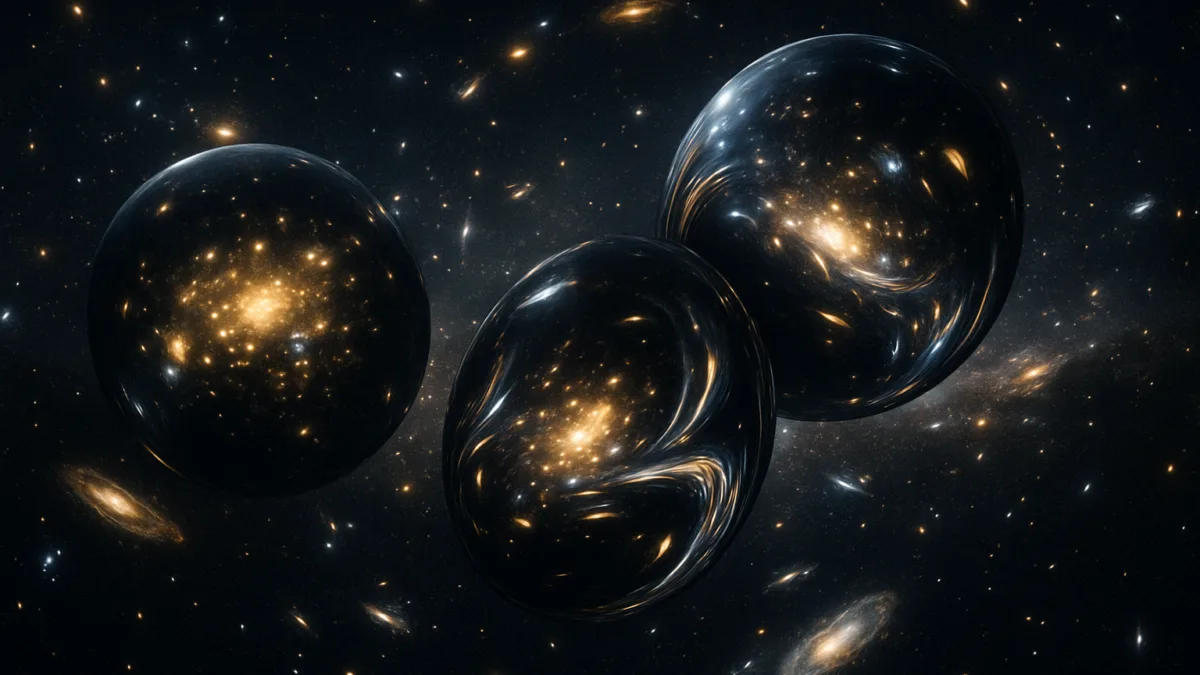
The European Space Agency showcases a striking example of gravitational lensing, illustrating how massive celestial bodies distort light from distant galaxies.
What Is the Cosmic House of Mirrors?
The European Space Agency (ESA) has introduced a fascinating celestial phenomenon known as the 'cosmic house of mirrors.' This term refers to the effect of gravitational lensing, where massive objects in space bend and magnify the light coming from galaxies that lie far behind them. This cosmic optical illusion allows scientists to observe distant and otherwise hidden regions of the universe.
Gravitational lensing occurs when a colossal celestial body, such as a galaxy cluster, exerts a strong gravitational field that warps the fabric of space-time. As a result, the light traveling from more distant galaxies is bent around the massive object, creating multiple distorted and magnified images, much like reflections in a house of mirrors.
How Gravitational Lensing Reveals Warped Galaxies
The ESA's recent revelation highlights how gravitational lensing makes it possible to study warped and distorted galaxies that would be difficult to observe directly. By analyzing the way light bends and magnifies, scientists can infer the presence and structure of galaxies that are billions of light-years away.
This phenomenon not only magnifies distant galaxies but also provides insights into the distribution of dark matter in galaxy clusters. Since dark matter does not emit light but contributes to gravitational fields, lensing effects help map its unseen influence on cosmic structures.
The 'cosmic house of mirrors' metaphor captures the complex and sometimes multiple images of the same galaxy created by light bending, which appear warped and replicated in a way that resembles reflections in a funhouse mirror.
Implications for Space Science and Observations
Understanding gravitational lensing advances our knowledge of the universe's structure and evolution. It allows astronomers to peer deeper into the cosmos, revealing galaxies from the early universe and providing clues about cosmic expansion and matter distribution.
The ESA's demonstration of this effect underscores the importance of space-based observatories and instruments capable of capturing such subtle phenomena. These observations are crucial for refining models of galaxy formation and the role of dark matter.
By studying these warped images, scientists can better understand how massive objects influence light and how the universe's large-scale structure is shaped, offering a clearer picture of the cosmos beyond what direct observation can achieve.
What to Expect Next and How to Follow Developments
As gravitational lensing continues to be a vital tool in astronomy, upcoming missions and observatories will further enhance our ability to observe distant galaxies and cosmic phenomena. The ESA and other space agencies are expected to expand their research, employing more advanced instruments designed to detect and analyze these lensing effects.
For readers interested in space science, following updates from the ESA and other scientific organizations offers a window into ongoing discoveries about the universe's hidden depths.
Staying informed about new findings in gravitational lensing can deepen appreciation for how the universe is observed and understood, highlighting the innovative techniques astronomers use to explore beyond the limits of traditional telescopes.
Fonti: express

Dr. Morgan directed the Archives Program from 2014 to 2017, gaining extensive experience in research documentation, information management, and the preservation of scholarly resources. Throughout her career, she has worked closely with academic publications and research materials, developing expertise in evaluating scientific sources and communicating complex topics to broad audiences.
Her primary areas of specialization include scientific publishing, research communication, editorial review, and the translation of technical research into accessible educational content. She has contributed to projects involving space science, astronomy, environmental science, history, archaeology, and emerging scientific discoveries, always emphasizing accuracy, transparency, and the responsible presentation of evidence.
As Editorial Director of Muskurahat.us, Dr. Morgan leads the editorial review process for scientific articles, ensuring that content is based on reputable sources, peer-reviewed research whenever available, and publications from recognized universities, research institutions, and international scientific organizations.
She is committed to promoting scientific literacy through clear, engaging, and well-documented articles that help readers better understand scientific discoveries and their impact on society. Her editorial philosophy is founded on accuracy, intellectual integrity, independent journalism, and continuous learning as scientific knowledge evolves.
Through her work at Muskurahat.us, Dr. Morgan supports the publication of trustworthy scientific content that makes complex research accessible to readers around the world while maintaining rigorous editorial standards.