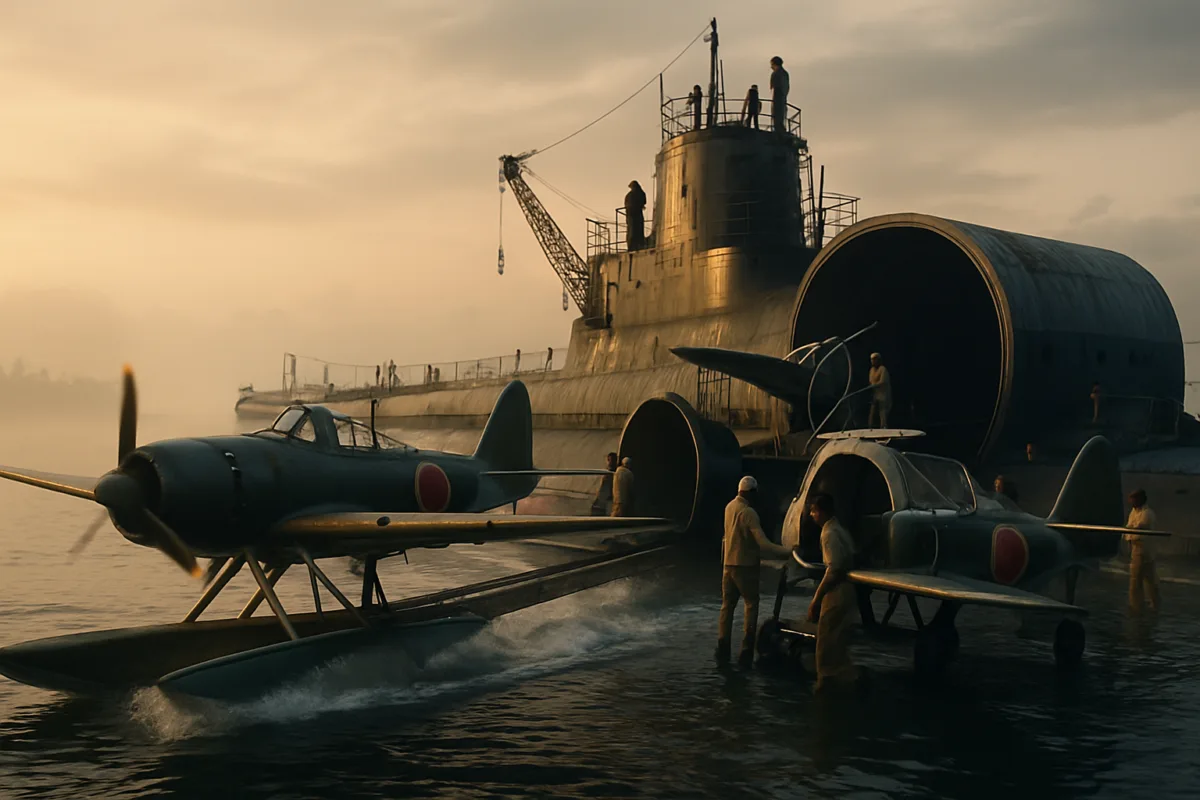
The image of a submarine breaking the surface and disgorging fully armed aircraft feels like the kind of cinematic extravagance you would expect from pulp fiction or a Bond film. Yet that image reflects a real technological experiment: navies in the early 20th century tested the idea of carrying airplanes aboard submarines to marry stealth with reach. The argument for submarine-borne aircraft was compelling—combine the submarine’s stealthy approach with the aircraft’s ability to scout or strike at a distance—but the historical record shows that the concept was less a strategic revolution than an ingenious, ultimately impractical sidestep. The story of Japan’s I-400 class crystallizes why the marriage of airplane and submarine was as fraught as it was fascinating.
A daring idea born of interwar imagination
After the First World War, naval strategists and naval engineers toyed with almost every permutation of force projection. It was natural that some thinkers asked whether submarines could be turned into mobile air bases. Early experiments were ingenious if clumsy: Germany and Britain trialed floatplanes carried on or above decks; these gave submarines some eyes beyond the horizon but exposed the aircraft to the elements and prevented the boat from diving. The 1920s brought a refinement—watertight hangars that stored disassembled seaplanes below or on deck, allowing the submarine to remain seaworthy and hidden until the moment of launch. Britain’s HMS M2, France’s Surcouf, and the United States’ S-1 project all embodied that compromise: a submarine that could surface, assemble or crane a small floatplane, and launch it by catapult.
The attraction was obvious. A submarine with organic air reconnaissance could spot convoys, shadow carriers, or lay eyes on enemy positions while remaining largely undetected. For nations with limited carrier fleets or long, exposed coastlines, the prospect of inexpensive, covert aerial reconnaissance or asymmetric strikes from the sea was alluring. In practice, however, the problems piled up faster than the benefits. These hybrid platforms tried to satisfy fundamentally conflicting design priorities: submarines must be streamlined and pressure-resistant; aircraft need space, maintenance facilities, and launch clearances. Making room for an airplane meant compromising the submarine’s hydrodynamics, speed, and diving characteristics. Worse, to use the aircraft effectively a sub had to surface for extended periods—precisely when it was most vulnerable to detection and attack.
Japan’s I-400 subclasses: ambition meets wartime desperation
If any navy pushed the idea to its extreme, it was Imperial Japan. Between the wars and during World War II, the Imperial Japanese Navy produced more than forty submarines designed or adapted to carry aircraft, culminating in the gargantuan I-400 class. These boats were not small reconnaissance platforms; they were conceived as undersea aircraft carriers capable of carrying three Aichi M6A Seiran floatplanes in a watertight hangar. At roughly 120 meters long and equipped with long-range capability and onboard petrol for aircraft, the I-400s were engineered to cross oceans and launch air raids far from Japanese bases—think of them as a surprising hybrid between a strategic missile platform and a maritime special-operations tool.
That ambition translated into audacity in plans as well as design. Japanese planners toyed with spectacular strategic ideas: strikes against the U.S. mainland, incendiary attacks on North American forests, and sabotage of critical choke points like the Panama Canal. The latter plan is as telling as it is theatrical. Damaging or closing the Panama Canal would have forced U.S. naval assets to reroute or delay transit, complicating American logistics across the Pacific. The I-400s were prepared for such missions in 1945, but operational reality—Japan’s shrinking territorial control, loss of air and surface superiority, and the overall collapse of logistical support—meant the submarines never carried out the grand strategic raids their designers envisaged.
Notable wartime operations and limitations
Japan did use submarine-borne aircraft operationally in more modest ways. The E14Y “Glen” floatplane launched from I-7 surveyed the damage at Pearl Harbor after the December 1941 attack, and I-25’s launched plane dropped incendiary bombs over Oregon in 1942—the first enemy aerial bombing of the continental United States. These raids were tactically clever and symbolically potent, but their material effects were negligible. They underscore a crucial reality: these aircraft extended the submarine’s reach, but they could not match the payload, endurance, or flexibility of carrier-based or land-based aviation. By 1944–45, as the Pacific war swung decisively against Japan, the resources required to maintain and operate these exotic boats were a luxury Japan could no longer afford.
The technical contradictions that sank the concept
Arguing that submarine-carriers were doomed is not mere hindsight bias; the engineering trade-offs were stark and unavoidable. First, space is the enemy of submarines. Keeping buoyancy, pressure hull integrity, fuel, torpedoes, and crew habitability requires tight spatial economy. A hangar and catapult demand significant volume and add weight above the centerline, worsening stability and hydrodynamics. Second, aircraft maintenance is a messy, time-consuming affair. Salt, humidity, and confined spaces strain even rugged floatplanes. Launch windows were weather-dependent; an aircraft could not take off in high seas, and recovery often required delicate seamanship. Third, and perhaps most damning, is the time and exposure required to assemble and launch the aircraft. Surfacing for long enough to ready and catapult a plane handed the enemy plenty of opportunities to detect and attack the submarine. In an era of increasingly potent maritime patrol aircraft and radar, that vulnerability was fatal to the concept’s viability as a frontline weapon.
Strategic mismatch and opportunity cost
Beyond engineering headaches, there was a strategic calculus. Navies invest in platforms that unlock predictable, scalable capabilities: carriers project sustained air power; submarines deliver torpedoes and missiles stealthily. The hybridization of these roles diluted both. Building and operating an I-400 consumed steel, skilled labor, fuel, and time that might otherwise have gone to more conventional submarines, aircraft, or surface ships. In the limited industrial economies of wartime, that trade-off matters. The I-400s arrived too late and in too few numbers to alter the strategic trajectory of the war. Their very novelty turned them into niche assets rather than force multipliers.
Why modern navies abandoned the submarine-aircraft marriage—and what they adopted instead
After World War II, no major navy persisted with the manned aircraft-carrying submarine idea, and the reasons are clear. Technological advances eliminated the need for such architectural contortions. Long-range land-based aviation, aircraft carriers, aerial refueling, reconnaissance satellites, and maritime patrol aircraft gave navies far more reliable and scalable ways to gather intelligence and project power. At the same time, submarine design took a different path: quiet nuclear-powered attack and ballistic missile submarines prioritized endurance, stealth, and missile standoff strike—attributes that are mutually exclusive with the needs of a flight deck and hangar.
Yet the conceptual impulse—the desire to combine stealth with extended reach—hasn’t disappeared; it’s simply been realized differently. Today’s navies are exploring unmanned systems that can be launched from submarines, dry-deck shelters that deploy swimmer delivery vehicles, and underwater launch systems for cruise missiles and loitering munitions. These approaches capture the strategic advantage of covert deployment without the crippling compromises of a manned aircraft hangar. A compact UAV designed for undersea storage and quick deployment requires far less internal volume than a manned floatplane, endures fewer environmental burdens, and does not require long surface intervals. In short, modern technology solves many—but not all—of the old problems.
Can future technology revive the submarine-borne aircraft?
Technically, yes: folding-wing UAVs, underwater launch capsules, and advanced materials could make a functional submarine-launched aerial capability feasible. But feasibility is not the same as strategic sense. The core weaknesses that sank the I-400—exposure during launch, heavy maintenance burdens, and opportunity costs—remain relevant. If a navy can place a sensor or a strike asset where it needs to be using less risky, cheaper platforms, it typically will. Nonetheless, the experiment of the submarine-carrier lives on as an instructive example of how innovative thinking can run headfirst into operational realities.
A maritime oddity with a lasting legacy
The saga of airplane-carrying submarines is more than a historical curiosity. It is a study in technological ambition, strategic imagination, and the constraints that link the two. Japan’s I-400s were marvels of naval engineering for their time—larger, more ambitious, and more provocative than anything their contemporaries had produced. They tell us something important about wartime decision-making: when strategy becomes desperate or aspirational, designers can produce spectacular answers, but spectacular answers still need to be useful to matter. The I-400s were useful in that they showcased a navy willing to defy convention and push engineering to new limits, but they were not useful enough to change the outcome of a global conflict.
Evaluating the idea today requires separating romance from utility. The image of a submarine surfacing to launch aircraft is irresistible precisely because it fuses two symbols of military power: stealth and air supremacy. Yet the historical and technical lessons are clear—hybrids often inherit the weaknesses of both parents. Instead of resurrecting the specific model of the I-400, modern military thinking channels the same strategic goal—stealthy, covert deployment of sensors and strikes—through approaches that respect the underlying physics and economics of naval warfare. That pragmatic take does not diminish the audacity of the past; it simply recognizes that innovation is most valuable when it combines cunning with practicality, not spectacle with fragility.

Dr. Morgan directed the Archives Program from 2014 to 2017, gaining extensive experience in research documentation, information management, and the preservation of scholarly resources. Throughout her career, she has worked closely with academic publications and research materials, developing expertise in evaluating scientific sources and communicating complex topics to broad audiences.
Her primary areas of specialization include scientific publishing, research communication, editorial review, and the translation of technical research into accessible educational content. She has contributed to projects involving space science, astronomy, environmental science, history, archaeology, and emerging scientific discoveries, always emphasizing accuracy, transparency, and the responsible presentation of evidence.
As Editorial Director of Muskurahat.us, Dr. Morgan leads the editorial review process for scientific articles, ensuring that content is based on reputable sources, peer-reviewed research whenever available, and publications from recognized universities, research institutions, and international scientific organizations.
She is committed to promoting scientific literacy through clear, engaging, and well-documented articles that help readers better understand scientific discoveries and their impact on society. Her editorial philosophy is founded on accuracy, intellectual integrity, independent journalism, and continuous learning as scientific knowledge evolves.
Through her work at Muskurahat.us, Dr. Morgan supports the publication of trustworthy scientific content that makes complex research accessible to readers around the world while maintaining rigorous editorial standards.