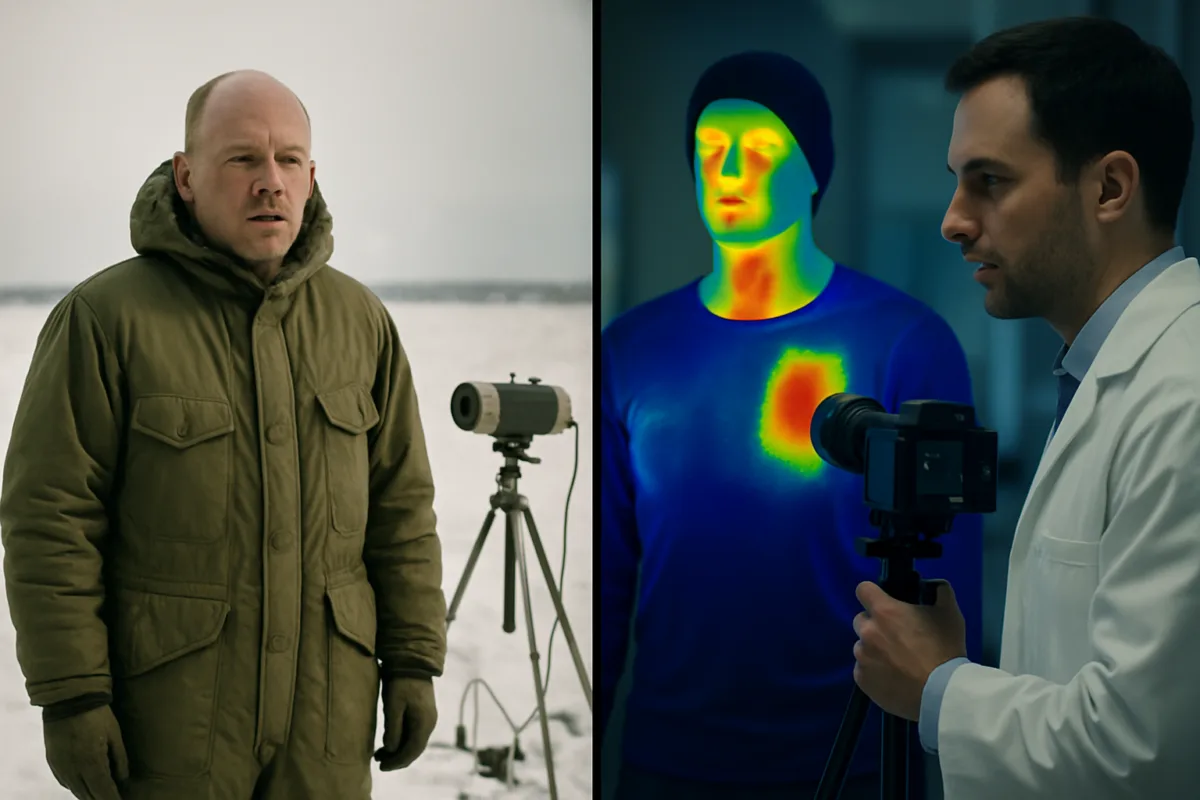
For decades many people have believed a startling-sounding claim: most of your body heat escapes through your head. It is a tidy rule of thumb that appears on hat tags, in scouting manuals and in parental warnings — and it is wrong. Understanding where that idea came from, what the data actually show, and what practical steps to take in cold weather helps separate useful guidance from misleading shorthand.
How a flawed experiment became a lasting belief
The story begins not with a biological peculiarity, but with a specific experimental setup and a translation error from context to general law. In the 1950s, researchers studying cold exposure ran tests in which volunteers were bundled into arctic survival suits that insulated the body from the neck down while leaving the head bare. Predictably, the exposed head gave off the largest share of heat in that setup — it was the only major patch of uncovered skin.
The 1950s survival-suit test and the misplaced conclusion
Under the conditions of that experiment the head lost the greatest amount of heat, but only because everything else was nearly sealed. When the result moved out of the laboratory and into training manuals, the crucial context often disappeared. A US Army survival manual repeated a concrete-sounding number — that 40 to 45 percent of body heat is lost through the head — treating the experiment’s conditional result as a universal physiological truth. Over time, the specific circumstances that produced that figure were forgotten and the number hardened into folk wisdom.
How an authoritative source amplified a myth
Authoritative documents carry weight. When a manual intended to help service members survive cold environments makes a claim, people tend to accept it. That acceptance can persist even when later scientists or physicians point out an error. The physicians Rachel C. Vreeman and Aaron E. Carroll revisited this claim in a 2008 paper for the British Medical Journal, showing that the dramatic figure had little basis outside the original, highly specific experimental conditions.
What the science actually says about head heat loss
Heat loss from the human body is governed by surface area, insulation and environmental conditions such as air temperature, wind speed and moisture. Skin is where the body exchanges heat with its surroundings; different parts of the body contribute roughly in proportion to how much exposed surface they represent. The head accounts for a modest fraction of total body surface area — roughly 7 percent on average — and multiple studies suggest heat loss from the head is roughly in line with that proportion.
Measured figures: roughly a tenth, not forty percent
Rather than an overwhelming 40–45 percent, measured estimates for heat loss through the head fall in the neighborhood of 7–10 percent of total body heat loss — close to the head’s surface-area share. In 2006, researchers at the University of Manitoba led by Thea Pretorius ran controlled cold-water immersion tests in which men were either insulated or uninsulated and their heads were kept above or below the water. Results showed head heat loss scaled with exposed surface area, reinforcing the simple surface-area logic rather than suggesting a unique property of the head.
Why physics favors the surface-area view
Heat transfer by convection and radiation depends on exposed area and temperature gradients. Unless an experiment artificially isolates or insulates significant portions of the body, no single part will be a disproportionately dominant pathway for heat loss. The head’s prominence on the body and its role in circulation or brain protection do not grant it special emissivity; it simply behaves like another patch of skin when it is uncovered.
Why this myth is sticky
Several social and cognitive factors explain why a demonstrably inaccurate claim can endure. First, simple rules are memorable. Saying “you lose most of your heat through your head” is concise and actionable. Second, institutional endorsement — the presence of the claim in military manuals or safety literature — gives the statement a perceived authority that resists casual correction. Third, claims learned in childhood become part of habitual reasoning: once people are taught to prioritize hats, they often continue to do so without revisiting the underlying evidence.
How evolution of a message matters more than accuracy
Information that helps people take protective action is often preserved and transmitted regardless of its technical accuracy. The hat guidance derives from a sensible place: covering exposed skin reduces heat loss. But reducing that guidance to a quantitative and universal claim about the head created an appealing narrative that outlived its empirical basis.
Practical implications: hats help, but not for mysterious reasons
Rejecting the myth does not mean a hat is useless. On the contrary: in real cold, any uncovered skin is a path for heat loss and covering the head reduces that loss just as covering the legs or torso would. The practical question is how to prioritize clothing choices and understand what keeps you warm in different environments.
When a hat really matters
In windy, wet or extremely cold conditions a hat helps because it reduces exposed skin area and traps a layer of warm air near the scalp, improving insulation. If you are sedentary in a cold environment, or if moisture is present (sweat or rain), the insulating value of a hat increases. In such scenarios the head can contribute a noticeable fraction of heat loss simply because it is one of the exposed regions.
Other measures are equally or more important
Layering clothing, keeping the torso insulated, protecting extremities, and managing moisture are all critical. The core (chest and abdomen) houses major organs and benefits strongly from insulation; losing core heat has more immediate physiological consequences. Warm, dry clothing, windproof outer layers and well-insulated footwear and gloves frequently make a larger difference to comfort and safety than focusing solely on head coverings.
Cold-water immersion and head exposure
Cold-water scenarios deserve special mention. In water, heat loss accelerates dramatically because water conducts heat away from the body far faster than air. In immersion tests, keeping the head above water reduces total heat loss compared with full immersion, but that reduction again reflects exposed surface area and the physics of conduction rather than a unique head-centric mechanism. Wearing a neoprene hood or other head protection in cold-water activities can be life-preserving.
How to evaluate similar health and safety claims
Myths of this sort often follow a pattern: a limited or conditional study yields a striking result, that result is generalized beyond its original scope, and the generalization is picked up by authority figures and transmitted widely. When you encounter a clear-sounding claim about the body or safety, a few simple checks can help you judge its reliability.
Questions to ask
Who performed the original test, and under what conditions? Does the claim depend on very specific circumstances that might not apply generally? Are there controlled studies or meta-analyses that confirm the finding? Is the claim being used to justify a practical recommendation that would still be sensible even if the numerical claim were false? Answers to these questions reveal whether a claim is robust or an overgeneralized artifact.
A simple physics check
Many claims about heat, cold and insulation can be approximated with basic physics reasoning: surface area, thermal conductivity, and the presence of insulating layers are often the main variables. If a claim posits a disproportionate effect for a single body part, test whether the assertion survives when you account for exposed area and the specific environmental context.
Believing that hats are useful in cold weather is sensible; believing that most of your heat always escapes through your head is not. When we examine the evidence closely, the head behaves like any other patch of exposed skin: it loses heat proportional to its area and the environmental conditions surrounding it. The myth began with a particular experimental setup and hardened into a generalization when context dropped away. Keeping that history in mind helps us adopt practical, physics-informed habits in cold weather — wear a hat when it makes sense, but also prioritize core insulation, windproofing and moisture management to stay safe and comfortable.

Dr. Morgan directed the Archives Program from 2014 to 2017, gaining extensive experience in research documentation, information management, and the preservation of scholarly resources. Throughout her career, she has worked closely with academic publications and research materials, developing expertise in evaluating scientific sources and communicating complex topics to broad audiences.
Her primary areas of specialization include scientific publishing, research communication, editorial review, and the translation of technical research into accessible educational content. She has contributed to projects involving space science, astronomy, environmental science, history, archaeology, and emerging scientific discoveries, always emphasizing accuracy, transparency, and the responsible presentation of evidence.
As Editorial Director of Muskurahat.us, Dr. Morgan leads the editorial review process for scientific articles, ensuring that content is based on reputable sources, peer-reviewed research whenever available, and publications from recognized universities, research institutions, and international scientific organizations.
She is committed to promoting scientific literacy through clear, engaging, and well-documented articles that help readers better understand scientific discoveries and their impact on society. Her editorial philosophy is founded on accuracy, intellectual integrity, independent journalism, and continuous learning as scientific knowledge evolves.
Through her work at Muskurahat.us, Dr. Morgan supports the publication of trustworthy scientific content that makes complex research accessible to readers around the world while maintaining rigorous editorial standards.