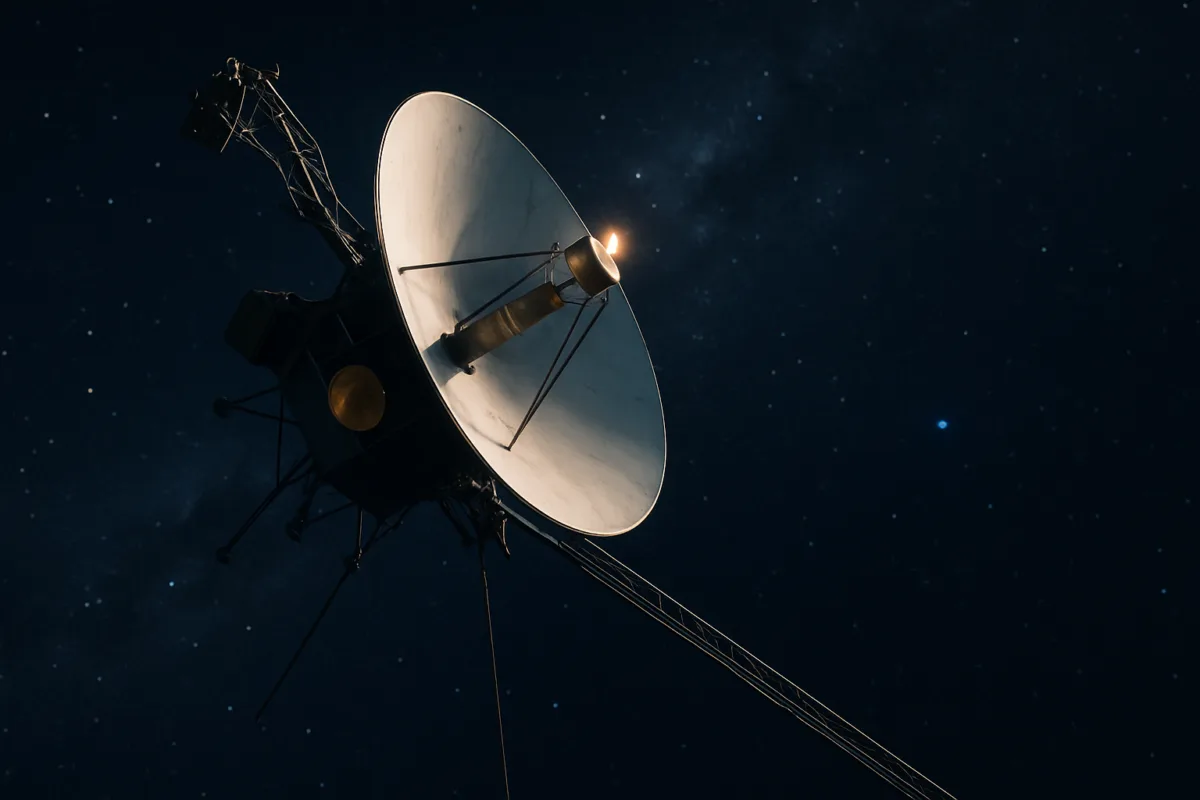
On 18 November 2026, at 2:16:07 a.m. Pacific Standard Time, Voyager 1 will reach a distance from Earth that is both simple and profound: one light-day. NASA has calculated this moment down to the second and the mile, placing a machine launched in 1977 on a human calendar of remoteness. That timestamp is more than a curiosity. It is a way to translate an almost incomprehensible span of space into the language of everyday experience, by using the single constant that links distance and communication speed: light.
Why the one-light-day milestone matters
Distances in space are often expressed in astronomical units, light-years, or kilometers. Those measures are scientifically useful but can feel abstract. The one-light-day milestone reframes distance as time. At that point a command issued from Earth will take exactly 24 hours to reach Voyager 1, and a reply, if the probe sends one immediately, will take another 24 hours to return. That two-day round trip is not a metaphor. It becomes an operational reality that changes how engineers, scientists, and the public imagine interaction with a remote spacecraft.
From human tempo to cosmic lag
Human activities depend on rapid feedback. Conversations, remote sensing, and even many robotic operations assume that the delay for a signal is measured in milliseconds or seconds. Move to distances like one light-day, and the tempo of interaction shifts. Decisions must be preplanned weeks or months in advance, autonomy becomes essential, and any check against unexpected behavior is delayed by a full day. The significance lies not in a physical barrier but in the transformation of communication into a form of correspondence across days.
How NASA calculated a second and a mile
Arriving at 2:16:07 a.m. PST on 18 November 2026 is the result of decades of tracking, refined navigation models, and precise ephemerides for both Earth and Voyager 1. NASA uses radio tracking via the Deep Space Network, doppler measurements, and trajectory models that account for the gravitational influences of planets, the Sun, and interstellar medium effects. Over nearly five decades, those datasets have been continually updated, which allows mission teams to predict positions far into the future with remarkable precision.
The role of ephemerides and the Deep Space Network
Ephemerides are tables or models that describe the positions of astronomical objects over time. For Voyager 1, the spacecraft’s trajectory is continually fit to tracking data and propagated forward using numerical integrators. The Deep Space Network provides the constant listening ears that supply the raw measurements. Although Voyager 1 carries no GPS and receives no real-time guidance, the combination of consistent tracking and robust physics yields a timestamp that reads like a calendar event rather than an uncontrolled guess.
Voyager 1: a 1977 spacecraft in a 2026 context
Voyager 1 was designed for a grand tour of the outer planets. Launched on 5 September 1977, it visited Jupiter in 1979 and Saturn in 1980, revealing new moons, complex ring dynamics, and atmospheric phenomena that reshaped planetary science. The mission would have been a triumph if its accomplishments had ended there. Instead Voyager 1 kept flying, eventually crossing the heliopause in 2012, an achievement that marked its entry into interstellar space in terms of local plasma environment. That it will become one light-day away is a separate milestone, one that measures the widening gap between Earth and a solitary, aging probe.
Outliving its mission
Originally built for a planetary tour measured in years, Voyager 1 has survived in an operational sense for decades. Engineers have made incremental sacrifices to keep its essential instruments running as the radioisotope thermoelectric generator provides ever less power. Systems have been turned off, heaters dimmed, and operations reimagined to squeeze more life from hardware conceived before personal computers were common. The result is a living example of engineering thrift and determination: a probe whose existence is a continuous negotiation between power budgets, scientific value, and the limits imposed by distance.
Distance turned into time: the communications reality
At ordinary scales, light travel time is invisible. A call across town, a video chat, or a command to a low-Earth orbit satellite feels instantaneous. Even the Moon, at about 1.3 seconds one way, does not force us into a new category of interaction. But once the travel time stretches to hours or days, so do expectations. One light-day turns the act of commanding a spacecraft into a commitment. Each instruction must be deliberate, and each data return will be a delayed message from a past state of the craft.
Operational impacts for ground teams
Teams operating distant spacecraft must plan for asynchronous feedback loops. Contingency procedures must be automated or preapproved, routine maintenance must be predictive, and the tolerance for surprises is low. For Voyager 1, most instruments are already off, and the mission depends on a few remaining science packages and the radio link. That radio link is not just telemetry; it is the lifeline of a mission whose voice is measured in days.
The quiet engineering feat behind the number
Consider what Voyager 1 has endured: launch stresses, radiation belts near Jupiter, the corrosive effects of long-term exposure to particle fluxes, mechanical degradation, and a power source that steadily declines. The Deep Space Network, too, has adapted. Antennas and receivers have been upgraded over the decades to track ever weaker signals from the probe. The cumulative effect is a partnership between an aging machine and an evolving ground infrastructure that keeps an interstellar whisper audible across billions of miles.
Power, heaters, and the art of thrift
Radioisotope thermoelectric generators lose output as the plutonium decays and thermocouples degrade. Mission managers face trade-offs: which instruments yield the most science per watt, and which systems must be sacrificed to keep the spacecraft communicating. Turning off heaters risks colder temperatures that can shorten component lifetimes, while keeping them on drains the same precious power that scientific instruments need. Each decision is irreversible in the short term and shapes what will be heard when the next light-day-delayed reply comes back.
Perspective: what a single day of light asks us to imagine
The human mind struggles with scales outside everyday experience. Saying Voyager 1 is 16,094,799,096 miles away is a fact, but it is abstract in a way that numbers often are. A day of light provides a different kind of bridge. Imagine a radio signal leaving Earth, passing the Moon in just over a second, slipping past Mars in minutes, crossing the outer planets in hours, and still requiring a full day to cover the remaining distance. That narrative compresses cosmic geometry into a temporal path that is easier to visualize and emotionally grasp.
From political borders to cosmic calendars
Human milestones often rest on borders and dates: a launch pad, a landing, a cataloged achievement. The one-light-day mark is neither a border nor a discovery. It is a calendared property of light. That makes it a poetic element of human engineering: a way of saying not only how far Voyager 1 is, but how long it takes for our words to reach it. It is a reminder that some accomplishments are measured as much by patience and maintenance as by initial ingenuity.
What remains after the instruments
Even if Voyager 1 ceases to return scientific data someday, it will still travel through the galaxy as a human artifact. Its golden record, engraved with sounds and images from Earth, will persist long after telemetry stops. The one-light-day milestone is an operational measure and also a cultural one. It is an emblem of continuity, showing that something launched in the 1970s continues to be part of our story and our conversation with the cosmos.
When the clock on 18 November 2026 ticks past 2:16:07 a.m. PST, nothing dramatic will happen on the probe, but on Earth we will have an exact moment to mark a vast distance. That marked time offers a way to return our attention to the technical discipline, emotional patience, and scientific curiosity required to carry human artifacts into deep space. The date is a small ritual of recognition for engineers past and present, for the Deep Space Network operators who still listen, and for anyone who has ever felt wonder at the idea that a machine built in another era can still be counted on a human calendar

Dr. Morgan directed the Archives Program from 2014 to 2017, gaining extensive experience in research documentation, information management, and the preservation of scholarly resources. Throughout her career, she has worked closely with academic publications and research materials, developing expertise in evaluating scientific sources and communicating complex topics to broad audiences.
Her primary areas of specialization include scientific publishing, research communication, editorial review, and the translation of technical research into accessible educational content. She has contributed to projects involving space science, astronomy, environmental science, history, archaeology, and emerging scientific discoveries, always emphasizing accuracy, transparency, and the responsible presentation of evidence.
As Editorial Director of Muskurahat.us, Dr. Morgan leads the editorial review process for scientific articles, ensuring that content is based on reputable sources, peer-reviewed research whenever available, and publications from recognized universities, research institutions, and international scientific organizations.
She is committed to promoting scientific literacy through clear, engaging, and well-documented articles that help readers better understand scientific discoveries and their impact on society. Her editorial philosophy is founded on accuracy, intellectual integrity, independent journalism, and continuous learning as scientific knowledge evolves.
Through her work at Muskurahat.us, Dr. Morgan supports the publication of trustworthy scientific content that makes complex research accessible to readers around the world while maintaining rigorous editorial standards.