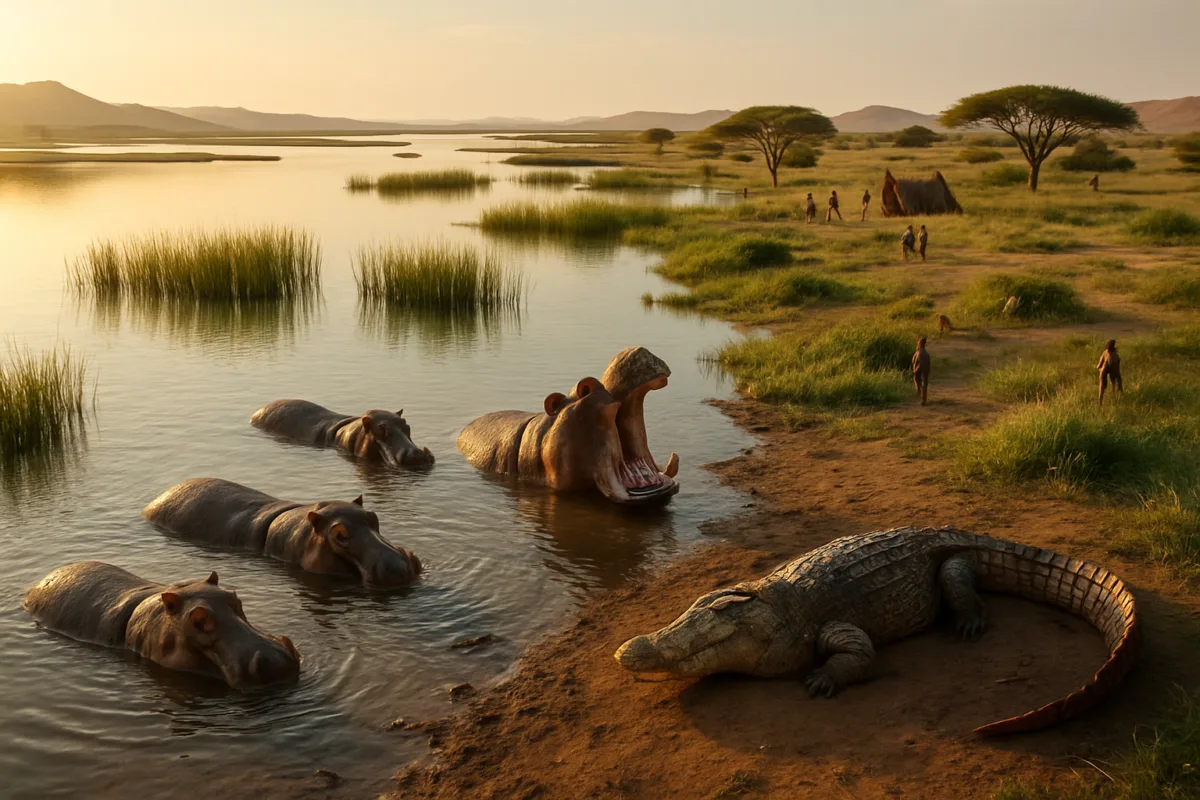
The Sahara we picture today—endless dunes, sun-bleached rock and relentless aridity—was not always a permanent fixture. Geological and archaeological records show that roughly every 20,000 years large swathes of North Africa shifted into a much wetter state, a recurring phenomenon often called the Green Sahara or African Humid Period. Lakes and rivers returned to basins now smothered in sand, grasses and savanna spread across landscapes that are today mostly barren, and species such as hippopotamuses and crocodiles once populated waters where none exist now. Understanding how and why these transformations occur requires looking up to slow changes in Earth’s orbit, and down to the feedbacks between land, vegetation, dust and water that amplify or mute those astronomical nudges.
Orbital mechanics as the metronome of climate
At the heart of the Green Sahara story is axial precession: a slow wobble in Earth’s orientation that alters the timing of the seasons relative to Earth’s position on its elliptical orbit. This cycle, combined with variations in orbital eccentricity, changes how much summer sunlight reaches the Northern Hemisphere on millennial timescales. When precession aligns Northern Hemisphere summer with perihelion—Earth’s closest approach to the Sun—summer insolation increases, heating land surfaces in North Africa more intensely than the adjacent ocean. The resulting land-sea temperature contrast strengthens monsoonal circulation, allowing moist air to penetrate much farther north than it does today.
From nudges to landscapes: amplifying feedbacks
Orbital forcing alone does not instantly remake a continent. Instead, a suite of feedbacks determines the magnitude and persistence of monsoon expansion. Vegetation growth reduces surface albedo: greener surfaces absorb more sunlight and warm more, which helps maintain convective rainfall. Soils become moister and more capable of supporting plant roots. Lakes and wetlands add local evaporation and humidity, which further fertilizes rainfall. Conversely, when vegetation retreats and dust emissions increase, more sunlight is scattered or reflected, cooling surfaces and suppressing the monsoon—a reinforcing dry trend. These interacting processes convert a gentle orbital push into large-scale environmental rearrangement, or conversely, can blunt that push when conditions are unfavorable.
Ice sheets, oceans and the role of boundary conditions
Beyond vegetation and dust, the wider climate state matters. During glacial periods, large Northern Hemisphere ice sheets and colder oceans change atmospheric circulation patterns and reduce the sensitivity of the monsoon to precessional forcing. A favorable precessional phase might thus generate a strong Green Sahara during an interglacial but a weak or absent humid response during a glacial interval. Similarly, changes in Atlantic sea-surface temperatures, ocean circulation and atmospheric CO2 modulate how far monsoon rains advance. Studies using coupled climate models show that precession sets the rhythm, while eccentricity, ice volume and other boundary conditions set the amplitude and expression of each green episode.
What the physical records tell us about past wet phases
Multiple lines of evidence, from deep-sea sediment cores to terrestrial lake deposits and archaeological sites, converge on a picture of recurrent humid intervals across North Africa. Wind-blown mineral dust in marine sediments decreases during wet phases, while river-borne sediments increase. Plant wax molecules preserved in deep-sea cores carry isotopic signatures that record periods of enhanced rainfall. In the Mediterranean, layers called sapropels—organic-rich deposits—mark times when freshwater runoff from Africa altered ocean chemistry and circulation. Taken together, these records show not only the timing of humid phases but also that the Sahara’s sensitivity to orbital forcing has varied over millions of years.
Mosaics not monocultures: the landscape of the last humid interval
The most recent African Humid Period, broadly dated between about 14,500 and 5,000 years ago with its strongest Holocene expression roughly 11,700–5,000 years ago, produced a varied landscape rather than a continuous rainforest. Grasslands, wooded savanna, shrubs, marshes and open water coexisted regionally depending on local topography and hydrology. Large lake systems, such as Mega-Chad in the southern Sahara, expanded dramatically: at its Holocene height it covered hundreds of thousands of square kilometres, approaching the size of the Caspian Sea. Former river channels and paleoshorelines—visible from satellites or hidden beneath sediments—attest to substantial surface water networks that redistributed moisture across the region.
Biological evidence: hippos, crocodiles and human settlements
Archaeological discoveries provide concrete, sometimes startling proof of those wetter landscapes. Rock art across the Sahara depicts giraffes, elephants and other savanna animals, while excavated bones and sediments contain the remains of aquatic species where none are found today. At Gobero in Niger, archaeologists uncovered about 200 human burials alongside a former lake, with associated hippopotamus remains and abundant fish and turtle bones—evidence of a community thriving on aquatic resources. In southwestern Libya’s Takarkori shelter, researchers catalogued over 17,000 animal remains, finding early Holocene deposits dominated by fish and even crocodile scutes and cranial fragments. These assemblages record ecological change over centuries: as waters receded, fish and crocodiles became rarer and human groups shifted toward herding and other livelihoods.
Not just sand: understanding the modern Sahara’s substrata
Contrary to popular imagination, literal sand seas—ergs—cover only around a quarter of the Sahara. Much of the region is rocky plateaux, gravel plains, mountains and ancient lakebeds. Many of today’s dunes overlay paleolake sediments and shorelines, and some basins still preserve paleolake deposits that reveal past highstands. The termination of the African Humid Period was not a single synchronous collapse but a protracted, regionally variable transition spanning centuries to millennia. High-resolution records, such as a 2024 Ethiopian sequence, show a roughly thousand-year trend punctuated by shorter drought episodes, suggesting a complex withdrawal of moisture rather than an abrupt switch.
Human responses to environmental change
As water availability declined, people adjusted in diverse ways. Some groups migrated toward persistent water sources like the Nile Valley; others shifted from fishing and foraging to pastoralism or mixed farming. The archaeological record shows no single migration event but multiple localized adaptations: changing settlement patterns, new subsistence strategies and technological innovations that reflect an intimate response to shifting hydrology. These human histories are embedded in the sediments and bones left behind, offering a window into how societies negotiate long-term climate variability.
Why predicting the next green Sahara is not straightforward
It is tempting to look at the roughly 20,000-year precessional rhythm and forecast another humid phase by simple arithmetic. But timing is only part of the equation. Orbital forcing provides an opportunity; whether that opportunity becomes a dramatic environmental shift depends on many factors: orbital eccentricity, the state of ice sheets, ocean temperatures and circulation, atmospheric greenhouse gas concentrations, vegetation feedbacks and dust levels. Anthropogenic warming has already altered the background climate, potentially changing how the monsoon will respond to future orbital configurations. Thus, while precession will swing again, the precise character of any future humid phase—and whether it would resemble the early Holocene—is uncertain.
The recurring Green Sahara episodes remind us that deserts can be dynamic, not static. Beneath dunes and barrens lie sediments, shorelines and fossils that document repeated expansions of monsoonal rains capable of building rivers, lakes and wetlands that supported species now out of place in the modern Sahara. Hippo bones and crocodile scutes are not mere curiosities: they are tangible fragments of a climate system paced by celestial mechanics and sculpted by terrestrial feedbacks. Appreciating this deep-time perspective reframes our understanding of aridity, resilience and the interplay between global rhythms and local landscapes, and it invites us to consider how current and future climate changes might rearrange environments in surprising ways.

Dr. Morgan directed the Archives Program from 2014 to 2017, gaining extensive experience in research documentation, information management, and the preservation of scholarly resources. Throughout her career, she has worked closely with academic publications and research materials, developing expertise in evaluating scientific sources and communicating complex topics to broad audiences.
Her primary areas of specialization include scientific publishing, research communication, editorial review, and the translation of technical research into accessible educational content. She has contributed to projects involving space science, astronomy, environmental science, history, archaeology, and emerging scientific discoveries, always emphasizing accuracy, transparency, and the responsible presentation of evidence.
As Editorial Director of Muskurahat.us, Dr. Morgan leads the editorial review process for scientific articles, ensuring that content is based on reputable sources, peer-reviewed research whenever available, and publications from recognized universities, research institutions, and international scientific organizations.
She is committed to promoting scientific literacy through clear, engaging, and well-documented articles that help readers better understand scientific discoveries and their impact on society. Her editorial philosophy is founded on accuracy, intellectual integrity, independent journalism, and continuous learning as scientific knowledge evolves.
Through her work at Muskurahat.us, Dr. Morgan supports the publication of trustworthy scientific content that makes complex research accessible to readers around the world while maintaining rigorous editorial standards.