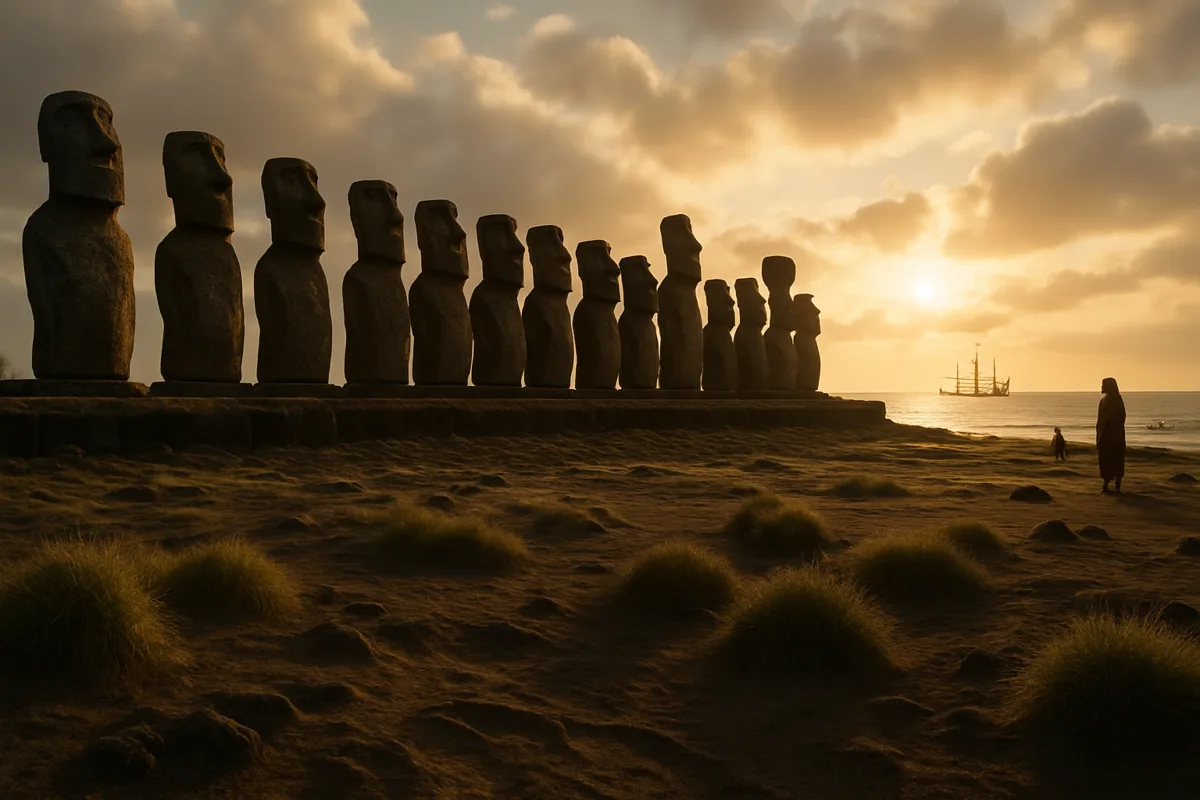
On the afternoon of 5 April 1722, a Dutch fleet under Admiral Jacob Roggeveen dropped anchor off a treeless volcanic islet in the South Pacific. The sailors counted people — roughly two to three thousand — and then they counted stone figures, nearly nine hundred of them, lined up on platforms with their backs to the ocean. They called the place Paasch-Eyland, or Easter Island, and could not reconcile the sight of monumental sculpture, active villages and almost no trees with any European frame of reference.
First impressions: an island outside European imagination
The encounter reads at once like discovery myth and anthropological snapshot. A three-ship expedition from Holland had been searching for Terra Australis when it found a triangular patch of basalt some 2,200 miles west of the Chilean coast and more than a thousand miles from the nearest inhabited land. The Dutch officers’ journals describe canoes paddling out to greet them, islanders swimming far from shore to reach the ships, and a line of statues at first mistaken for people. By Roggeveen’s own count the population was small, but later archaeological work suggests that his figure captured only a fragment of what had once been — and that the island had supported more inhabitants in the centuries before contact.
How the moai were made: the quarry and craft
The central workshop of Rano Raraku
Every moai originates from a single eastern quarry, a volcanic cone known today as Rano Raraku. Its slopes still hold hundreds of unfinished carvings, figures partially extruded from the bedrock like icebergs of stone. The largest completed statue rises to about ten metres; an abandoned design on the quarry wall suggests the islanders could have produced a 21-metre figure that would have weighed nearly 270 tonnes. The material — a relatively soft volcanic tuff — made sculpting feasible with the stone tools available on the island.
Time, labour and meaning
Rapa Nui oral tradition frames each statue as a portrait of a deceased ancestor and a vessel for mana, a protective spiritual force. Carving a moai could occupy a team for months, even a year. The work involved not only chisel-and-peck stonecraft but also coordinated social effort: quarrying, finishing, transporting and installing a stone in its ahu (ceremonial platform) were collective acts that reinforced lineage, ritual authority and social cohesion.
The moai in motion: how statues “walked”
When Europeans asked islanders how the statues had been moved, the answer was consistent and astonishing: the moai walked. For two centuries that explanation was dismissed as folklore. Early European theories leaned on rollers and sleds, which also conveniently served to explain the island’s near-total tree loss. But archeological experiments during the late 20th and early 21st centuries changed the conversation. Full-scale replicas have been moved upright across rough terrain by small teams using rope and coordinated rocking motions. The statues were carved with a forward tilt and a curved base, enabling controlled steps — literally a series of controlled falls — that let teams “walk” the figures to their coastal platforms.
Rethinking collapse: trees, rats and adaptation
The old collapse narrative
Popular accounts long framed Rapa Nui as a cautionary tale: a society that overexploited its resources, cut its last tree to move statues, collapsed into warfare and famine, then dwindled into the population Roggeveen recorded. That narrative fits a moral arc that resonated with twentieth-century anxieties about ecological limits, but more recent evidence complicates the picture.
Alternative explanations and evidence
Pollen cores do show deforestation. But careful re-examination of stone tools once catalogued as weapons has revealed wear patterns consistent with agriculture, not combat. The story of environmental degradation becomes more nuanced when you add two other factors. First, the Polynesian rat, introduced inadvertently with the first settlers, fed on palm nuts and hindered forest regeneration. Second, the walking-statue method undermines the idea that vast tracts of timber were required simply to transport moai. Instead of active, wholesale strangulation of the landscape by axe and saw, a complex mix of human use, invasive species, climatic variability and long-term adaptation appears to be responsible for the island’s treeless state.
From standing to fallen: the moai’s dramatic change
Roggeveen saw the moai standing. Fifty-two years later, Captain James Cook came and found many toppled. By the nineteenth century nearly every moai lay face-down off its ahu. Records and later archaeological interpretation indicate that the islanders themselves knocked many of them over, often with deliberate intent: placed stones at the statues’ necks ensured the heads would snap when toppled. The dominant scholarly interpretation ties the toppling to social upheaval following European contact — epidemic disease, slave raids and missionary-driven cultural disruptions eroded the institutions that had sustained ancestor cults and ritual maintenance of the monuments. In short, the fall of the statues was as much a social and spiritual rupture as it was a physical one.
Archaeology, restoration and modern stewardship
Beginning in the mid-20th century, teams collaborating with the Rapa Nui community began to re-erect the toppled moai. Ahu Tongariki on the southeast coast, where fifteen figures now stand shoulder to shoulder, is the most iconic of these restorations. This site and others now sit at the intersection of heritage tourism, local cultural renewal and scientific research. Modern mapping projects — including high-resolution 3D surveys — allow archaeologists and island custodians to monitor erosion, visitor impact and subtle shifts in the landscape that are invisible at human scale.
New threats: water, climate and Ahu Tongariki
The next major threat to the moai is not human hand or heritage neglect but rising water. A recent study modelled the impact of storm waves and projected sea-level changes, concluding that within decades, not centuries, strong wave events could reach the foundations of coastal ahu like Tongariki. The moai have outlasted their builders and multiple waves of outside interpretation. The prospect of wave-driven erosion and inundation reframes the conservation challenge: how do you preserve monumental ritual landscapes under fluid, accelerating climate stress?
Community, science and global responsibility
Responses combine local stewardship with international support. Chilean governance, UNESCO protections and collaborative scientific research all play roles in planning for coastal defences, site management and the documentation of endangered features. But preservation also raises thorny ethical questions: what should be restored, what should be left as ruin, and whose voice directs long-term interventions on territory with a fraught colonial history? Rapa Nui community leadership and cultural revitalization projects are central to any legitimate plan, and their priorities must be balanced against scientific urgency and global interest in protecting heritage under existential threat.
Reading Roggeveen’s log alongside three centuries of archaeology reveals a more complex, and in some ways more humane, story than the collapse myth allowed. The Dutch were not the first to see an inexplicable monument; they were outsiders who encountered a living tradition and, in many cases, refused to accept the islanders’ own explanations. The Rapa Nui said the statues walked; experimental archaeology confirmed they had. The island’s deforestation was real, but its causes and cultural consequences were multifaceted, involving invasive species, adaptation strategies and significant resilience. The moai were toppled not by mechanical necessity but as part of social rupture after contact with Europe, and later restored both by islanders and archaeologists working together. Now the statues face a different danger: sea and storm. Protecting them demands a blend of traditional knowledge, community leadership and scientific planning carried out with sensitivity to history and sovereignty. Standing or fallen, the moai are not simply relics to be explained by outsiders; they are enduring signs of a people’s past ingenuity and present stewardship, and their future will be written by choices made today about what to protect and how to remember.

Dr. Morgan directed the Archives Program from 2014 to 2017, gaining extensive experience in research documentation, information management, and the preservation of scholarly resources. Throughout her career, she has worked closely with academic publications and research materials, developing expertise in evaluating scientific sources and communicating complex topics to broad audiences.
Her primary areas of specialization include scientific publishing, research communication, editorial review, and the translation of technical research into accessible educational content. She has contributed to projects involving space science, astronomy, environmental science, history, archaeology, and emerging scientific discoveries, always emphasizing accuracy, transparency, and the responsible presentation of evidence.
As Editorial Director of Muskurahat.us, Dr. Morgan leads the editorial review process for scientific articles, ensuring that content is based on reputable sources, peer-reviewed research whenever available, and publications from recognized universities, research institutions, and international scientific organizations.
She is committed to promoting scientific literacy through clear, engaging, and well-documented articles that help readers better understand scientific discoveries and their impact on society. Her editorial philosophy is founded on accuracy, intellectual integrity, independent journalism, and continuous learning as scientific knowledge evolves.
Through her work at Muskurahat.us, Dr. Morgan supports the publication of trustworthy scientific content that makes complex research accessible to readers around the world while maintaining rigorous editorial standards.