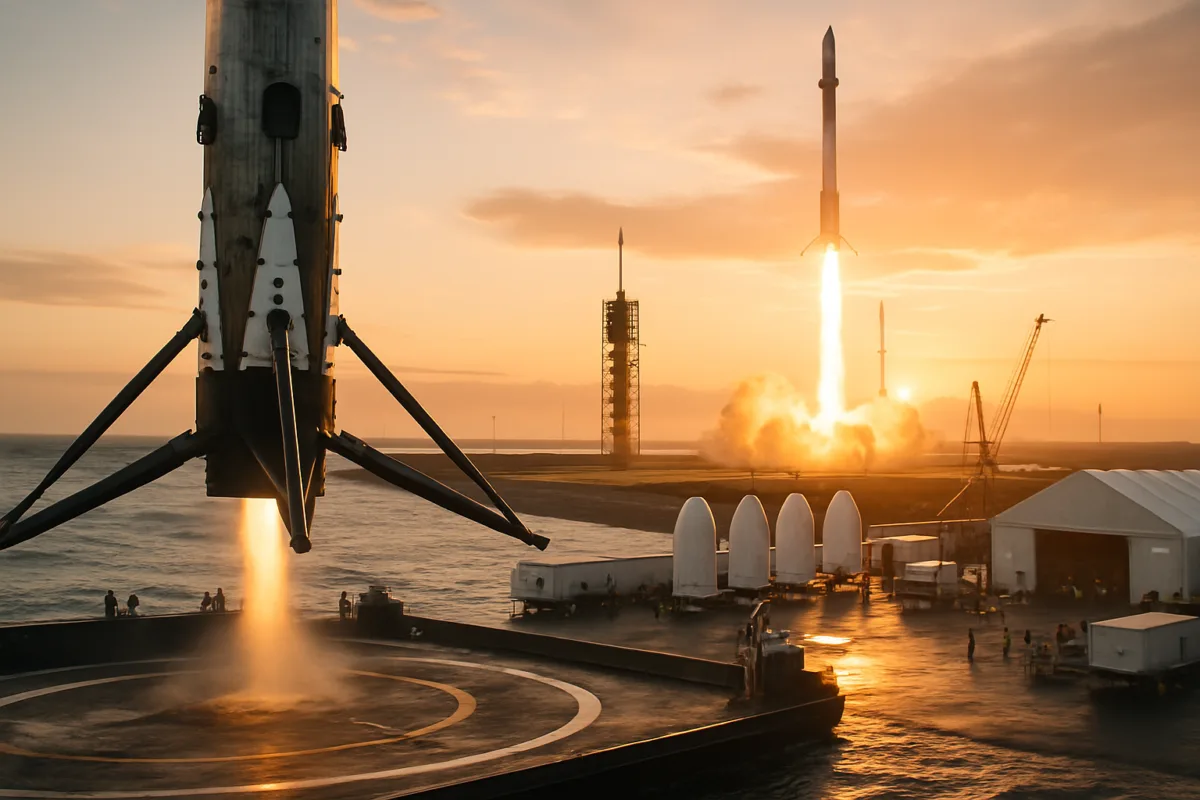
In 2025, a partly reusable rocket family stopped behaving like a string of experiments and started behaving like infrastructure. SpaceX flew 165 Falcon 9 missions that year, a cadence that averaged one launch every 2.21 days, and each flight delivered its payload successfully. To understand how a system moves from spectacular demonstration to predictable operation, we need to analyze the processes that enabled that shift: the decision logic, the ground procedures, the maintenance cycles, the business feedback loops, and the ways in which risk was separated from routine objectives.
Reusability as an operational process
At the heart of Falcon 9’s transformation is a simple reframing. Reuse is not a single technical trick; it is a sequence of repeatable steps that turn hardware into a managed, serviceable vehicle. A reused booster is not merely a piece of metal that survived a descent. It becomes an asset with flight history, inspection records, maintenance requirements, refurbishment slots, and an operational lifetime. The shift from one-off hardware to fleet management requires standardized procedures that can be executed quickly and reliably.
Inspection and decision gates
Every recovery triggers a tight inspection loop. Sensors, visual inspection, nondestructive testing, and data telemetry converge to create a health snapshot. The process analysis looks at gatekeeping decisions: is the booster flight-proven enough to be reflown with minimal checks, or does it require deeper refurbishment? SpaceX’s 2025 record, in which 157 of 165 missions used flight-proven boosters, implies a set of validated decision thresholds. Those thresholds determine turnaround time, cost per reflown flight, and the acceptable risk envelope for customers and internal missions.
Data-driven maintenance
Telemetry from ascent, reentry, landing, and prior flights is aggregated to feed maintenance schedules. Engines, tanks, thermal protection elements, and landing legs follow different inspection cadences. The process separates quick acceptance checks from components that need scheduled replacement or overhaul. The effect is predictable throughput: when you can forecast how long a booster will stay in refurbishment, you can schedule future launches with confidence.
Separating primary mission from recovery
An essential process insight is the separation of payload delivery from booster recovery. The primary mission metric is whether a satellite, cargo, or crew reaches the intended trajectory. Booster recovery is a secondary, though economically significant, objective. In 2025, Falcon 9 delivered every payload successfully while experiencing only a handful of recovery failures, two of which were intentional for high-energy missions and one an unsuccessful landing attempt. That separation lets operators accept recovery failures without failing the core mission.
Operational trade-offs and mission planning
Each flight carries a mission profile and an associated recovery plan. For some high-energy trajectories, landing the booster is impractical or risks payload constraints; in those cases the booster is intentionally expended. The process of deciding when to expend means balancing mission performance, customer expectations, and reuse economics. By codifying those trade-offs, the fleet can sustain a high launch cadence without making every customer dependent on recovery outcomes.
Cadence and the vertical loop
Process analysis cannot ignore demand. A launch fleet only looks like infrastructure when it has predictable demand to match its throughput. In 2025, Starlink was the dominant customer, accounting for 123 of Falcon 9’s 165 launches. Vertical integration created a loop: SpaceX built satellites, needed capacity to deploy them, and used its fleet repeatedly to accelerate network growth. That loop reduces idle time for launch assets and justifies investment in procedures that make quick turnarounds economical.
Scheduling, recovery sites, and geography
Operating a launch every 2.21 days requires choreography across multiple launch pads and recovery zones. Launch windows are balanced against range constraints and airspace management, and recovery ships and droneships must be positioned with precision. The process analysis highlights how distributed operations — pads in Florida and California, recovery vessels in the Atlantic and Pacific — are synchronized through standardized preflight checklists, modal logistics protocols, and redundancy in ground crews. Consistency in personnel training and modular tooling also reduces variability in turnaround time.
Supply chain and fleet lifecycle
A repeated cadence exposes parts supply and refurbishment capacity to steady demand. Engines, avionics modules, and landing gear components wear according to predictable cycles, so stocking and replacing them becomes a logistics problem rather than an ad hoc scramble. The lifecycle of a booster thus becomes an economic variable. When a vehicle is designed to fly many times, the manufacturing cadence, spares inventory, and overhaul docks all become part of the production line.
Risk management and the public perception gap
Despite the numbers, many observers still picture reusable rockets as experimental spectacles, because the early years involved dramatic failures and visible test flights. Process analysis explains why the public memory lags technical maturity. The early failure modes were public and memorable: platforms exploding, failed leg deployments, and tipped boosters. Over time, the processes matured. Failures became rarer, inspection standards tightened, and decision rules evolved to trade off risk and value.
Designing for routine failure modes
Part of making reuse operational is anticipating and normalizing failure modes. Engineers plan for lost recoveries without cascading effects on primary missions. By treating booster landings as optional under defined conditions, operators can preserve the core service while extracting economic benefit from successful recoveries. This approach reframes reuse as resilience rather than fragility.
Metrics that matter
Process maturity is reflected in measurable outcomes. SpaceX reported more than 620 orbital launches by 31 March 2026 with an overall mission success rate above 99 percent. Within the 2025 window, a 100 percent payload delivery record and near-universal use of flight-proven boosters are the operational markers of success. Tracking metrics such as average turnaround time per booster, number of flights per booster, and the ratio of intentional expend missions to recovered missions gives a clear picture of fleet health and economic progress.
From demonstration to infrastructure
When a rocket flies as often as an airline route, processes replace improvisation. That is the essential transformation Falcon 9 illustrates. Systems that were once hand-tuned on a per-flight basis become codified policies. Crew training moves from ad hoc problem solving to rote execution of validated procedures. Forecasting becomes more accurate, and customers can buy schedules rather than bespoke missions. The result is a market in which one company can make launch behave like a utility across its own portfolio.
Implications for the next generation
Falcon 9’s operational model is not an endpoint but a foundation. SpaceX is developing Starship for full reuse, and other players are experimenting with different reusable architectures. The procedural lessons will be portable: standardized inspections, clear decision gates for expend vs recover, tight telemetry-driven maintenance loops, and integration between the customer demand pipeline and launch throughput. The harder questions now are about scaling beyond a single vertically integrated fleet and about ensuring safety and reliability as reuse proliferates across different providers.
Processes matter because they translate engineering capability into predictable service. Falcon 9 in 2025 shows how a partly reusable rocket can change the economics and tempo of launch by turning hardware into an asset with a managed lifecycle. That shift does not make rockets safe in some absolute sense: they still burn, vibrate, and fail. But it does make failure modes manageable and launches schedulable. If the industry adopts these procedural templates, more rockets will stop being rare events and start being part of infrastructure, with all the operational and regulatory consequences that follow.

Dr. Morgan directed the Archives Program from 2014 to 2017, gaining extensive experience in research documentation, information management, and the preservation of scholarly resources. Throughout her career, she has worked closely with academic publications and research materials, developing expertise in evaluating scientific sources and communicating complex topics to broad audiences.
Her primary areas of specialization include scientific publishing, research communication, editorial review, and the translation of technical research into accessible educational content. She has contributed to projects involving space science, astronomy, environmental science, history, archaeology, and emerging scientific discoveries, always emphasizing accuracy, transparency, and the responsible presentation of evidence.
As Editorial Director of Muskurahat.us, Dr. Morgan leads the editorial review process for scientific articles, ensuring that content is based on reputable sources, peer-reviewed research whenever available, and publications from recognized universities, research institutions, and international scientific organizations.
She is committed to promoting scientific literacy through clear, engaging, and well-documented articles that help readers better understand scientific discoveries and their impact on society. Her editorial philosophy is founded on accuracy, intellectual integrity, independent journalism, and continuous learning as scientific knowledge evolves.
Through her work at Muskurahat.us, Dr. Morgan supports the publication of trustworthy scientific content that makes complex research accessible to readers around the world while maintaining rigorous editorial standards.