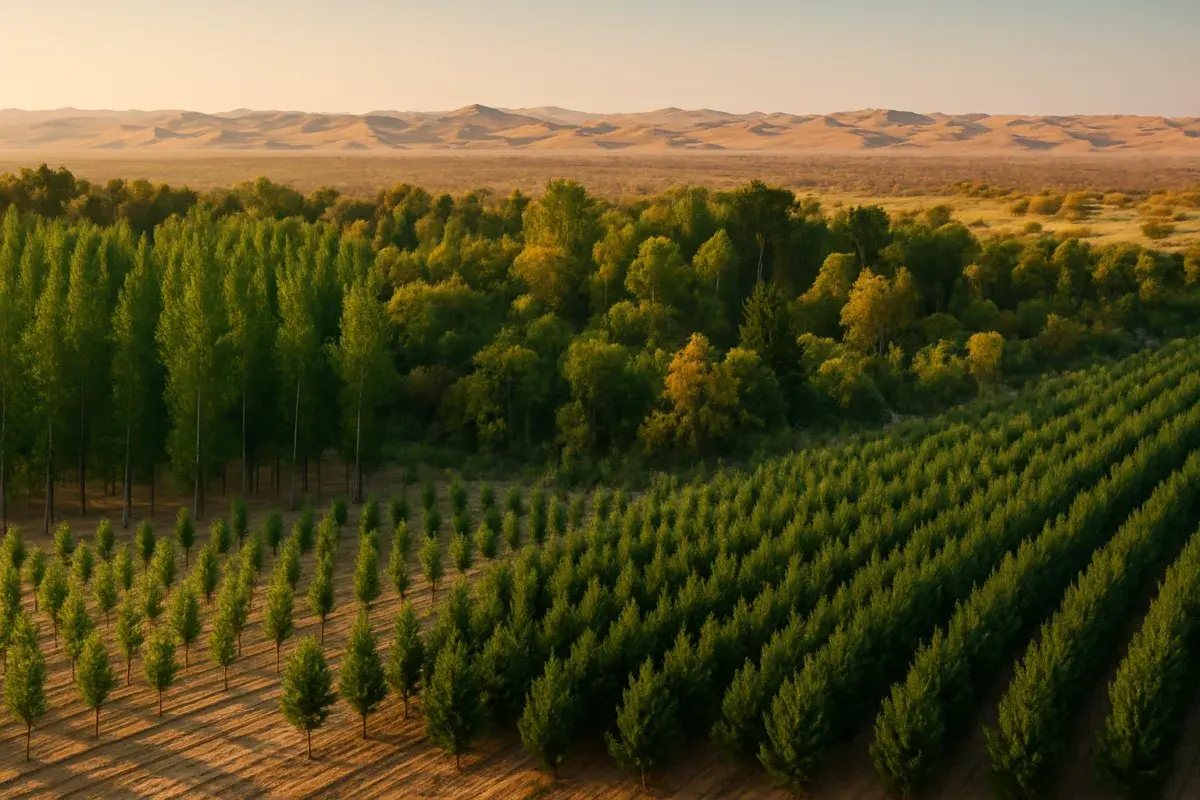
In the decades since 1978, China’s ambitious Three-North Shelterbelt Program has reshaped large swathes of its northern landscape: billions of trees have been planted to slow spreading deserts and restore vegetation across arid zones. A 2026 satellite-driven study finds that, by one commonly used metric, the country’s planted stands have been increasing their leaf cover faster than naturally regenerated forests. This finding matters for how scientists model forest responses to climate change, for policy choices about afforestation, and for public understanding of what reforestation can — and cannot — accomplish.
Context: The Great Green Wall and a long-term national effort
The Three-North Shelterbelt Program, sometimes called China’s Great Green Wall, began as a large-scale plan to raise forest cover across northern provinces from around 5–10% toward a higher target, aiming to check the Gobi and Taklamakan deserts. Over more than four decades, the program has resulted in the planting of an estimated 66 billion trees, producing vast belts and patches of planted woodland and shrubland. By 2024 China reported national forest coverage at roughly 25% of its land area, up from near 10% in 1949, and announced milestones such as completing thousands of kilometres of green belt around desert margins. But the program has had mixed ecological outcomes, including moments of large-scale mortality, groundwater depletion concerns, and criticism about reliance on fast-growing monocultures.
What the satellite study measured
Leaf area index as a proxy for canopy growth
The study led by Yuhang Luo and colleagues used satellite-derived leaf area index (LAI) to compare planted and natural forests across sampled sites in China. LAI measures the area of leaves per unit ground area and is a widely used indicator of canopy density and photosynthetic surface. The headline result was that planted stands increased their LAI about 66% faster than natural forests in the sampled data. That result grabbed attention because it suggests planted forests can build canopy rapidly — a desirable trait if the goal is to cover ground and reduce wind and dust from desert margins.
Age and growing-stage effects
However, much of that apparent advantage is explained by the age structure of planted stands. Planted forests tend to be younger on average than natural woodlands, and younger trees are on steeper growth trajectories: they add leaf area quickly as they establish and fill canopy space. When the researchers controlled for age and similar growth conditions, the growth-rate advantage of planted over natural forests narrowed to about 4.6% — still measurable, but far smaller than the top-line comparison. The gap was most pronounced in mixed and evergreen types of planted stands.
Study scope and caveats
It is important to emphasize what the study does and does not claim. It reports a pattern observable by satellite across a sample of plots, using LAI as a single metric. It is not a plot-by-plot audit of every planted area versus every natural stand in China, nor is it a comprehensive assessment of total carbon storage, biodiversity value, or long-term resilience. The authors themselves note that the advantage is time-limited: planted stands show the biggest relative gains in their middle decades (around 30–40 years old) and the advantage declines after that.
Why planted forests can expand canopy faster
Species choice and silviculture
Two connected explanations help account for the faster LAI gains in planted stands. First is species selection. Afforestation programs often favor fast-growing species — poplars, eucalyptus, and other taxa chosen for rapid establishment — particularly when the primary objective is to quickly stabilize soils, reduce wind erosion, or create visible green belts. Second is active management: many plantations are tended to reduce competition from shrubs and grasses, receive supplemental water or fertiliser in some zones, and are arranged in densities calculated to maximize early canopy closure. These practices accelerate leaf-area accumulation compared with older, more structurally complex natural forests where multiple layers of vegetation compete for light and soil resources.
CO2 fertilization and resource availability
Another factor is the interaction with rising atmospheric CO2, sometimes called CO2 fertilization. Younger, vigorously growing plants and managed stands with fewer competitors can show stronger growth responses to elevated CO2 availability because they are actively expanding leaves and biomass and can exploit the extra carbon if water and nutrients are not limiting. In contrast, older and denser natural forests, with established root systems and understory competition, may show muted leaf-area responses even if they continue to sequester carbon in other pools such as wood or soil.
What leaf area does not capture
Carbon storage is multifaceted
LAI is a useful indicator of canopy structure and potential photosynthetic capacity, but it is not a direct measure of total carbon sequestration. Carbon is stored across a forest’s components: wood, bark, roots, leaf litter, and soils. Young planted trees can produce large leaf areas quickly but may store less carbon in woody biomass and soil compared with older natural forests. Independent researchers have pointed out studies showing that natural stands sometimes accumulate more above-ground carbon than planted counterparts during early years, a finding that can appear to conflict with LAI-based comparisons. Different metrics can tell different parts of the growth and carbon story.
Biodiversity, resilience and ecosystem function
Rapidly established monoculture plantations typically support fewer species of plants, animals and microbes than natural, mixed-species forests. They can be more vulnerable to pests, diseases and extreme weather because genetic and structural uniformity reduces ecological redundancy. Historical setbacks in China’s planting program — for example, the 2000 outbreak that killed roughly a billion poplars in one province — highlight that vulnerability. Planted stands may offer quick gains in canopy cover but often lack the long-term ecological complexity and resilience of naturally regenerating woodlands.
Hydrological impacts and soil concerns
Afforestation in dry or water-limited regions can affect groundwater and soil moisture. Dense stands of trees, especially those that are non-native or poorly matched to local hydrology, can consume significant soil water and lower groundwater tables, with possible consequences for surrounding agriculture and ecosystems. Research from China’s Loess Plateau and other regions has documented situations where afforested land lost more soil moisture than adjacent farmland, raising questions about local trade-offs between vegetation cover and water availability.
Implications for policy, modeling and practice
For climate and carbon models
The study underscores a methodological gap in many global climate and carbon models: forests are often treated as a single, homogeneous category without distinguishing between planted and natural stands or accounting for stand age. Because planted forests and young stands can show different growth trajectories and responses to CO2, lumping all forests together risks misestimating regional and global carbon dynamics. Incorporating distinctions by forest type, age structure and management regime would help models better reflect the heterogeneous reality of terrestrial vegetation.
For afforestation policy
Afforestation can be an important tool for erosion control, dust mitigation and carbon uptake, but policy should be sophisticated rather than simplistic. Rapid canopy gain is valuable for certain goals — shading, dust suppression, and visual landscape restoration — but planners must weigh trade-offs: biodiversity, long-term carbon storage, water budgets, and resilience to pests and climate extremes. Mixed-species plantings, native species use, careful siting in relation to groundwater and agricultural needs, and long-term maintenance and monitoring will generally produce more robust outcomes than large-scale monocultures planted without ongoing stewardship.
Practical recommendations for future planting efforts
Policymakers and land managers can combine the strengths of both approaches. Use fast-growing species strategically where quick canopy closure is essential and risks to water or biodiversity are low, but prioritize natural regeneration and mixed plantings in areas where long-term carbon storage and ecological function are primary goals. Invest in monitoring that goes beyond canopy cover to track soil carbon, root development, species richness, and hydrology. Build age-structured data into national accounting systems and climate models to capture how carbon uptake trajectories change over decades.
China’s massive planting effort offers lessons as other countries scale reforestation and afforestation initiatives. Satellite-observed LAI gains show what is possible when human effort and management push vegetation onto the landscape. But LAI is one lens, and it should be paired with ground-based measures that capture carbon pools, biodiversity, soil health and water impacts. The most resilient strategy will be a diversified one: matching species and management to local conditions, combining planted and natural regeneration approaches, and planning for the decades-long arc of forest development rather than just the first few decades of rapid canopy growth.
In short, the story of the Great Green Wall is not a simple tale of trees versus desert; it is an evolving experiment in land management that highlights both opportunity and caution. Rapid leaf-area gains in planted stands demonstrate the power of directed restoration, but they also point to the nuanced trade-offs policymakers must weigh when aiming for climate mitigation, ecosystem recovery, and sustainable land use over the long term.

Dr. Morgan directed the Archives Program from 2014 to 2017, gaining extensive experience in research documentation, information management, and the preservation of scholarly resources. Throughout her career, she has worked closely with academic publications and research materials, developing expertise in evaluating scientific sources and communicating complex topics to broad audiences.
Her primary areas of specialization include scientific publishing, research communication, editorial review, and the translation of technical research into accessible educational content. She has contributed to projects involving space science, astronomy, environmental science, history, archaeology, and emerging scientific discoveries, always emphasizing accuracy, transparency, and the responsible presentation of evidence.
As Editorial Director of Muskurahat.us, Dr. Morgan leads the editorial review process for scientific articles, ensuring that content is based on reputable sources, peer-reviewed research whenever available, and publications from recognized universities, research institutions, and international scientific organizations.
She is committed to promoting scientific literacy through clear, engaging, and well-documented articles that help readers better understand scientific discoveries and their impact on society. Her editorial philosophy is founded on accuracy, intellectual integrity, independent journalism, and continuous learning as scientific knowledge evolves.
Through her work at Muskurahat.us, Dr. Morgan supports the publication of trustworthy scientific content that makes complex research accessible to readers around the world while maintaining rigorous editorial standards.