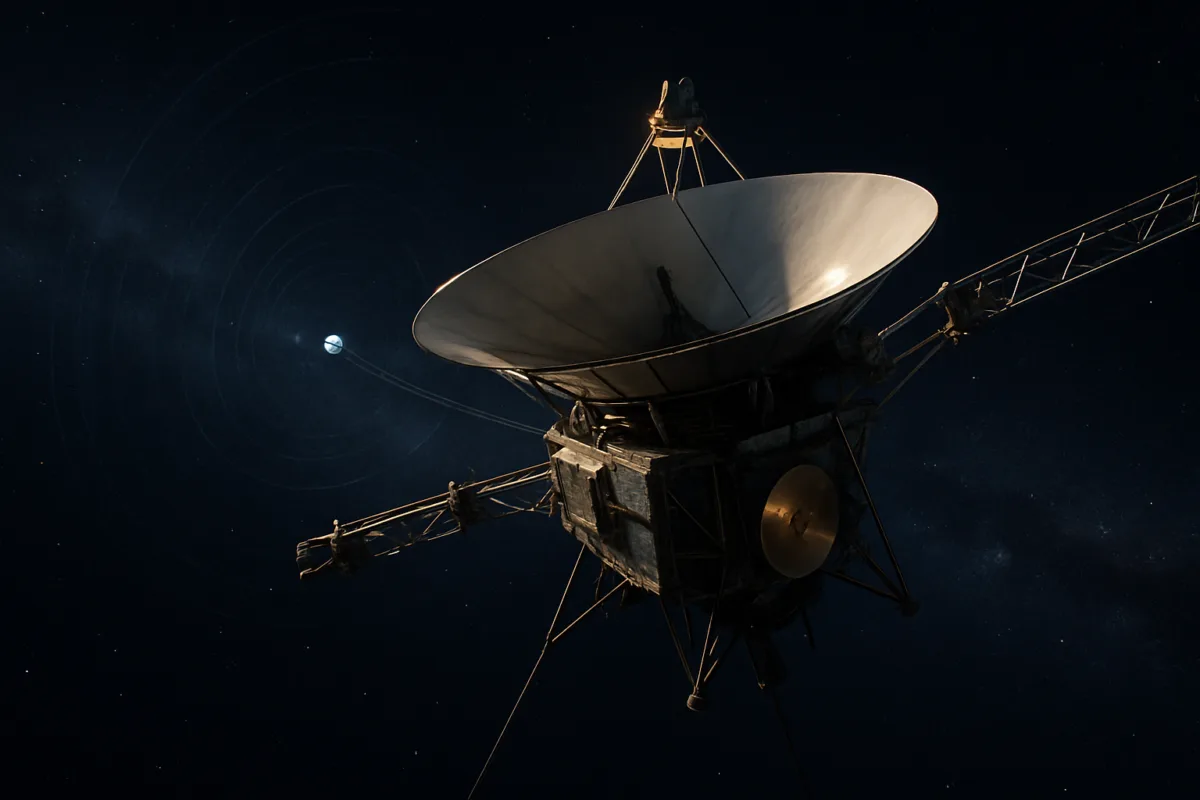
Voyager 1 is not a rocket perpetually firing into the dark. It is a carefully aimed artifact riding a trajectory shaped decades ago, a craft whose outward motion is owed not to a running engine but to the precise geometry of planetary encounters long in the past. In November 2026, that coast will be measured in human-scale time: Voyager will sit one light-day from Earth, a distance at which a radio message takes 24 hours to arrive. Understanding how that happens—why a machine can travel so far while its operating life narrows—reveals the elegant blend of celestial mechanics, engineering trade-offs, and the endurance of human design.
How a spacecraft keeps moving without a continuous engine
Images often suggest that deep-space probes thrust onward under their own power. Voyager 1 contradicts that intuition. After launch, a spacecraft follows the momentum and path imparted by its initial velocity and by later interactions. Voyager’s famous 38,000-mile-per-hour speed is not the output of an ongoing propulsion system; it is the remnant of carefully orchestrated encounters with massive bodies—principally Jupiter and Saturn—that redirected and accelerated the probe during its first two years of flight.
Momentum, inertia and the vacuum
In the near-perfect vacuum of space, absent significant forces like atmospheric drag or collisions, an object tends to keep moving at a constant velocity. That inertia is why planets can orbit for billions of years and why a satellite can coast for decades. For Voyager 1, the initial launch and subsequent gravity assists set a trajectory that needed no continuous thrust to maintain its outward motion. The Sun’s gravity, the residual gravitational pull of planets, and the probe’s own inherited velocity together determine where it goes next.
Gravity assists: planets as celestial slingshots
The key trick behind Voyager’s extended reach was gravity assist, a technique that uses a planet’s motion and gravity to change a spacecraft’s trajectory and speed without expending onboard propellant. In the late 1970s, the outer planets formed a rare alignment that mission planners exploited to design a Grand Tour: a sequence of flybys that would send a single probe past multiple giant planets.
How a gravity assist works in plain terms
Picture a spacecraft approaching a moving planet. As it swings around, it steals a tiny bit of the planet’s orbital momentum, changing its own speed and direction. From the spacecraft’s perspective, the flyby pulls it onto a new path; from the planet’s perspective, the change is imperceptible. This exchange is purely gravitational—no fuel is exchanged—but the outcome can be dramatic. Jupiter’s massive gravitational field provided the initial large energy change that directed Voyager 1 toward Saturn. Saturn’s gravity then bent the probe’s path out of the ecliptic plane, sending it northward and carving an escape trajectory from the region dominated by the Sun’s wind.
Why the 1979–1980 encounters were decisive
Voyager 1’s close approach to Jupiter on 5 March 1979 and to Saturn on 12 November 1980 were not just opportunities for groundbreaking science; they were the propulsion system of the mission. After the Saturn encounter, there was no next planet to snag another boost—the probe’s flight plan had become an escape onto a path that would carry it outward for decades. The velocity achieved by these flybys—commonly rounded to roughly 38,000 miles per hour relative to the Sun—has been carrying Voyager ever since.
Small thrusters, big differences: stationkeeping versus propulsion
It would be misleading to say Voyager has no engines at all. The spacecraft carries hydrazine thrusters used for attitude control: small pulses that rotate and point the spacecraft so its high-gain antenna can aim at Earth. Those thrusters are essential for maintaining communications and for keeping instruments correctly oriented, but they are not used to propel Voyager outward in any significant way. They are the difference between a motionless relic and an operable observatory.
Why attitude control matters more than propulsion out here
Even when the main scientific mission has concluded, directing the spacecraft’s antenna toward Earth is fundamental. Without precise pointing, radio signals would not reach home. That requires tiny, intermittent thruster firings to correct drift and compensate for reaction wheel limitations or other small disturbances. These maneuvers consume a precious resource: hydrazine fuel. Mission teams monitor that budget carefully, balancing the need to preserve pointing capability against the constraint of dwindling propellant reserves.
Powering the instruments: the slow fade of electricity
Motion and operation are distinct. Voyager 1’s kinetic journey is virtually assured on human timescales; its ability to do science depends on electrical power coming from radioisotope thermoelectric generators (RTGs). These devices convert heat from the decay of radioactive material into electricity, but their output decays steadily. Over decades, the available power has dropped, forcing engineers to shut off instruments, heaters, and systems to concentrate remaining energy on the most critical functions.
From a full scientific suite to a narrow payload
As of early 2026 updates from NASA, only a couple of science instruments remained active on Voyager 1—most notably the magnetometer and the plasma wave subsystem. Other sensors were turned off either because their power demands could no longer be supported or because their performance degraded. This gradual pruning is an exercise in prioritization: which measurements offer the highest scientific value for the least power cost? The answers have allowed Voyager to keep returning data about the outer reaches of the heliosphere and beyond, but the margin shrinks with every passing year.
One light-day: when distance becomes time
On 18 November 2026, at a specified moment measured in Pacific Standard Time, Voyager 1 is expected to cross a threshold that is easy to express in human terms: it will be one light-day away. That is the distance light travels in 24 hours, roughly 16.09 billion miles. At that separation, any command sent from Earth will not be acted on until the day after it was sent, and any reply will come another full day later. Conversations become asynchronous by astronomical standards; operational decisions are made with an understanding that responses are delayed by entire days.
The operational implications of such a delay
Engineers must write sequences of instructions that anticipate delays and potential failures. Troubleshooting cannot be interactive. If a commanded test fails, mission control waits a day for the telemetry to arrive, reviews it, plans a corrective action, sends it, and waits another day to learn if it worked. The one-light-day marker is therefore more than a poetic milestone: it alters the tempo of mission operations and reinforces the difference between being far away and being effectively isolated.
The Saturn flyby that never really ended
Saturn’s role in Voyager 1’s long-term motion is an illustration of how brief events can have enduring consequences in orbital mechanics. The closest approach—around 78,000 miles from Saturn on 12 November 1980—was a short-lived scientific bonanza, but the gravitational redirection accomplished during that encounter continues to determine Voyager’s path. That encounter turned a flyby into an escape trajectory, nudging the probe out of the plane where planets circle and into a trajectory that will take it into interstellar space indefinitely.
An artefact carrying human messages into the future
One of the most poignant aspects of Voyager 1 is that, even as its instruments fall silent, the spacecraft remains a messenger. Tucked into its body is the Golden Record, a time capsule of sounds and images representing Earth and humanity. Should Voyager ever be found by distant intelligences—an event of vanishingly small probability—it will still bear the imprint of human curiosity. For now, the craft continues to transmit what it can, governed by a legacy of planetary encounters and the quiet persistence of its trajectory.
The story of Voyager 1 reframes how we think about movement in space. It is not a continuously powered journey but a long coasting motion set by early choices and made possible by the physics of gravity. The engineering achievement is twofold: designing and executing gravity-assisted trajectories that sent the probe beyond the heliosphere, and keeping it operational long enough for human eyes to watch it reach distances measured in light-days. By the time it sits a full day of light from Earth, Voyager will still be traveling on momentum earned in another era, a testament to foresight, elegant mechanics, and the patient endurance of machines we sent out to keep telling us about the vastness beyond home.

Dr. Morgan directed the Archives Program from 2014 to 2017, gaining extensive experience in research documentation, information management, and the preservation of scholarly resources. Throughout her career, she has worked closely with academic publications and research materials, developing expertise in evaluating scientific sources and communicating complex topics to broad audiences.
Her primary areas of specialization include scientific publishing, research communication, editorial review, and the translation of technical research into accessible educational content. She has contributed to projects involving space science, astronomy, environmental science, history, archaeology, and emerging scientific discoveries, always emphasizing accuracy, transparency, and the responsible presentation of evidence.
As Editorial Director of Muskurahat.us, Dr. Morgan leads the editorial review process for scientific articles, ensuring that content is based on reputable sources, peer-reviewed research whenever available, and publications from recognized universities, research institutions, and international scientific organizations.
She is committed to promoting scientific literacy through clear, engaging, and well-documented articles that help readers better understand scientific discoveries and their impact on society. Her editorial philosophy is founded on accuracy, intellectual integrity, independent journalism, and continuous learning as scientific knowledge evolves.
Through her work at Muskurahat.us, Dr. Morgan supports the publication of trustworthy scientific content that makes complex research accessible to readers around the world while maintaining rigorous editorial standards.