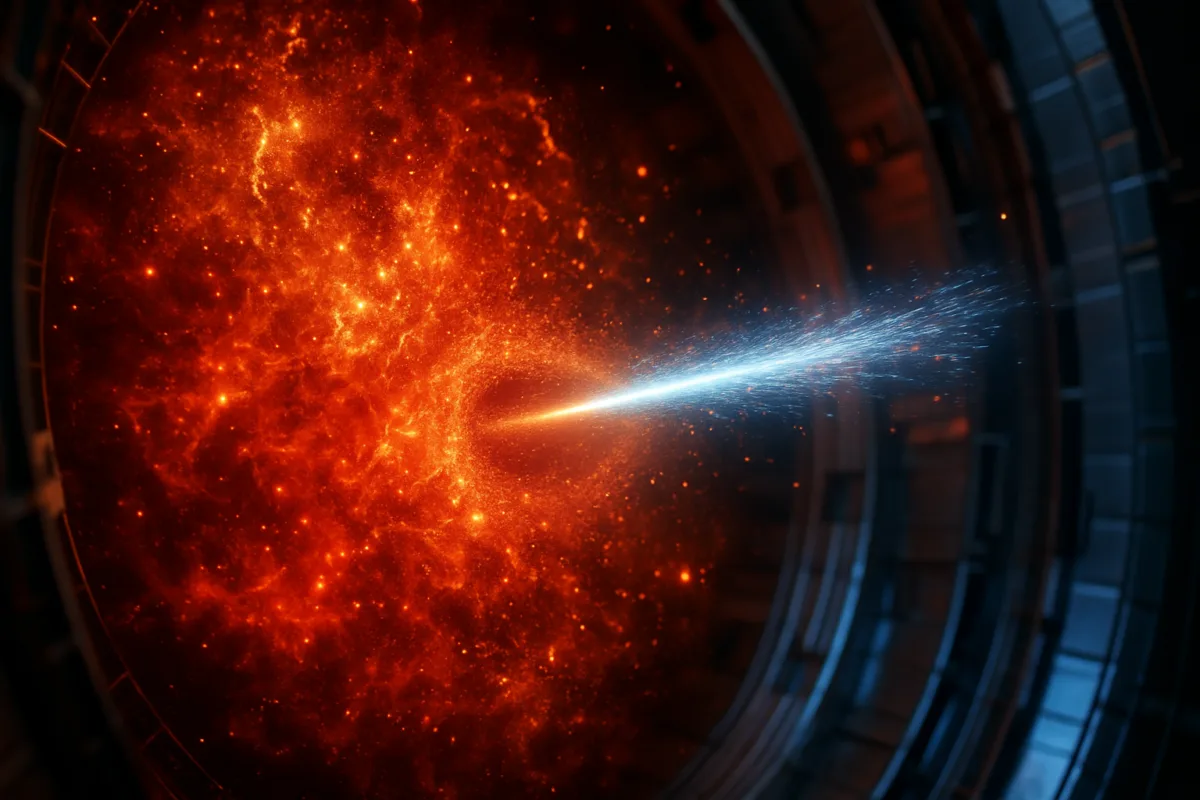
The Large Hadron Collider has again given physicists a window into the earliest instants of the universe. By colliding lead nuclei at ultra-relativistic energies, the CMS experiment has not only recreated the primordial quark-gluon plasma that filled the universe microseconds after the Big Bang, it has also reported the first direct observation of a diffusion wake produced when a fast-moving parton traverses that almost perfect fluid. This measurement, assembled from many dijet events, reveals a subtle deficit of low-momentum charged particles where theory long predicted the plasma would be depleted by a passing quark or gluon.
A glimpse of the universe in its first microseconds
Before protons, neutrons and atoms formed, matter existed in an extreme state where quarks and gluons were not confined inside hadrons. At temperatures of trillions of degrees, the concept of discrete particles gives way to a dense, strongly interacting medium called quark-gluon plasma, or QGP. Experiments at Brookhaven National Laboratory and CERN have shown that this medium behaves less like a dilute gas and more like a nearly perfect liquid with very low viscosity. Recreating and probing QGP in the laboratory allows physicists to test quantum chromodynamics, the theory of the strong interaction, under conditions that mirror those of the early universe.
How the LHC makes a microscopic fireball
When two heavy nuclei collide at the LHC, the kinetic energy concentrated in the small overlap region turns into heat and creates a fleeting fireball of QGP. This fireball expands and cools within a tiny fraction of a second, and as it does, its quarks and gluons recombine into the ordinary hadrons that detectors record. To study what the plasma does while it exists, physicists probe it with hard processes that occur early in the collision and produce energetic quarks or gluons, called partons. Those partons fragment into narrow sprays of particles called jets. As a parton or the developing jet traverses the plasma, it loses energy to the medium in a process known as jet quenching. The way that deposited energy and momentum redistribute through the QGP reveals its transport properties and collective behavior.
Jets, wakes, and the fluid response
If the QGP behaves like a fluid, then a fast-moving parton should disturb it much like a boat moving through water produces a wake. Theoretical work over the past two decades predicted that a passing parton would generate a hydrodynamic response: a region of enhanced flow and particle production in some directions and a trailing depletion or diffusion wake on the opposite side. Detecting this wake is challenging because the experimental signature is small and must be separated from the large particle background and from the particles associated directly with the competing jet on the other side of the event.
The dijet approach and why it helps
Dijet events are abundant at the LHC and provide two nearly opposing jets originating from hard parton scatterings. While dijets offer a larger dataset than photon-jet or Z-jet tagging, they present a complication: the wake from one jet can be superimposed on the excess particle production associated with the opposing jet, masking any depletion. The CMS collaboration used a clever technique proposed recently to overcome this: by selecting dijet pairs separated by different amounts in pseudorapidity, the relative positions of the wake and the competing jet shift within the detector. Subtracting small-gap events from large-gap events suppresses the jet-related excess and brings the diffusion wake into view.
Event selection and the signal window
CMS analysed lead-lead collisions at a centre-of-mass energy of 5.02 teraelectronvolts per nucleon pair, using data recorded in 2018 and referencing proton-proton data from 2017. Events were required to contain a leading jet with transverse momentum above 130 GeV and a second jet above 50 GeV. The collaboration then examined the distribution of lower-momentum charged particles around the dijet system, focusing particularly on particles with transverse momenta between 1 and 2 GeV where the predicted depletion should be most visible. Centrality selection played a crucial role: the effect is strongest in the 0 to 30 percent most central collisions, where the largest and longest-lived QGP droplets form.
What CMS actually observed
Using the pseudorapidity gap subtraction method, CMS detected a clear depletion of low-momentum charged particles on the side opposite the traversing jet. For the specified momentum window and the most central collisions, the depletion differed from a no-wake baseline by more than five standard deviations, meeting the threshold commonly used in particle physics to claim an observation. It is important to note that this is a statistical inference assembled from many collisions and many dijet pairs rather than an image of a single quark drilling a channel through the plasma. Nevertheless, the result aligns with the decades-old theoretical expectation that fast partons generate a hydrodynamic wake in the QGP.
Comparing data and theory
The observation confirms qualitative features predicted by models that couple parton energy loss to a hydrodynamic response of the medium. Calculations that include jet-medium interactions reproduce the general trend and locate the depleted region roughly where data find it. However, the picture is not yet quantitatively complete. Prominent theoretical frameworks, including HYBRID and CoLBT-hydro, tended to predict a deeper depletion than the CMS experiment measured. A model without jet-medium interactions produced no comparable dip, reinforcing that the effect is indeed tied to the plasma response.
What the discrepancy means
The mismatch between the measured depth of the wake and leading theoretical predictions is where progress will be made. It suggests that current descriptions of how energy and momentum deposited by jets spread through the plasma may miss important physics. Possibilities include differences in the microscopic mechanisms of energy deposition, the role of pre-equilibrium dynamics before hydrodynamics is valid, or transport coefficients such as shear viscosity and diffusion rates that differ from assumed values. By constraining these ingredients, more precise wake measurements can sharpen our knowledge of QGP properties.
Experimental challenges and systematic checks
Extracting such a small effect from heavy-ion collisions requires careful control of backgrounds and systematic uncertainties. CMS validated the signal by studying its dependence on collision centrality and on the transverse momentum of the charged particles. The depletion weakens in more peripheral collisions, consistent with smaller plasma volumes producing a smaller hydrodynamic response. It also becomes less pronounced for particles in the 2 to 4 GeV range, aligning with theoretical expectations about how deposited momentum is redistributed among softer particles. Cross-checks with proton-proton reference data and different event selections further reinforced the robustness of the observation.
Implications for QCD and the early universe
Observing a diffusion wake connects the microscopic dynamics of energetic partons to the macroscopic behavior of QCD matter. It demonstrates that QGP responds collectively to local perturbations and that energy lost by jets is not immediately thermalized into an isotropic bath. Instead, deposited momentum drives directed flows and localized modifications to particle production. These insights feed back into our understanding of the strong force under extreme conditions and help to refine how the early universe evolved in its first microseconds when such a plasma dominated.
Where experiments and theory will go from here
The wake detection opens new experimental and theoretical directions. On the experimental side, combining dijet measurements with tagged probes such as photons or Z bosons will allow cleaner isolation of initial parton kinematics and reduce ambiguities related to the initiating parton type. Systematic studies across collision energies and with varied trigger thresholds can map how the wake scales with parton energy and medium temperature. On the theoretical side, model builders will tune jet energy loss mechanisms, explore pre-equilibrium stages, and refine hydrodynamic treatments to match the observed wake depth and shape. Together, these efforts should lead to more precise determinations of transport coefficients and a better microscopic-to-macroscopic bridge for QCD matter.
Beyond laboratory interest, the measurement is also a conceptual triumph: it shows how phenomena conceived in fluid dynamics emerge from quantum field theory in extreme conditions. The diffusion wake is a tangible manifestation of how a nearly perfect liquid made of quarks and gluons remembers and reacts to local disturbances. This is more than a technical result. It is an empirical step toward a fuller picture of how the universe transitioned from a hot, dense plasma into the complex particle-filled cosmos we observe today, and it highlights the ongoing dialogue between experiment and theory that drives progress in high-energy nuclear physics.

Dr. Morgan directed the Archives Program from 2014 to 2017, gaining extensive experience in research documentation, information management, and the preservation of scholarly resources. Throughout her career, she has worked closely with academic publications and research materials, developing expertise in evaluating scientific sources and communicating complex topics to broad audiences.
Her primary areas of specialization include scientific publishing, research communication, editorial review, and the translation of technical research into accessible educational content. She has contributed to projects involving space science, astronomy, environmental science, history, archaeology, and emerging scientific discoveries, always emphasizing accuracy, transparency, and the responsible presentation of evidence.
As Editorial Director of Muskurahat.us, Dr. Morgan leads the editorial review process for scientific articles, ensuring that content is based on reputable sources, peer-reviewed research whenever available, and publications from recognized universities, research institutions, and international scientific organizations.
She is committed to promoting scientific literacy through clear, engaging, and well-documented articles that help readers better understand scientific discoveries and their impact on society. Her editorial philosophy is founded on accuracy, intellectual integrity, independent journalism, and continuous learning as scientific knowledge evolves.
Through her work at Muskurahat.us, Dr. Morgan supports the publication of trustworthy scientific content that makes complex research accessible to readers around the world while maintaining rigorous editorial standards.