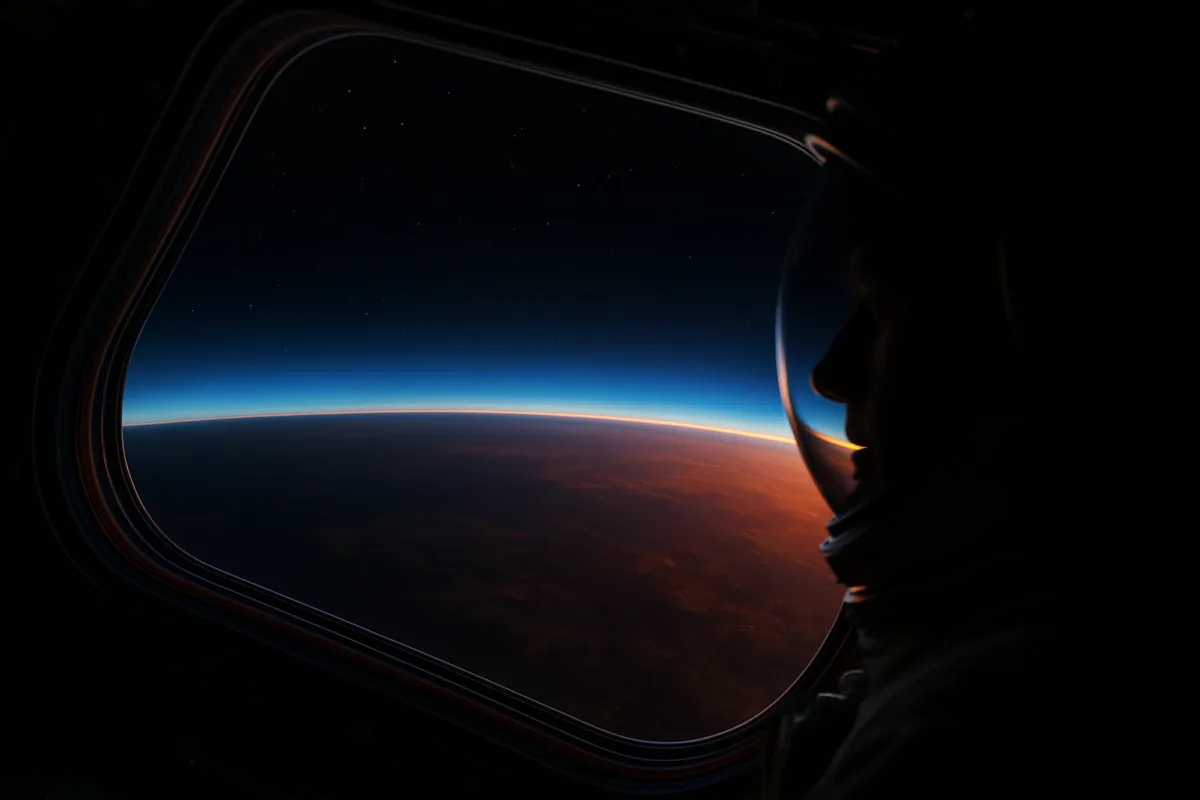
Watching Earth from low orbit is a lesson in perspective made visible: a narrow, luminous band wraps the planet, delicate enough for astronauts to describe as something they could ‘rub out with a thumb.’ That striking image is not simply poetic. It emerges from a set of physical and perceptual processes — orbital mechanics, light scattering, viewing geometry and human cognition — that together transform a sky that seems boundless on the ground into a thin, fragile limb when seen from the International Space Station (ISS). This analysis walks through those processes to explain why 16 sunrises a day and a thin blue edge can reframe how we think about the environment beneath our feet.
The basic clock: why the ISS sees 16 sunrises and sunsets
The ISS travels roughly 400 kilometres above Earth at about 28,000 kilometres per hour and completes an orbit in approximately 90 minutes. That rhythm yields about 16 sunrises and 16 sunsets every 24 hours. The arithmetic is simple: 24 hours divided by 1.5 hours per orbit equals about 16 passes through the day-night terminator. But the lived reality is more complex. Each transition from sunlight to shadow takes only seconds as the station sweeps through the boundary between Earth’s shadow and direct sunlight; photographic exposures may freeze the moment into a serene tableau, yet the crew experience is one of swift, cinematic change.
Operational context on the station
Despite the orbital cadence, station life is tied to a 24-hour schedule keyed to Coordinated Universal Time. Sleep, meals, exercise and research follow human circadian needs, not the rapid alternation of natural light outside a window. Artificial lighting management on board — including timed dimming and blue-enriched light for wake periods — creates a controllable day-night signal for astronauts. The orbital sunrise and sunset become a striking backdrop rather than the crew’s practical clock, and the human nervous system is buffered by a deliberate operational design that separates spectacle from routine.
How the atmosphere turns into a line: geometry and scattering
Turning the visual impression into a physical explanation starts with geometry. From the station’s vantage, observers view the atmosphere edge-on along the tangent to the planet’s surface. Looking along that long path, sunlight interacts with a far greater column of air than it would looking straight down. Molecules and particles along this extended line scatter sunlight into our view, producing the familiar blue band by day and rich reds and oranges near sunset and sunrise when sunlight traverses more of the lower atmosphere.
Molecular scattering and aerosols
Rayleigh scattering preferentially redirects shorter (bluer) wavelengths, which is why the daytime limb appears blue when sunlight comes from above. Near the terminator, the sun’s rays skim through denser, lower layers of the atmosphere; much of the shorter-wavelength light is scattered out, and longer wavelengths dominate, creating the warm hues of dawn and dusk. Superimposed on these optical effects are variable modifiers: dust, smoke, volcanic aerosols and clouds reshape the limb’s thickness and coloration from one orbit to the next. The same physical laws operate whether you’re on the ground or in orbit; what changes is the path length and angle, and that changes everything about the perceived boundary.
Estimating apparent thickness: thumb rules and angular measures
Astronaut descriptions of the limb often use familiar gestures — a thumb at arm’s length, an index finger — to communicate scale. Such metaphors work because the apparent angular width of the atmospheric limb is indeed small. NASA astronaut Ed Lu estimated the atmospheric limb at about one degree across as seen from the ISS, comparable to an index finger held at arm’s length. One degree is a rough, perceptual measure: it helps translate an unfamiliar view into an everyday metric, but it’s not a literal thickness in kilometres. The atmosphere tapers gradually; there is no hard edge. Definitions like the Kármán line at 100 kilometres are operational conventions, useful for policy and aeronautics, not a physical wall in space.
From kilometres to perception
To reconcile angular cues with physical height, recall that the troposphere — the layer with nearly all weather and water vapor — reaches from the surface up to roughly 6 kilometres at the poles and up to about 20 kilometres at the equator. The stratosphere extends to about 50 kilometres. The station sits roughly 400 kilometres up, so the layers that contain almost all human activity occupy a tiny fraction of that distance. The apparent narrowness is therefore a product of scale: a thin shell of atmosphere contains the entirety of human life, while beyond it lies the vastness of near-empty space.
From view to vocabulary: the process of translating experience
Astronauts’ accounts of the blue line recur in different words across missions and agencies, producing a consistent impression in public discourse. This is a process of translation: a visual phenomenon is simplified into a metaphor or an image that is communicable to people on the ground. Some choose emotive language — ‘fragile blue film’ or ‘thin and fragile’ — while others favor comparative, descriptive phrases — ‘a line you could rub out with a thumb.’ Each translation performs a function: it collapses unfamiliar spatial relationships into a shareable mental picture, but it also shapes public understanding in ways that can be reductive.
Why some descriptions resonate
Short, potent metaphors tend to stick because they map onto a physical gesture and an emotional interpretive frame. Saying ‘this is all that stands between us and deadly space’ is rhetorically powerful because it connects a remote scientific fact to a visceral human vulnerability. The process by which an astronaut forms that sentence involves perception, memory, comparison to terrestrial senses, and a selection of terms likely to convey the visual and emotional weight to a non-expert audience. The result is not a scientific report but a cultural artifact that shapes how people think about the planet.
Operational and psychological consequences aboard the ISS
Beyond public description, the thin limb triggers operational and psychological effects inside the station. Practically, rapid sunrises and sunsets can disrupt circadian rhythm if lighting is poorly managed; NASA’s lighting schedule and sleep protocols are designed to prevent such drift. Psychologically, the repeated exposure to Earth-as-limb contributes to what spaceflight writers call the overview effect — a cognitive shift toward seeing Earth as a single, fragile system. Some astronauts report stronger conservation-oriented thinking after extended missions, while others note a re-scaling of personal identity: locations that once felt central become parts of a broader, shared home.
Design lessons for Earth observation communication
Understanding the process by which orbital views become messages suggests practical lessons for science communication. First, preserve nuance: the limb is not a membrane but an optical artifact of a gradient atmosphere. Second, use concrete measures alongside metaphors: mention angular estimates, altitudes, and the role of scattering to anchor impressions in repeatable physics. Third, leverage the emotional power responsibly: the same images that inspire stewardship can mislead if they imply a hard boundary or oversimplify complex atmospheric dynamics.
Implications for stewardship and policy
The visual thinness of the atmosphere makes an abstract fact visible: nearly all biological activity, weather and human infrastructures lie within a narrow shell enveloping the globe. Translating that visibility into policy is a separate process, one that requires bridging perception with scientific metrics like greenhouse forcing, ozone concentrations and particulate loads. The limb’s image can catalyse public attention but turning attention into targeted mitigation involves research, engineering and governance steps that are less cinematic but more consequential.
When the ISS orbits and the sun slides behind Earth, each brief sunset is a gesture that ties the physics of motion to the ethics of care. The blue line is at once an optical consequence of scattering and geometry, a mnemonic device for communicating scale, and a prompt for reflection about human vulnerability on a planet that wears its life-support system so lightly. That single, slender band can be measured, debated and modelled, but it also persists as an image that reframes ordinary perceptions — a reminder that what we call the sky is a thin, precious envelope that makes habitability possible.

Dr. Morgan directed the Archives Program from 2014 to 2017, gaining extensive experience in research documentation, information management, and the preservation of scholarly resources. Throughout her career, she has worked closely with academic publications and research materials, developing expertise in evaluating scientific sources and communicating complex topics to broad audiences.
Her primary areas of specialization include scientific publishing, research communication, editorial review, and the translation of technical research into accessible educational content. She has contributed to projects involving space science, astronomy, environmental science, history, archaeology, and emerging scientific discoveries, always emphasizing accuracy, transparency, and the responsible presentation of evidence.
As Editorial Director of Muskurahat.us, Dr. Morgan leads the editorial review process for scientific articles, ensuring that content is based on reputable sources, peer-reviewed research whenever available, and publications from recognized universities, research institutions, and international scientific organizations.
She is committed to promoting scientific literacy through clear, engaging, and well-documented articles that help readers better understand scientific discoveries and their impact on society. Her editorial philosophy is founded on accuracy, intellectual integrity, independent journalism, and continuous learning as scientific knowledge evolves.
Through her work at Muskurahat.us, Dr. Morgan supports the publication of trustworthy scientific content that makes complex research accessible to readers around the world while maintaining rigorous editorial standards.