At a compact, baked patch of ancient lakeside earth in Suffolk, a sequence of material clues comes together to rewrite a long chapter of human technological history. Heat-altered soil, flint tools fractured by intense temperatures, and two small fragments of iron pyrite are the threads archaeologists have traced back to a single process: deliberate fire-making by humans around 400,000 years ago. This article uses a process-analysis approach to unpack how those finds were identified, why the combination matters, and what it means for understanding the emergence of controlled ignition in the Middle Pleistocene.
Identifying a hearth: field observations and initial hypotheses
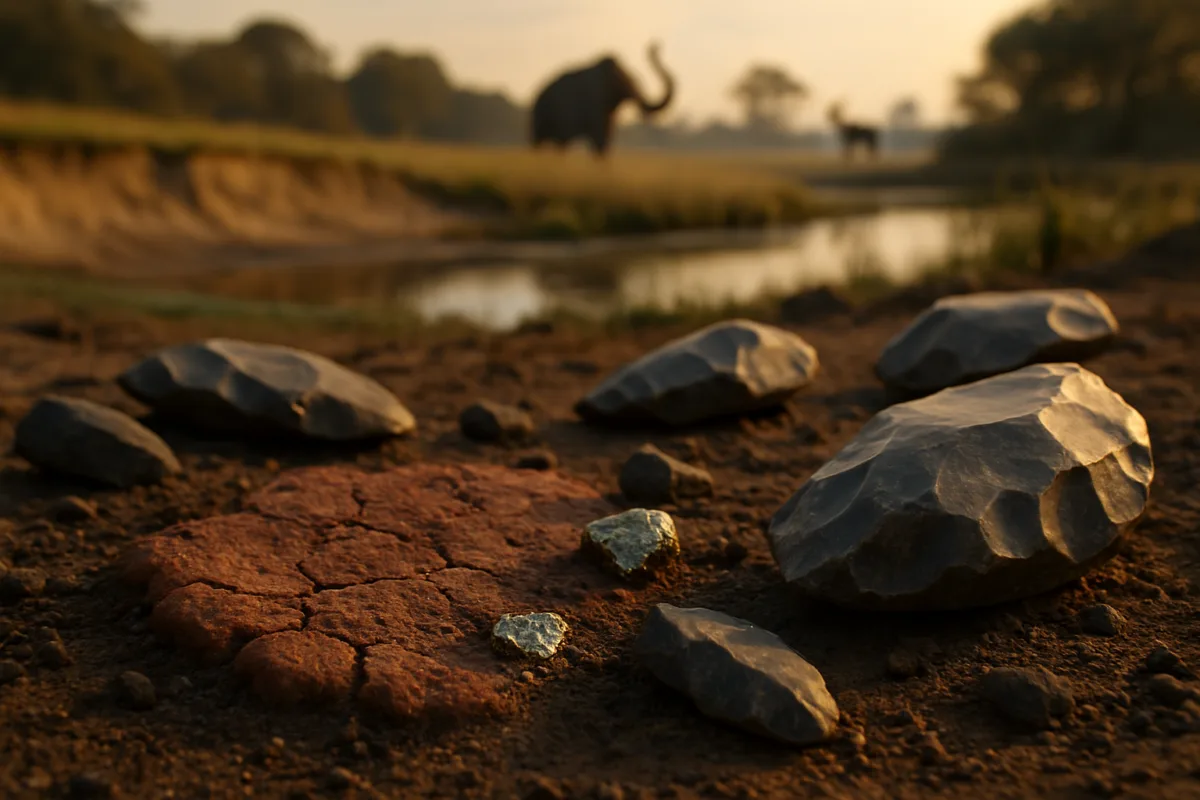
The first step in any archaeological process is careful observation of context. At the Barnham clay pit in Suffolk, excavations exposed a thin, isolated band of reddened clay roughly half a metre across, sealed beneath pond-edge sediments. That band stood out: it was a localized patch that contrasted sharply with surrounding unheated deposits. Close by, archaeologists recovered flint handaxes with fractures consistent with thermal damage. These initial field signals generated a working hypothesis: the band represented an in situ hearth—a campsite where people had maintained fire repeatedly.
From visual cues to testable claims
Visual cues alone cannot distinguish many geological processes from human activity. The process here required moving from observation to testable claims. The research team formulated key questions: Had the sediment actually experienced combustion-level temperatures? Were the high temperatures localized and repeated? Could the damaged flints be linked to the same event? Was there evidence of materials that could produce ignition—sparks—rather than mere use of naturally occurring fire? Testing these questions demanded a suite of laboratory techniques capable of reading thermal histories preserved in minerals and organic residues.
Laboratory workflows that reveal heat histories
To convert their field observations into robust evidence, the researchers ran a battery of laboratory analyses. Thin-section microscopy of the sediment allowed them to examine microscopic changes in clay structure and organic remains that indicate heating. Infrared spectroscopy and measurements of magnetic mineral transformations provided additional proxies for temperature. Combustion chemistry analyses searched for products of combustion such as specific charred compounds and changes in iron minerals that align with high-temperature exposure.
Interpreting temperature thresholds and repetition
Multiple lines of evidence converged on a critical result: the patch of clay experienced temperatures exceeding 700 degrees Celsius. That threshold matters. Many natural fires, depending on fuel and conditions, can reach high temperatures, but the combination of extreme heat, small spatial scale, and signals of repeated heating points away from a single passing wildfire. In the analytical workflow, the researchers looked for signatures of multiple heating cycles—layering of combustion products, recrystallization patterns in minerals, and variations in magnetism that indicate reheating. The pattern at Barnham matched repeated, focused heating consistent with a constructed hearth used over time.
Linking artifacts to place: the role of heat-fractured flint
Stone tools found adjacent to the reddened clay provided an important link between hearth and human activity. Flint fractures display diagnostic differences depending on cause: mechanical flaking from knapping, post-depositional breakage, or thermal shock from rapid heating. The handaxes around the feature had characteristics of heat fracturing—shallow crazing, spall scars, and patterns of conchoidal fractures consistent with exposure to intense heat. In the process of analysis, specialists compared these patterns with experimental heating of flint to establish that the fractures likely occurred in situ and contemporaneously with the heated clay.
Eliminating alternative scenarios
Process analysis requires not just positive evidence but also the elimination of reasonable alternatives. Could natural wildfire, riverbank burning, or later human activity explain the pattern? The researchers used stratigraphic relationships, localized combustion chemistry, and the tight spatial association of artifacts and pyrite to exclude broader-scale fires or later contamination. The sedimentary sealing by pond deposits further protected the feature from later disturbance, strengthening the argument that the hearth and heat-fractured flints were contemporaneous and ancient.
Pyrite: a missing link in ignition technology
Even with a secure hearth, the deeper technological question remained: did people merely tend natural fire, or did they make it on demand? Enter pyrite. When struck against sharp flint, iron pyrite ejects tiny particles that oxidize rapidly and become incandescent—sparks capable of igniting suitable tinder. The discovery of two small pyrite fragments at Barnham is pivotal because pyrite is not a common local stone at the site. Its presence demanded a process explanation: acquisition, transport, and intentional use.
Assessing provenance and use-wear
To turn two fragments into a technological inference, analysts assessed where that pyrite could have originated and whether the pieces showed use-wear. Surveys of nearby sites and thousands of stones indicated that pyrite was essentially absent in the local lithic assemblage, making geological coincidence unlikely. Microscopic examination of the fragments sought striations and impact facets consistent with striking against flint. While the fragments were small, their context beside a repeatedly heated surface and heat-shocked flints created a cohesive process narrative: people had brought pyrite to the lakeside, struck sparks, and used them to ignite tinder in a constructed hearth.
From artifacts to behavior: reconstructing a fire-making sequence
Process analysis now assembles the sequence of actions implied by the material evidence. First, individuals or groups identified and transported a non-local mineral—pyrite—alongside flint tools. They prepared a hearth site at a lakeside location, arranging combustible materials and preserving a small, focused area for repeated use. When fire was needed, they struck pyrite against flint to produce sparks and carefully introduced those sparks to prepared tinder, achieving ignition. Over time, the same spot was reheated, perhaps for cooking, warmth, or other domestic activities, producing the layered thermal signatures detected in the sediment.
Complexity beyond the strike
Making fire on demand is more than generating a spark. The process presupposes knowledge of suitable tinder preparation, control of oxygen and fuel, and coordination among group members. It also assumes cultural transmission—knowing where to find pyrite, how to carry and store it, and how to use it effectively. The rarity of pyrite at Barnham suggests that this knowledge network extended beyond one site; people remembered resource locations and incorporated them into technological routines. In a processual reading, the two pyrite fragments are evidence of an embedded chaîne opératoire that includes procurement, transport, skillful manipulation, and repeated domestic practice.
Broader implications and methodological caveats
Barnham shifts the earliest secure archaeological evidence for deliberate ignition in Britain by several hundred thousand years. Yet process analysis cautions against overreach. Preservation bias means that many early innovations may have left no recoverable trace; pyrite weathers easily and hearths can erode or be redeposited. The Barnham case is exceptional because pond sediments sealed and protected the tiny feature. The discovery therefore refines our evidential record—it shows that controlled ignition was in the repertoire of human groups in northwestern Europe during the Middle Pleistocene—but it does not prove where or when the very first fire-making event occurred.
Who made the fire?
Without human remains directly associated with the hearth, identification of the users is inferential. Comparative morphology of contemporaneous human fossils in Europe suggests early Neanderthal populations are a plausible candidate, but the region hosted diverse hominin lineages whose relationships are still being resolved. The process approach resists definitive species labeling and instead focuses on behavioral capacities: populations present at Barnham had the cognitive and cultural ability to incorporate ignition into their technological repertoire.
Seen through a process lens, the Barnham find is a window into the long, distributed development of a practice that transformed human lifeways. The archaeological sequence traces an innovation chain—from resource knowledge and material transport to skillful manipulation and repeated use—that made fire a controllable and portable technology. That small patch of baked earth and two tiny fragments of fool’s gold thus illuminate how people converted natural phenomena into reliable tools for daily life, extending control over heat, food, and social time in ways that would shape human evolution for hundreds of millennia.

Dr. Morgan directed the Archives Program from 2014 to 2017, gaining extensive experience in research documentation, information management, and the preservation of scholarly resources. Throughout her career, she has worked closely with academic publications and research materials, developing expertise in evaluating scientific sources and communicating complex topics to broad audiences.
Her primary areas of specialization include scientific publishing, research communication, editorial review, and the translation of technical research into accessible educational content. She has contributed to projects involving space science, astronomy, environmental science, history, archaeology, and emerging scientific discoveries, always emphasizing accuracy, transparency, and the responsible presentation of evidence.
As Editorial Director of Muskurahat.us, Dr. Morgan leads the editorial review process for scientific articles, ensuring that content is based on reputable sources, peer-reviewed research whenever available, and publications from recognized universities, research institutions, and international scientific organizations.
She is committed to promoting scientific literacy through clear, engaging, and well-documented articles that help readers better understand scientific discoveries and their impact on society. Her editorial philosophy is founded on accuracy, intellectual integrity, independent journalism, and continuous learning as scientific knowledge evolves.
Through her work at Muskurahat.us, Dr. Morgan supports the publication of trustworthy scientific content that makes complex research accessible to readers around the world while maintaining rigorous editorial standards.