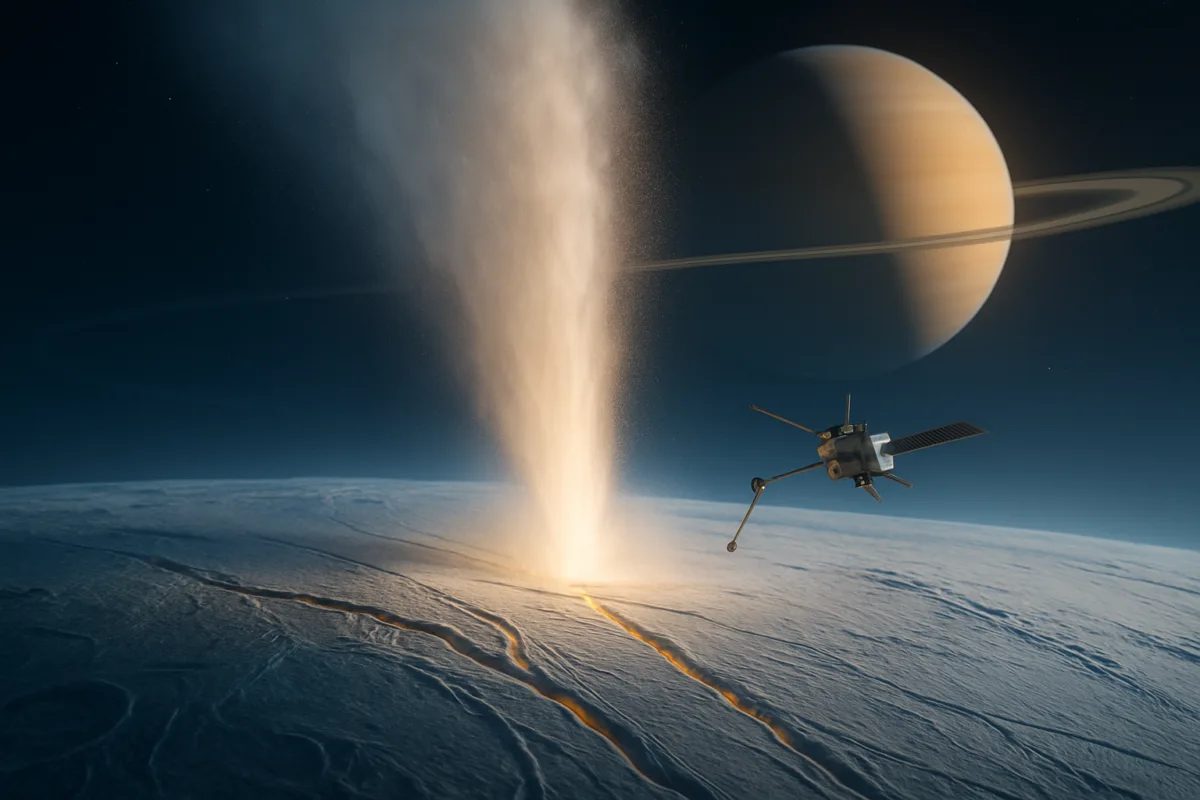
When a tiny world the size of a large city hurls water, salts and organics into space, scientists do more than stare in wonder. They run a process: measurement, calibration, inference, modelling and cautious interpretation. Enceladus, Saturn’s icy moon, provides a laboratory for that process because its south polar fractures repeatedly deliver samples of an otherwise inaccessible ocean. This article traces the chain of steps scientists use to turn raw plume signals into statements about habitability, explains the limitations at each stage, and outlines the practical steps a next mission would follow to close remaining gaps.
From pixels and ion counts to physical quantities: the measurement step
The first task is simple in description and fiendish in execution: capture the plume. For Cassini that meant targeted flybys through the jet material using instruments like an Ion and Neutral Mass Spectrometer and a Cosmic Dust Analyzer. For the James Webb Space Telescope, it meant remote spectroscopy of fluorescent water vapour extending thousands of kilometres from the moon. Each instrument produces a different raw data product — photon fluxes, mass-to-charge spectra, impact-produced fragment spectra — and each demands its own calibration pipeline.
Instrument calibration and noise handling
Calibration transforms detector counts into physical units. For mass spectrometers this requires correcting for detector efficiency by mass and energy, for neutral losses during sampling, and for background contamination. For dust analyzers it requires modelling the impact physics: the collision energy, fragmentation patterns and charge build-up all affect which fragments are detected. Remote telescopes add another layer: radiative transfer models translate spectral radiance into column densities of molecules, but they must account for fluorescence, temperature, and instrument line shapes. At every stage, error bars are quantified, and systematic uncertainties are tracked separately from statistical noise.
Deconvolution and chemical identification: how signals become species lists
Raw spectra are mixtures. Peaks overlap, molecules fragment, and energetic impacts create ions not present in the source. To get a species list, scientists use libraries of laboratory spectra and physics-based deconvolution algorithms. For Cassini’s high-speed dust impacts, researchers simulated collisions in vacuum chambers to see how various organics break apart at similar energies. They then matched those fragmentation patterns to flight data, allowing tentative identification of aromatic fragments, esters, and nitrogen-bearing moieties.
Statistical confidence and the role of reanalysis
Initial identifications are often conservative. Reanalysis adds value because new lab experiments, better fragmentation libraries, or improved noise models can lift previous ambiguities. That is how sodium phosphates moved from a speculative signal to a documented detection: teams revisited archived dust spectra, ran controlled analogue experiments and integrated geochemical modelling to test plausibility. Each reanalysis documents which features are robust and which depend on model assumptions.
Linking plume chemistry to ocean composition: transport, dilution, and provenance
Detecting a molecule in the plume is not the same as measuring it in the ocean. Scientists therefore build transport models that connect the source to the detector. These models account for the geometry of the fractures, phase changes that occur during ascent, condensation, sputtering by charged particles, and ballistic trajectories in Enceladus’s weak gravity. They also model mixing with surface frost and the creation of secondary species via photochemistry in Saturn’s magnetospheric environment.
Estimating source abundances
To infer source concentrations, researchers invert these transport models. For water vapour, the process is relatively straightforward because emission lines and fluorescence efficiencies are well understood; mapping by JWST of water at tens of thousands of kilometres provided an independent outflow estimate near 300 kilograms per second. For fragile organics and salts, the inversion is more complex: grains may originate from different depth levels, salts can fractionate during freezing, and high-speed sampling may fragment large molecules beyond recognition. Scientists therefore produce ranges rather than single numbers, tied to scenarios that assume different fracture widths, temperature profiles and grain dynamics.
Geochemical inference: what plume constituents tell us about the ocean’s interior
Once source abundances are constrained, geochemical models can be used to infer interior conditions. The presence of salts and silica nanoparticles suggests water-rock interactions at elevated temperatures; molecular hydrogen points to serpentinization or related redox reactions in a porous rocky core. Detection of orthophosphates in salt-rich ice grains implies that phosphorus is mobilized and available at concentrations that could be favorable for prebiotic chemistry. Each inference ties a measured species to a plausible reaction pathway and a set of environmental parameters: temperature, pH, redox state and water-to-rock ratio.
Energy budgets and potential metabolisms
Hydrogen and oxidants form the core of habitability assessments because they represent chemical potential energy. On Earth, certain microbes combine H2 with CO2 to make methane and biomass. Cassini observed H2, CO2 and methane in the plume, indicating pathways that could support chemotrophic life if other conditions are met. Geochemical models then estimate the flux of such reactants available over time, comparing them to expected microbial energy requirements. The result is a probabilistic statement: Enceladus has the raw ingredients and potential energy flows compatible with habitability, not proof of life.
Testing scenarios: integrating laboratory experiments and numerical models
The next step is synthesis: feed the constrained ocean chemistries into experimental reactors and planetary-scale models. In the lab, researchers mimic hydrothermal reactions with rock analogues and simulated ocean water to test whether silica nanoparticles or phosphates are produced under the inferred conditions. They run prebiotic chemistry experiments that combine detected molecules like hydrogen cyanide with plausible mineral surfaces to see whether amino acids or nucleic acid precursors can form. On the modelling side, reactive transport simulations explore how long compositional gradients persist and whether energy fluxes could support stable ecosystems.
Handling alternative explanations
Rigorous analysis requires actively trying to disprove the most exciting hypotheses. For instance, organics can be exogenous (delivered by comets or meteorites) or produced by radiolysis of ices in Saturn’s rings. To distinguish these, scientists compare isotopic ratios, expected production rates and spatial distributions. Where data are insufficient, they design measurements that would differentiate sources: isotopic measurements, intact molecular detection, or targeted sampling of emerging vapour versus grain populations.
From insight to design: how process analysis informs future missions
The chain of inference described above identifies the weakest links. Cassini’s instruments were transformative but not optimized for life detection: high-speed impacts fragmented molecules and limited identifications. A follow-on mission can be engineered explicitly to reduce fragmentation and preserve larger organics. That leads to concrete design choices: lower relative velocities during sampling, soft dust collectors, cryogenic capture to trap volatiles intact, higher-resolution mass spectrometers with tandem capabilities and onboard contamination control. Each instrument trade-off is justified by the analysis of where current uncertainties limit interpretive power.
Operational steps for in-situ sampling
An operational blueprint emerges from the process analysis. First, perform remote plume mapping to identify densest regions and temporal variability. Second, approach along trajectories that minimize impact speeds for grain collection and maximize column density for gas sampling. Third, capture grains in aerogel or cryogenic collectors to preserve macromolecules. Fourth, route volatiles through preconcentration systems to enable isotopic and chirality measurements. Lastly, sequence in-situ analyses and sample caching for eventual return if feasible.
Data analysis pipelines and open archives
Designing the data workflow ahead of time reduces interpretive friction later. Standardized calibration files, open fragmentation libraries derived from analogue experiments, and pipelines that produce both machine-readable and human-interpretable uncertainty budgets are essential. Open archives of raw and calibrated data enable reanalysis as methods improve, which is exactly how major reinterpretations of Cassini data led to discoveries like phosphate signals years after initial collection.
Enceladus exemplifies a scientific process that converts remote signals into plausible narratives about an alien ocean. Each step — measurement, calibration, species identification, transport inversion, geochemical modelling and experimental testing — carries assumptions and uncertainties. By making those assumptions explicit, iterating with new lab data, and designing follow-up missions that target the weakest links, researchers methodically sharpen the question of habitability. The plume is more than spectacle; it is a conveyor of data that lets us test hypotheses about water-rock chemistry, nutrient availability and energy flux in a world that, despite its small size, shows the restless signs of an ocean under ice. Every new measurement refines the models and helps define the next engineering step, bringing us closer to answering whether the building blocks we now detect are part of a living system or a rich prebiotic chemistry poised on the threshold of something greater.

Dr. Morgan directed the Archives Program from 2014 to 2017, gaining extensive experience in research documentation, information management, and the preservation of scholarly resources. Throughout her career, she has worked closely with academic publications and research materials, developing expertise in evaluating scientific sources and communicating complex topics to broad audiences.
Her primary areas of specialization include scientific publishing, research communication, editorial review, and the translation of technical research into accessible educational content. She has contributed to projects involving space science, astronomy, environmental science, history, archaeology, and emerging scientific discoveries, always emphasizing accuracy, transparency, and the responsible presentation of evidence.
As Editorial Director of Muskurahat.us, Dr. Morgan leads the editorial review process for scientific articles, ensuring that content is based on reputable sources, peer-reviewed research whenever available, and publications from recognized universities, research institutions, and international scientific organizations.
She is committed to promoting scientific literacy through clear, engaging, and well-documented articles that help readers better understand scientific discoveries and their impact on society. Her editorial philosophy is founded on accuracy, intellectual integrity, independent journalism, and continuous learning as scientific knowledge evolves.
Through her work at Muskurahat.us, Dr. Morgan supports the publication of trustworthy scientific content that makes complex research accessible to readers around the world while maintaining rigorous editorial standards.