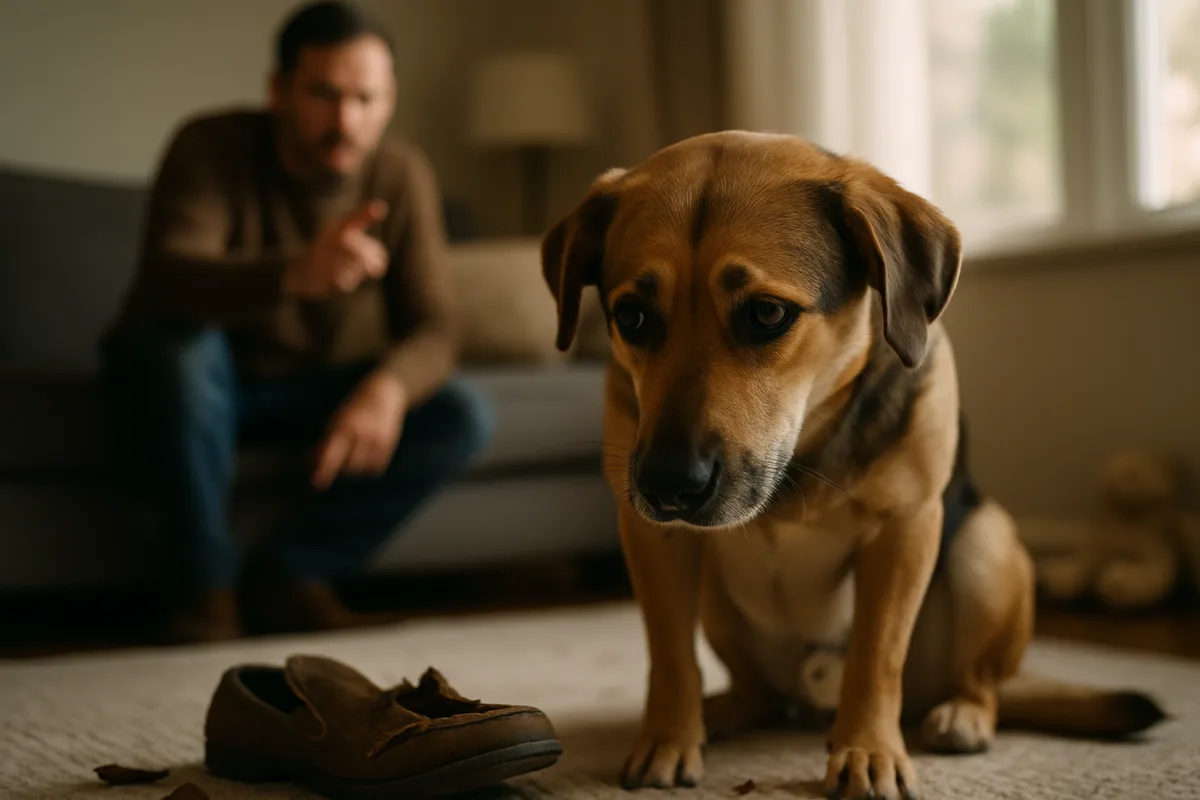
When you come home to a chewed shoe or an overturned trash can and your dog offers that classic hangdog face — ears flattened, eyes averted, body low — it can be almost impossible not to read it as a confession. After all, lowered eyes and a slinking posture look like remorse in a human. But careful experimental work suggests that the expression most owners call guilt may not be an admission of wrongdoing at all. Instead, it appears more often to be a reaction to the owner’s cues, especially the tone and body language of a scolding person.
What the research found
In an influential 2009 study, researcher Alexandra Horowitz set out to disambiguate the so-called ‘guilty look’. The experiment was simple but cleverly controlled. Owners told their dogs not to take a treat, and then left the room. While they were gone, some dogs ate the treat and others did not. When owners returned, they either scolded the dog or greeted it warmly. Crucially, in some cases owners were deliberately misinformed about what the dog had done, so the owner’s behavior was independent of the dog’s actual action.
The clever design
This cross-balanced arrangement produced four scenarios: dog ate the treat and was scolded; dog ate the treat and was greeted; dog did not eat the treat and was scolded; dog did not eat the treat and was greeted. Independent observers then scored ‘guilty-look’ behaviors — avoidance of eye contact, lowered tail, flattened ears, cowering, rolling over — in the brief period after the owner returned.
The finding is striking. Whether dogs had actually eaten the forbidden treat made almost no difference to how often they displayed guilty-look behaviors. What mattered was how the owner reacted. Dogs whose owners scolded them showed many more appeasement behaviors regardless of their actual guilt. Obedient dogs that had done nothing wrong often produced the strongest guilty looks if their owner scolded them anyway.
What the look actually signals
Read without the guilt narrative, those behaviors look less like confession and more like a suite of submissive or calming signals. Dogs flatten their ears, avert attention, and adopt low postures in many social situations where tension is present. Horowitz herself cautioned that the results do not prove dogs never feel guilt. What the study does show is that the hangdog look is unreliable as evidence that a dog is aware of having committed a specific misdeed.
Why we see guilt where none may exist
Given these findings, why do so many owners still confidently interpret the expression as remorse? Part of the answer is cognitive wiring. Humans are highly social animals built to infer hidden mental states from facial and bodily signals. We naturally anthropomorphize: we project our own motives and complex emotional life onto animals. A dog avoiding eye contact looks like shame to a human observer because that is how humans often behave in similar circumstances.
Memory, context, and confirmation bias
Other cognitive habits play a role. If you come home to a mess and see your dog nearby looking apologetic, it is tempting to connect the two facts and form a narrative: the dog did the thing and now feels bad. Confirmation bias strengthens that interpretation over time. Each time a guilty-looking dog sits near a chewed slipper, the story is validated in your mind, even though the dog’s posture may simply reflect being scolded or sensing tension.
What this means for owners and training
The empirical result carries practical implications. If the hangdog face is primarily a reaction to your cues, then scolding a dog after the fact is an ineffective way to teach or correct behavior. Dogs are most likely to connect reinforcement or punishment to events that immediately follow their action, not to consequences that appear minutes or hours later. Scolding a dog for a past misdeed may only produce stress and confusion, and may encourage submissive behaviors that you mistake for understanding.
Before you scold
If you find a mess, take a moment to assess the situation calmly. Does the evidence convincingly indicate which dog was responsible? Is the behavior dangerous or simply frustrating? Rather than immediately raising your voice or assuming guilt, keep your tone neutral and collect facts. If the dog is in the middle of an undesirable behavior, interrupting it immediately and redirecting to an acceptable alternative works far better than retrospective punishment.
Training and prevention strategies
Because delayed punishment is not an effective teacher, prevention and proactive training are the better long-term approaches. Here are practical steps grounded in behavioral principles:
- Management: Use gates, crates, or closed doors to prevent access to tempting items when you canât supervise. Many problems disappear with simple environmental controls.
- Consistent rules: Keep household rules consistent across family members. Mixed messages make it harder for a dog to know what is expected.
- Reinforcement of desirable behavior: Catch the dog doing the right thing and reward it. This builds a stronger association than scolding for past behavior.
- Immediate correction: If you catch a dog in the act of doing something unsafe or undesirable, redirect immediately with a calm ‘no’ or an interruption cue and guide them to an alternative behavior that you then reward.
- Mental and physical enrichment: Many damaging behaviors arise from boredom or excess energy. Provide walks, puzzles, chew toys, and training sessions to reduce the urge to make mischief.
Responding when you find a mess
When you discover a chewed shoe or a toppled kitchen bin and the dog greets you with the hangdog face, try this sequence: stay calm, secure the dog if necessary, remove the danger or evidence, check for signs of delayed digestive risk, and then address prevention. If the behavior is habitual, break it with management and training rather than post-hoc scolding. If the mess is minor and no harm was done, a neutral or even playful response will avoid teaching the dog that human tone predicts punishment.
The limits of current knowledge
It’s important to be cautious about overgeneralizing from a single study. Horowitz’s experiment involved fourteen dogs and carefully controlled conditions, which provides a strong hint but not a final verdict on canine inner life. The question of whether dogs can feel a moral-type emotion analogous to human guilt remains open. Designing experiments to probe complex self-referential feelings in animals is challenging both ethically and methodologically.
At the same time, the study illuminates what our common interpretations get wrong. It reminds us that many social signals in dogs are reactive — aimed at defusing tension or appeasing a stronger social partner — rather than declarative admissions of wrongdoing. This does not make dogs emotionally simple. It simply reframes the expression: often it is about the present social atmosphere rather than a past misdeed.
How to read and respond to appeasement signals
Understanding the difference between appeasement and true problem awareness helps strengthen the human-dog bond. Appeasement signals — lip licking, yawning, turning the head away, low posture, and avoiding eye contact — indicate a dog is trying to reduce social tension. Responding with calmness and predictable rules reduces stress, whereas sharp tones and unpredictable punishment can increase anxiety and prompt more submissive displays that owners misinterpret as guilt.
When your goal is behavior change, shaping alternatives with positive reinforcement and consistent management produces more reliable results. If your goal is calm companionship, learning to modulate your own tone and body language will make your dog feel safer and reduce the frequency of those anxious, guilty-looking expressions.
Seeing that hangdog face and feeling moved is natural. We are wired to interpret such cues as meaningful, and the emotional response we have to our dogs is part of what makes the relationship so rewarding. But recognizing that the ‘guilty look’ is often a direct reaction to our own behavior rather than a clear sign of contrition helps us act more kindly and effectively. By prioritizing immediate, constructive responses and consistent training, we improve both communication and welfare — and we reduce those awkward moments where a dog looks ashamed for something it didn’t do.

Dr. Morgan directed the Archives Program from 2014 to 2017, gaining extensive experience in research documentation, information management, and the preservation of scholarly resources. Throughout her career, she has worked closely with academic publications and research materials, developing expertise in evaluating scientific sources and communicating complex topics to broad audiences.
Her primary areas of specialization include scientific publishing, research communication, editorial review, and the translation of technical research into accessible educational content. She has contributed to projects involving space science, astronomy, environmental science, history, archaeology, and emerging scientific discoveries, always emphasizing accuracy, transparency, and the responsible presentation of evidence.
As Editorial Director of Muskurahat.us, Dr. Morgan leads the editorial review process for scientific articles, ensuring that content is based on reputable sources, peer-reviewed research whenever available, and publications from recognized universities, research institutions, and international scientific organizations.
She is committed to promoting scientific literacy through clear, engaging, and well-documented articles that help readers better understand scientific discoveries and their impact on society. Her editorial philosophy is founded on accuracy, intellectual integrity, independent journalism, and continuous learning as scientific knowledge evolves.
Through her work at Muskurahat.us, Dr. Morgan supports the publication of trustworthy scientific content that makes complex research accessible to readers around the world while maintaining rigorous editorial standards.