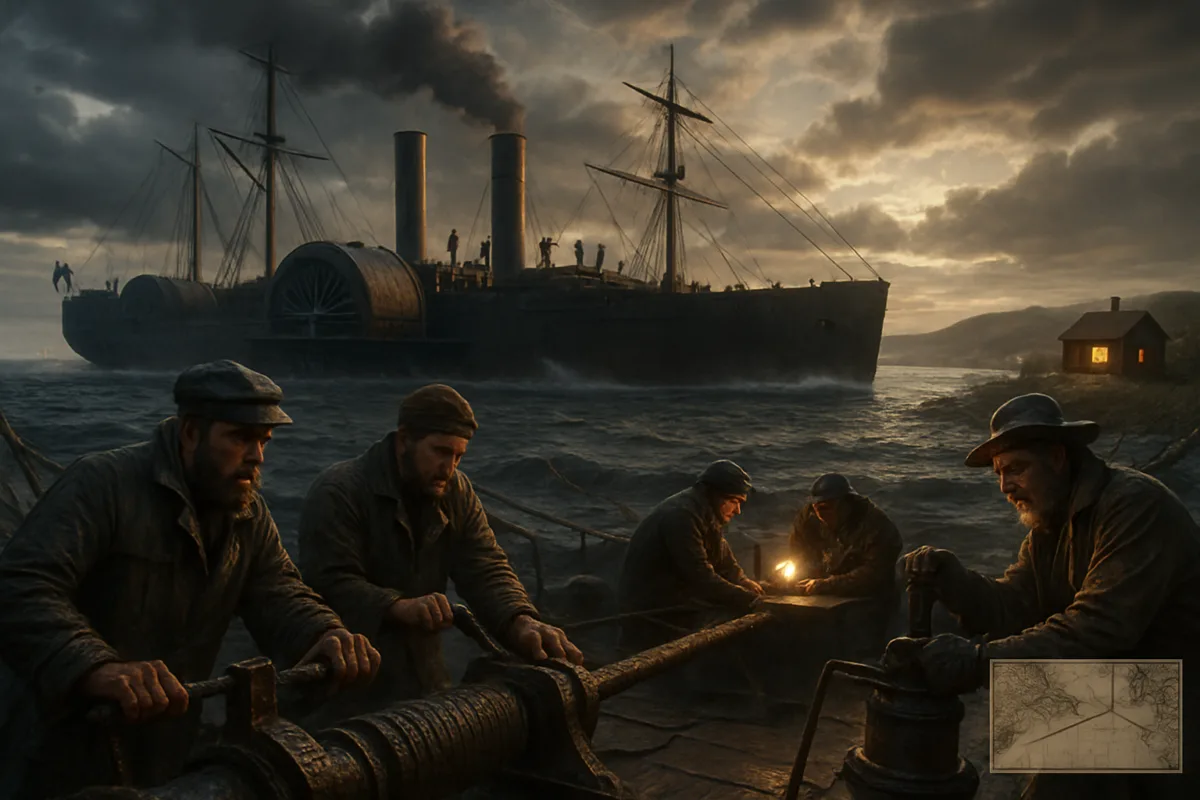
On 27 July 1866 the cable ship Great Eastern reached Heart’s Content in Newfoundland with an unbroken telegraph line trailing back across the Atlantic to Valentia Island in Ireland. For the first time Europe and North America had a communications link built to last. That sentence describes an arrival, but the story behind it is a sequence of experiments, failures, technical insights and logistical improvisations that together rewired the relationship between distance and information.
The eleven-day world: why speed mattered
Before undersea telegraphy, information moved at the pace of transport. News, instructions and market details crossed oceans only as fast as a steamer, and often slower. Diplomatic dispatches and commercial papers routinely took a week or more. A notorious example was the dispatch about Abraham Lincoln’s assassination, which took eleven days to reach the United States minister in London. That delay was not merely inconvenient; it structured how governments negotiated, how markets priced risk, and how newspapers framed events. The ocean acted as a built-in temporal filter that gave geography a kind of decision-making authority.
Early attempts and the lessons of failure
What became durable transatlantic communications was not the product of a single successful expedition but of iterative learning. The 1858 cable, championed by Cyrus West Field and his Atlantic Telegraph Company, was cause for global celebration when it briefly connected Ireland and Newfoundland. Yet its life was measured in weeks rather than years. Electric signals could be transmitted, but endurance and signal fidelity failed under real operational stresses.
Mechanical stresses and cable survivability
The first wave of failures exposed a sequence of mechanical problems. Subsea deployments had to survive manufacture, transportation, the mechanical ordeal of being paid out from a moving ship into thousands of meters of water, and the corrosive, shifting environment of the deep sea. Early cables snapped under tension or were damaged while being loaded and stowed. When a long length of conductor went slack or stretched, it created focal points of strain that could open a path to rapid failure.
Electrical degradation: resistance, capacitance and dispersion
Beyond brute strength, the cable had to preserve electrical signals across thousands of kilometers. Conduction along a long, insulated wire is not simply about resistance; it is about the interaction of resistance and capacitance. Telegraph pulses, which are sudden changes in voltage, are smeared by the cable’s distributed capacitance and resistance. The result is dispersion: sharp pulses widen and blend into one another across distance, making it progressively harder to distinguish discrete marks at the receiving end. Early operators tried to increase voltage to drive signals farther, but higher voltages could degrade insulation and accelerate failure. The solution required better materials, more thoughtful electrical operation, and instruments sensitive enough to detect faint currents without introducing destructive stresses.
Engineering the durable cable
Solving the dual mechanical and electrical challenges demanded an integrated process. Wire metallurgy, insulating compounds, sheathing methods and cable geometry had to be optimized in parallel. Experimentation focused on insulating the conductor from both electrical leakage and seawater, while the conductor itself needed to balance conductivity with tensile strength.
Materials and manufacturing improvements
Improvements in insulation and sheathing reduced leakage and physical wear. The central conductor remained copper for its conductivity, but the layers that wrapped it evolved. Gutta-percha, a natural latex used as an insulator, was applied with better control; outer armoring of iron wires provided tensile strength; and manufacturing tolerances tightened to reduce weak spots. Each improvement cut the probability of abrupt failure during payout or dampened the steady seepage that would otherwise erode signal quality over months.
Electrical practice and receiver sensitivity
Alongside better cables came better measurement. Operators refined sending techniques to avoid voltage spikes that could stress insulation. Receiving instruments were tuned for sensitivity, allowing detection of the smaller, smeared signals that long cables produced. This combination of gentler transmission and finer detection made a practical difference: it turned a brittle, noisy connection into a reliably interpretable channel.
The role of the Great Eastern and operational scale
A new class of ship changed the deployment process. Designed by Isambard Kingdom Brunel and repurposed for cable-laying, the Great Eastern was so large that it could carry the entire length of a transatlantic cable in internal tanks. That capacity eliminated the risky at-sea splice between two strings from separate ships and reduced the number of transfer operations, each a potential failure point.
Even with that advantage, the process was not straightforward. In 1865 Great Eastern came within roughly 600 miles of Newfoundland before the cable broke and sank. The crew attempted an arduous grappling operation to recover it from the seabed but ultimately returned without success. The loss was expensive and sobering, yet informative: the sunk cable’s design and failure profile could be examined and used to improve the next manufactured run.
The 1866 expedition: recovery, redundancy and completion
The 1866 crossing was an exercise in operational maturity. The ship left Ireland on 13 July and reached Heart’s Content on 27 July with a working cable. Rather than stopping there, the crew returned to the field, located the abandoned 1865 cable, spliced its recovered end to new lengths and laid a second route by September. That second cable was not merely redundancy; it was proof that repairs and complex at-sea splice operations could be executed reliably. The process had moved from isolated success to replicable method.
Splicing at sea and the procedural choreography
Splicing a cable mid-ocean required careful choreography. The crew needed to locate the lost end, haul it up with grappling gear, inspect for damage, cut and secure a joint, and then pay out additional length while managing tension so the new splice would not be rapidly strained. Each step had precise tolerances and contingencies for rough seas. The successful recovery and splicing demonstrated a procedural competence that transformed cable-laying from risky adventurism into disciplined engineering practice.
Operational realities: speed, cost and access
The new link shortened a transatlantic message from days to minutes, but that compression of time was bounded by human and economic factors. Telegraph operators still had to encode, send and transcribe messages at a finite speed. The improved 1866 line managed roughly eight words a minute. A terse dispatch could cross quickly; a detailed report still tied up the line for long stretches. More consequentially, cost constrained who benefited. Early tariffs were steep: initial prices could be about ten dollars a word with a ten-word minimum, which placed the service well beyond the reach of ordinary wages. Governments, newspapers, financiers, and large commercial firms acquired priority access first.
Systemic effects: markets, diplomacy and perception of distance
Breaking the temporal barrier changed systemic dynamics. Financial markets on opposite sides of the Atlantic could respond to the same information within the same trading cycle, removing the stale-information advantage that geographic separation had previously conferred. Economic historians find evidence that the information lag for some securities shrank from about ten days to effectively zero after the durable cable opened. That did not homogenize prices or erase arbitrage, but it altered strategic calculations and reduced some informational asymmetries.
Diplomacy shifted in comparable ways. Where ministries once built ocean voyages into contingency plans, reliable telegraphy allowed instructions and intelligence to move in hours rather than weeks. That compression accelerated decision cycles and created new pressures for faster political coordination. Yet it also concentrated advantage: those able to pay for or control cable access could project influence and respond to crises in ways that others could not.
From steam-era cables to modern undersea networks
The optic-fiber networks of today inherit the same logic the 1866 cable made visible. Much of global digital traffic travels beneath the seas on fibres grouped into armored cables. Mechanical survivability, signal integrity, redundancy, and the logistics of repair remain central concerns. Modern cables use different materials and physics, but the process of iterative engineering—observe failure, adjust design, refine procedures, scale operations—remains the engine of progress. The 1866 crossing is a milestone in that process, not a one-off miracle.
Understanding this sequence as a process matters because it reframes the iconic image of a completed cable. The history is not just about a single ship reaching a single shore; it is about a series of decisions and experiments that changed the temporal architecture of human activity. The Atlantic did not grow smaller in a strictly spatial sense on that July day, but time did. That alteration reshaped finance, diplomacy, journalism and the lived sense of distance, and it laid the infrastructural and procedural groundwork for the global networks on which so much now depends.

Dr. Morgan directed the Archives Program from 2014 to 2017, gaining extensive experience in research documentation, information management, and the preservation of scholarly resources. Throughout her career, she has worked closely with academic publications and research materials, developing expertise in evaluating scientific sources and communicating complex topics to broad audiences.
Her primary areas of specialization include scientific publishing, research communication, editorial review, and the translation of technical research into accessible educational content. She has contributed to projects involving space science, astronomy, environmental science, history, archaeology, and emerging scientific discoveries, always emphasizing accuracy, transparency, and the responsible presentation of evidence.
As Editorial Director of Muskurahat.us, Dr. Morgan leads the editorial review process for scientific articles, ensuring that content is based on reputable sources, peer-reviewed research whenever available, and publications from recognized universities, research institutions, and international scientific organizations.
She is committed to promoting scientific literacy through clear, engaging, and well-documented articles that help readers better understand scientific discoveries and their impact on society. Her editorial philosophy is founded on accuracy, intellectual integrity, independent journalism, and continuous learning as scientific knowledge evolves.
Through her work at Muskurahat.us, Dr. Morgan supports the publication of trustworthy scientific content that makes complex research accessible to readers around the world while maintaining rigorous editorial standards.