On 2 January 2004, a deliberate experiment in materials engineering, celestial navigation and contamination control unfolded at six kilometres per second. NASA’s Stardust spacecraft intersected the coma of comet Wild 2 and exposed a silica aerogel collector to a stream of dust that had been lofted from the comet’s nucleus. The returned grains — microscopic, fragile and scientifically precious — made a seven-year journey back to Earth and were handled by teams that treated them as if performing microsurgery on ancient fragments of the Solar System.
Mission architecture: defining objectives and constraints
Designing a mission to return solid cometary material required laying out a constrained decision space. Objectives included encountering a small, active comet, capturing intact particles with minimal thermal or mechanical alteration, and delivering the collector to Earth intact for terrestrial laboratory study. Constraints were severe: the target moved at high relative speed; the sample mass expected was tiny (fractions of a milligram); contamination and alteration risks were high; and the mission had to work within launch mass, power and communications budgets.
Selecting the target and timeline
Wild 2 emerged as a strategically useful choice. Its orbit had been redirected by Jupiter decades earlier, bringing material into the inner Solar System after relatively few perihelion passages. That history implied less thermal processing than many short-period comets, increasing the chance of preserving primordial constituents. Mission planners synchronized complex trajectory steps — a 1999 launch, an Earth gravity assist in 2001, a 2002 asteroid flyby, and the 2004 encounter — to maximize scientific return while keeping the spacecraft within fuel and lifetime limits.
Measurements shaping design
From the outset, the mission team had to reconcile what could be measured in flight with what would be gained by returning a physical sample. Remote instruments can probe composition, morphology and jets, but analysis tools on Earth evolve. The decision to return material traded increased mission risk and complexity for the long-term value of preserved samples that could be re-examined with future technologies.
Materials engineering: crafting a ‘soft catch’ medium
Stopping particles moving at 6.1 kilometres per second without destroying them demanded a novel approach. A hard collector would convert kinetic energy into intense, localized heating and shock, pulverizing or melting grains. The solution was silica aerogel: a translucent, highly porous solid roughly 99.8 percent air, engineered to provide extremely low initial resistance and gradually increasing deceleration as depth increased.
Grading density to manage deceleration
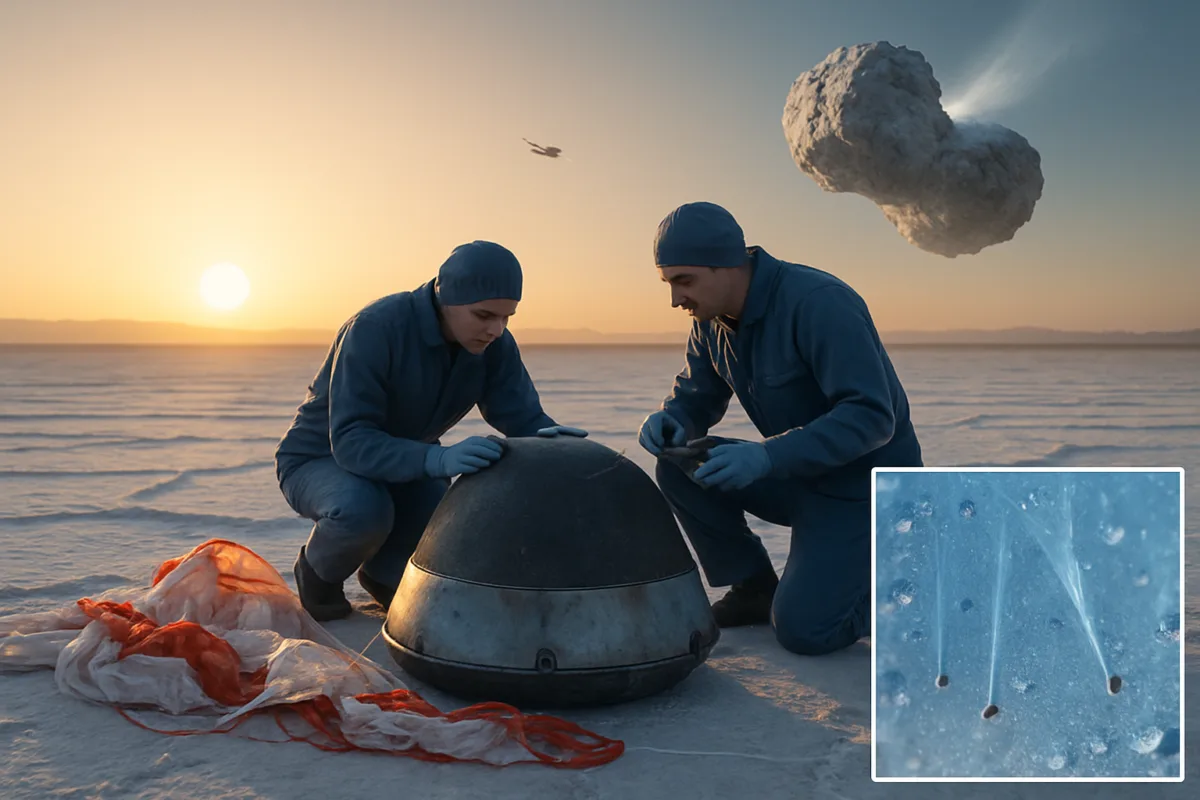
A key design parameter was the aerogel density gradient. By fabricating tiles with increasing density with depth, the spacecraft created a braking profile that allowed particles to carve elongated tracks rather than producing point-of-impact explosions. The resulting trajectories within the aerogel often resembled tapered carrots — narrow entries broadening toward the terminal grain — giving scientists a spatial record of deceleration and heating.
Trade-offs and failure modes
Even with graded aerogel, capture was not benign. Larger or loosely aggregated particles could fragment; some components experienced melting; and organic molecules risked alteration by transient heating. Designers accepted these trade-offs because the alternative — no sample return — would preclude direct laboratory study. The mission therefore incorporated stringent contamination control and metadata capture, so laboratory analysts could separate capture artifacts from original cometary signatures.
Encounter execution: navigation, exposure and protection
Executing the flyby required precise navigation and timing. Stardust passed within roughly 236 kilometres of the nucleus, traversing the coma rather than the extended tail. The collector was oriented to face incoming grains during the brief high-risk window, while the spacecraft’s Whipple shields guarded sensitive systems from larger impacts. On the opposite face of the collector, the mission also opportunistically gathered particles from interstellar streams during other portions of its cruise.
Operational choreography
The encounter combined high-speed imaging, dust instrumentation and passive capture. Cameras mapped nucleus morphology and jet sources, establishing the geological provenance of intercepted grains. Dust sensors provided flux and particle-size context. All of this telemetry was recorded so that subsequent lab work on specific tracks could be tied back to encounter geometry and local activity on Wild 2.
Sample containment and cruise: preserving context
After the flyby, the collector was retracted into a sealed return capsule and remained isolated for years. This phase turned the collector into a time capsule: the minute particles captured in the aerogel were preserved from further contamination or degradation while the spacecraft completed its long journey back to Earth across 4.63 billion kilometres. The capsule itself was designed to separate from the bus for a high-speed atmospheric entry while the main spacecraft continued on for future missions.
High-speed return: atmospheric entry and recovery
On 15 January 2006 the return capsule separated and entered Earth’s atmosphere at 12.8 kilometres per second — a record for human-made objects. The thermal and aerodynamic environment during entry posed a separate design challenge. A carbon-based heat shield had to absorb and radiate the enormous kinetic energy without allowing heat or ablation products to contaminate the preserved collector. A drogue and then main parachute sequence slowed the capsule for a planned landing on the Utah Test and Training Range.
From touchdown to cleanroom
Despite crosswinds that shifted the ground track, recovery teams located the capsule using a radio beacon 44 minutes after touchdown. Opening the canister required a temporary cleanroom at Dugway Proving Ground and subsequent transfer to NASA’s Johnson Space Center. Even then, the work was not finished: tens of thousands of particles larger than one micrometre had to be catalogued, and the records of track position, orientation and aerogel context became essential metadata for later laboratory extraction.
Laboratory techniques: microsurgery on ancient grains
Extracting grains from aerogel is a delicate, stepwise process. Analysts map tracks with microscopy, isolate wedges of aerogel around a track, and then work inward to the terminal particle. The imagery of ‘microsurgery’ is apt: technicians cut, handle and mount micrometre-scale materials while avoiding contamination and accidental loss. Preparation techniques differ depending on analytical goals: transmission electron microscopy, isotopic mass spectrometry and mineralogical analyses each require different sample mounts and cleaning protocols.
Distinguishing original signals from capture artifacts
Because capture involves kinetic heating and possible fragmentation, scientists repeatedly ask whether an observed mineral or organic signature reflects cometary origin or is a byproduct of the encounter or terrestrial handling. To address this, multiple cross-checks are employed: comparing residues from aerogel adjacent to tracks, analyzing aluminum foil on spacecraft surfaces for impact residues, and using isotopic signatures that distinguish extraterrestrial from terrestrial carbon or oxygen. The iterative nature of these investigations exemplifies why returned samples gain value over decades.
Scientific outcomes: surprises and iterative reinterpretation
Initial analyses revealed that Wild 2’s non-volatile grains were more heterogeneous than expected. High-temperature minerals, including crystalline silicates and refractory inclusions akin to those in primitive meteorites, appeared alongside cold-formed materials. The presence of an inclusion named Inti and oxygen-16 enrichments implied that matter from close to the young Sun had been transported outward into the comet-forming region. Such findings forced researchers to revise simplistic models of radial isolation in the early Solar System and to emphasize efficient large-scale transport processes.
Organic molecules and context
The detection of glycine in 2009 was another milestone. While not evidence of life, the identification of an amino acid with an extraterrestrial isotopic signature demonstrated that biologically relevant molecules can form and survive in cometary environments. This reinforced hypotheses that comets could have delivered prebiotic ingredients to early Earth, and it highlighted the need for rigorous contamination control and isotopic analysis to validate such claims.
Legacy and ongoing value: why a returned sample matters
Stardust’s achievement has two complementary legacies. First, it established that deliberate sample return from beyond the Moon is feasible, incorporating spacecraft navigation, novel materials, and high-speed reentry technologies. Second, and perhaps more enduring, is the archival value of physical samples. As instruments advance and new analytical techniques emerge, preserved grains can be reexamined, contested results can be resolved, and future generations of scientists can ask questions not yet conceived when the mission was planned.
Analyzing the process of the Stardust mission clarifies how technical design choices, operational procedures and laboratory protocols cohere into a single scientific outcome. Each phase — from target selection and aerogel engineering to cleanroom handling and isotopic discrimination — embodies trade-offs and safeguards meant to maximize scientific fidelity. The mission converted remote observation into repeatable, manipulable laboratory data, proving that with careful design and disciplined execution, even sub-milligram samples can reshape our models of where planetary ingredients originate and how they move through a young Solar System. The grains embedded in aerogel remain a small but potent bridge between fieldwork in space and the evolving toolkit of Earth-based science, continually inviting new questions about our cosmic origins.

Dr. Morgan directed the Archives Program from 2014 to 2017, gaining extensive experience in research documentation, information management, and the preservation of scholarly resources. Throughout her career, she has worked closely with academic publications and research materials, developing expertise in evaluating scientific sources and communicating complex topics to broad audiences.
Her primary areas of specialization include scientific publishing, research communication, editorial review, and the translation of technical research into accessible educational content. She has contributed to projects involving space science, astronomy, environmental science, history, archaeology, and emerging scientific discoveries, always emphasizing accuracy, transparency, and the responsible presentation of evidence.
As Editorial Director of Muskurahat.us, Dr. Morgan leads the editorial review process for scientific articles, ensuring that content is based on reputable sources, peer-reviewed research whenever available, and publications from recognized universities, research institutions, and international scientific organizations.
She is committed to promoting scientific literacy through clear, engaging, and well-documented articles that help readers better understand scientific discoveries and their impact on society. Her editorial philosophy is founded on accuracy, intellectual integrity, independent journalism, and continuous learning as scientific knowledge evolves.
Through her work at Muskurahat.us, Dr. Morgan supports the publication of trustworthy scientific content that makes complex research accessible to readers around the world while maintaining rigorous editorial standards.