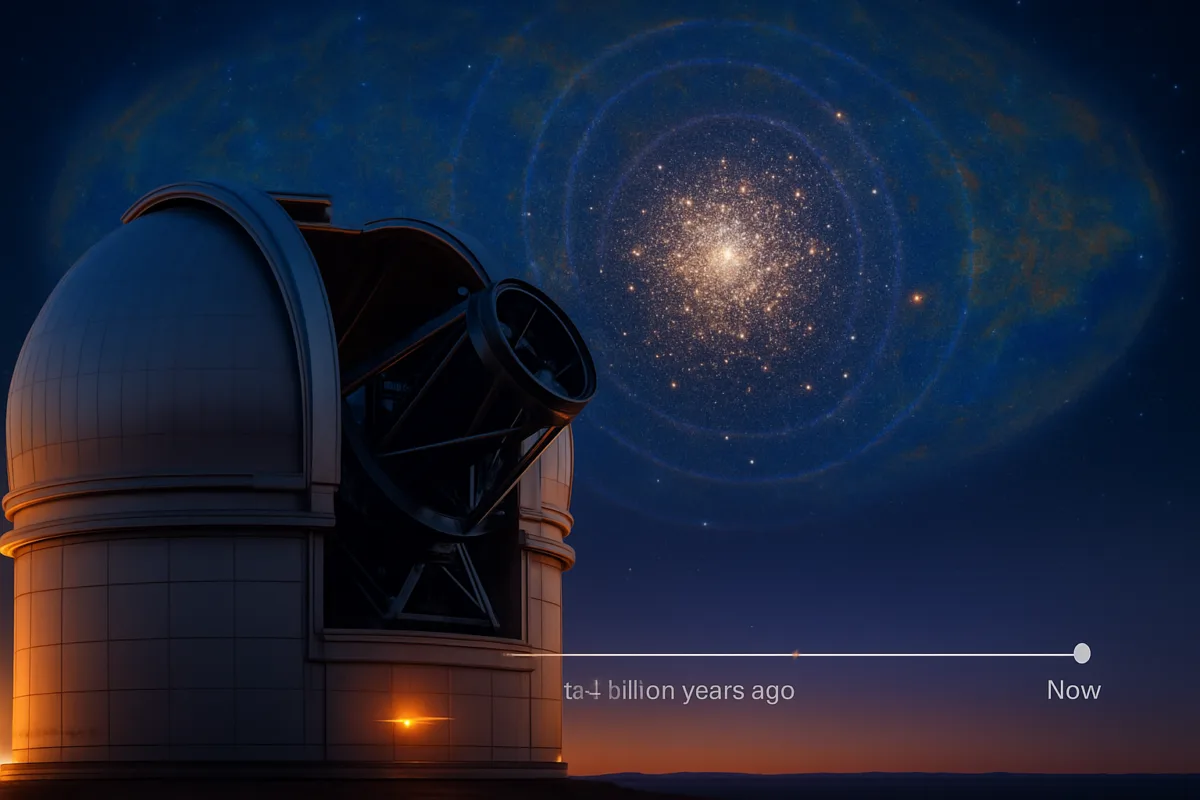
How old is our universe? That question sits at the intersection of precise observation, physical theory, and layered inference. It is deceptively simple: assign a single number to the time elapsed since the cosmos began its current expanding phase. But the path from raw data—faint microwave photons, exploding stars, ticking nuclear clocks inside ancient stars—to a published age requires many steps: choosing a cosmological model, calibrating distance ladders, modeling the physics of the early universe, and quantifying uncertainties. In this article I examine, step by step, how scientists measure the age of the universe, why the current numerical answer is widely accepted, where tensions and uncertainties remain, and what future measurements could change the picture.
Background and scientific context: measurable clocks and the cosmological framework
Estimating the age of the universe combines empirical clocks with theoretical scaffolding. Observationally, researchers exploit multiple independent methods—cosmic expansion rates, the fossil glow of the cosmic microwave background (CMB), the radioactive and cooling ages of stars, and the ages of star clusters. Theoretically, most age calculations assume a cosmological model: the Lambda Cold Dark Matter (ΛCDM) model, which describes a spatially homogeneous universe filled with radiation, baryonic matter, cold dark matter, and a cosmological constant (Λ) that drives accelerated expansion.
Two broad principles guide the process analysis: first, different observational probes are sensitive to different epochs and physical assumptions; second, translating an observable (for instance, the angular scale of acoustic oscillations in the CMB) into elapsed time requires a chain of calculations, each with its own sources of statistical and systematic uncertainty. The age derived from any method is therefore a compound result.
How old is our universe: evidence from the cosmic microwave background
The CMB is the most direct route to a precise cosmological age under the ΛCDM framework. These are relic photons released when the universe cooled enough, about 380,000 years after the Big Bang, for electrons and protons to combine into neutral atoms—a process called recombination. Tiny temperature and polarization anisotropies in the CMB contain a wealth of information about the contents of the universe and its expansion history.
To estimate age from the CMB, researchers measure the angular pattern of acoustic peaks in the power spectrum of temperature and polarization anisotropies. These peaks reflect the physical scale of sound waves in the primordial plasma and their angular scale encodes the geometry and expansion history of the intervening universe. Under ΛCDM, the peak locations depend sensitively on the Hubble constant (H0), the densities of matter and radiation, and the cosmological constant. Combining the angular pattern with the physics of recombination and the inferred matter-energy content yields a best-fit cosmic timeline, including the time since the Big Bang.
The Planck satellite (European Space Agency) provided the most precise full-sky CMB measurements to date. Analyses of Planck data within the ΛCDM model produce an age of the universe around 13.8 billion years, with formal statistical uncertainties of a few tens of millions of years. This result is contingent on the assumed model: if extensions to ΛCDM (for example, additional relativistic particle species, evolving dark energy, or spatial curvature) are allowed, the derived age can shift modestly. Still, within the standard model, the CMB route gives the tightest and most widely cited estimate.
How old is our universe: competing measurements and the Hubble tension
Another direct route uses measurements of the current expansion rate, the Hubble constant (H0). In a simple cosmology the age of the universe is roughly the inverse of H0 (more precisely, the age depends on the full expansion history, including matter and dark energy contributions). Measuring H0 locally—using geometric distances to nearby galaxies calibrated by Cepheid variable stars and Type Ia supernovae, or using maser-hosted galaxies and parallax—yields an independent age estimate when combined with an assumed cosmological model.
In recent years, precise local determinations of H0 (notably by the SH0ES team led by Adam Riess and collaborators) have obtained values around 73 km/s/Mpc. When those H0 values are interpreted within ΛCDM together with other constraints, they indicate an age slightly younger than the Planck/CMB-derived age. The discrepancy is part of the broader “Hubble tension”: a statistically significant difference between early-universe inferences of H0 (from the CMB and large-scale structure, which imply ~67 km/s/Mpc) and late-universe local measurements (which imply ~73 km/s/Mpc).
Because age and H0 are linked through the expansion history, this tension maps into a tension in derived ages if one forces a single cosmological model. Resolving the disagreement may require new physics (for example, early dark energy, additional relativistic particles, or modifications to recombination physics) or may point to unrecognized systematic errors in one or more measurement techniques. Until resolved, the discrepancy is the primary source of ongoing uncertainty in the precise estimate of the universe’s age.
Scientific evidence and current research: how different methods converge and why they matter
Robust science depends on converging evidence from independent methods. In addition to the CMB and H0 ladder, several astrophysical clocks provide complementary age estimates that test the model-dependent inferences.
1) Globular clusters. These dense, ancient star clusters in the halos of galaxies host some of the oldest stars known. Stellar evolution models fit to color–magnitude diagrams for globular cluster stars yield ages typically in the range 12–13.5 billion years. These ages depend on stellar physics inputs (opacities, nuclear reaction rates, element abundances) and distance estimates; modern treatments using Gaia parallaxes and updated stellar models produce results consistent with a ~13-billion-year-plus universe.
2) Radioactive dating in stars. Heavy elements such as uranium and thorium are produced in rapid neutron-capture (r-process) events. Measuring the relative abundances of long-lived radioactive isotopes and stable r-process elements in very metal-poor stars allows astronomers to compute radioactive decay ages. Typical decay ages for the oldest stars are around 12–13 billion years, with substantial uncertainties arising from nucleosynthesis yield models and initial abundance assumptions.
3) White dwarf cooling. White dwarfs cool predictably as they radiate away leftover thermal energy. Modeling populations of white dwarfs—particularly the cutoff in the white dwarf luminosity function—provides an age for the oldest white dwarfs and, by extension, the stellar populations that produced them. These methods yield ages of roughly 10–12 billion years for halo white dwarfs, compatible with the older ages from CMB and globular clusters once formation time is considered.
4) Large-scale structure and baryon acoustic oscillations (BAO). The same acoustic physics imprinted in the CMB also leaves a preferred scale in the distribution of galaxies (BAO). BAO measurements provide a geometrical ruler to calibrate distances at lower redshifts and, when combined with other probes, constrain the expansion history and thereby the cosmic age in a model-dependent manner. BAO results generally support the ΛCDM-derived ages.
Methodological clarity: what each approach assumes
It is essential to understand that all cosmological age estimates are conditional: most are computed within a framework that assumes general relativity on cosmic scales and the constituent components of the universe (radiation, baryons, cold dark matter, and dark energy). Stellar-based methods add layers of astrophysical modeling—stellar interiors, nucleosynthesis, and distance scales—that entail independent, sometimes large, systematic uncertainties. The value of multiple approaches is that they test different assumptions: if independent methods converge, confidence in the age estimate rises.
Detailed data table
| Method | Key observable(s) | Representative age estimate | Representative institutions / surveys | Main limitations |
|---|---|---|---|---|
| Cosmic Microwave Background (CMB) | Angular power spectrum of temperature and polarization anisotropies | ≈ 13.8 billion years (Planck analyses) | Planck Collaboration (ESA), several university-affiliated analysis teams | Model dependence (ΛCDM assumed); sensitivity to recombination physics and calibration |
| Local Hubble constant (distance ladder) | Parallax → Cepheids → Type Ia supernovae distances; direct H0 | Implied ages vary; local H0 ≈ 73 km/s/Mpc suggests slightly younger universe if ΛCDM is forced | SH0ES Team (HST), Gaia mission (parallaxes), various SN surveys | Potential systematics in distance calibration, sample selection, metallicity effects on Cepheids |
| Globular cluster ages | Stellar color–magnitude diagrams, main-sequence turnoff | ~12–13.5 billion years | Multiple observatories; Gaia mission for distances; stellar model groups | Stellar physics uncertainties, cluster distance measurements, and chemical composition effects |
| Radioactive dating in metal-poor stars | Abundance ratios of long-lived isotopes (U/Th) and stable r-process elements | ~12–13 billion years (large uncertainties) | High-resolution spectrographs on large telescopes; nuclear astrophysics groups | Uncertainty in initial production ratios and stellar atmosphere modeling |
| White dwarf cooling | White dwarf luminosity functions, cooling models | ~10–12 billion years for oldest populations | Large telescopes and surveys (e.g., SDSS), theoretical cooling models | Model uncertainties in crystallization, atmospheric composition, and progenitor lifetimes |
| BAO + large-scale structure | Galaxy clustering scale, BAO peak | Consistent with CMB-derived age when combined within ΛCDM | SDSS/BOSS/eBOSS, DESI and other galaxy surveys | Dependence on model assumptions and data combination methods |
What scientists still do not know: uncertainties, degeneracies, and the Hubble tension
Even with precise data, several important unknowns remain. One major issue is the Hubble tension described earlier. If local and early-universe values of H0 do not reconcile within measurement errors and known systematic uncertainties, then at least one of the following must be true: (a) an unrecognized systematic error exists in one or more datasets or calibrations; (b) the standard ΛCDM model is incomplete; or (c) both. Any of these possibilities would affect the derived age of the universe.
Another source of uncertainty is model degeneracy. Certain extensions to ΛCDM—such as extra relativistic species (parameterized as ΔNeff), varying dark energy properties, or nonzero spatial curvature—can shift the best-fit age by hundreds of millions of years. While current combined datasets tightly constrain many of these extensions, small departures remain allowed and could subtly change age estimates.
On the astrophysical side, ages derived from stellar populations depend on the fidelity of stellar models. Physical inputs such as opacity tables, reaction rates (notably 14N(p,γ)15O that affects main-sequence lifetimes), convection prescriptions, and the treatment of diffusion can change inferred stellar ages by several percent. For the oldest stars, a change of a few percent corresponds to several hundred million years—non-negligible compared with CMB uncertainties.
Finally, cosmic chronology depends on epochs prior to recombination (e.g., primordial nucleosynthesis, pre-recombination energy injection) only indirectly; however, exotic processes before or during recombination could alter both the CMB observables and the inferred age. Researchers explore such possibilities but so far have found no compelling, data-driven reason to abandon ΛCDM.
Why this matters: scientific and philosophical implications
Knowing the age of the universe is not merely an exercise in big numbers. The estimate ties together disparate physical sciences: nuclear physics (in radioactive dating), stellar astrophysics (in cluster ages and white dwarf cooling), plasma physics and atomic physics (in recombination and CMB formation), and general relativity (in the cosmological model). A precise age constrains models of structure formation, the timeline for galaxy and star formation, and the synthesis of the elements. It also provides a boundary condition for theories that attempt to describe what, if anything, preceded the Big Bang phase that marks the start of the observable universe’s standard evolution.
Philosophically, the cosmic age frames human history against the immensity of time. It anchors narratives about the emergence of complexity—from first stars and galaxies to planets and life—allowing scientists to place those developments on a temporal scale rooted in measurement.
Future research and outlook: what would change the age estimate?
Several near-term and mid-term improvements could refine or revise the universe’s estimated age:
– Improved local H0 measurements. Continued data releases from the Gaia astrometric mission, better calibration of Cepheids and alternative distance anchors (e.g., detached eclipsing binaries, masers), and expanded samples of Type Ia supernovae will test current local H0 values and may reduce systematic uncertainties.
– Next-generation CMB experiments. Projects like the Simons Observatory and CMB-S4 will measure CMB polarization and small-scale anisotropies with higher sensitivity, improving constraints on cosmological parameters and testing extensions to ΛCDM that could affect the age.
– Large-scale structure surveys. Upcoming wide-field spectroscopic surveys (such as DESI) and imaging surveys (e.g., Vera Rubin Observatory/LSST) will sharpen BAO and growth-of-structure measurements, further constraining expansion history and potential model extensions.
– Stellar physics advances. Better nuclear reaction rates, opacities, and 3D stellar atmosphere models—combined with more precise parallax distances from Gaia—will make stellar-based age estimates more reliable and reduce cross-method discrepancies.
– Multi-messenger astrophysics. Gravitational-wave standard sirens (binary neutron star mergers where the distance is measured directly) provide an independent route to H0 and therefore to age inference. As detector sensitivity and detection rates improve, standard sirens could help arbitrate between local and early-universe H0 values.
Frequently Asked Questions
How precise is the current best estimate of the universe’s age?
Within the standard ΛCDM cosmological model and using Planck CMB data, the age is known to roughly a few parts in ten thousand—formally around 13.8 billion years with uncertainties on the order of tens of millions of years. However, taking into account model uncertainty and the Hubble tension, effective uncertainty for a non-specialist should be viewed as a few hundred million years.
Can the age of the universe be measured without assuming a cosmological model?
Not completely. Some methods, such as radioactive dating of individual stars or white dwarf cooling, provide lower bounds on cosmic age that are relatively model independent, but to compute a global age for the universe one must model the expansion history and composition of the cosmos to translate measured quantities into a time since the initial hot, dense phase.
What is the Hubble tension and why does it matter for the age?
The Hubble tension is a statistically significant disagreement between the expansion rate inferred from early-universe observations (CMB) and direct late-universe measurements (distance ladder methods). Because the age is linked to the expansion rate and the universe’s energy contents, the tension implies that either our measurements or our model is incomplete—each scenario could shift the derived age.
Do alternate cosmologies predict very different ages?
Some alternate cosmological models predict modestly different ages—typically differing by up to a few hundred million years under reasonable parameter choices. Very radical alternatives would change the age more drastically, but they generally also conflict with multiple precise observations such as the CMB peak structure and the observed abundances of light elements.
How do stellar ages compare with cosmological ages?
Stellar ages for the oldest objects (globular clusters, metal-poor halo stars) cluster around 12–13.5 billion years. These are consistent with the cosmological age when allowing for formation time between the Big Bang and the birth of the first stars. Concordance between stellar-based and cosmological methods strengthens overall confidence.
Could future observations prove the universe is significantly older or younger than 13.8 billion years?
Large, well-justified shifts are unlikely given current constraints, but modest revisions of a few percent remain possible if new physics is required to resolve tensions or if systematic errors are discovered. The most plausible changes would be at the level of several hundred million years rather than multiple billions.
Sources and Further Reading
Planck Collaboration — “Planck 2018 results. VI. Cosmological parameters” — 2018/2020. (Planck is the principal full-sky CMB dataset used to derive the canonical age under ΛCDM.)
WMAP Science Team — “Wilkinson Microwave Anisotropy Probe (WMAP) nine-year results” — 2013. (Earlier full-sky CMB satellite that provided strong constraints on cosmology prior to Planck.)
Riess, A. G., et al. — SH0ES Team publications on H0 — 2016–2021. (Represent key local H0 measurements using Cepheids and Type Ia supernovae.)
NASA Astrophysics Data System and Hubble Space Telescope science communications — explanatory material on distance ladders, Cepheids, and Type Ia supernovae.
Academic reviews on cosmic chronometry and stellar ages: textbooks and review articles in Annual Reviews of Astronomy and Astrophysics discussing globular cluster ages, white dwarf cooling, and radioactive dating techniques.
Large-scale structure and BAO surveys: SDSS/BOSS/eBOSS collaboration papers and early DESI project descriptions (technical literature detailing BAO measurements and implications for cosmology).
Nuclear astrophysics and r-process studies: reviews summarizing nucleosynthesis, the production of heavy radioactive isotopes, and their use in stellar age determinations.
For readers who want direct entry points, the institutional pages of ESA/Planck, NASA/WMAP, and the Hubble Space Telescope’s educational resources provide accessible summaries and links to primary literature.

Dr. Morgan directed the Archives Program from 2014 to 2017, gaining extensive experience in research documentation, information management, and the preservation of scholarly resources. Throughout her career, she has worked closely with academic publications and research materials, developing expertise in evaluating scientific sources and communicating complex topics to broad audiences.
Her primary areas of specialization include scientific publishing, research communication, editorial review, and the translation of technical research into accessible educational content. She has contributed to projects involving space science, astronomy, environmental science, history, archaeology, and emerging scientific discoveries, always emphasizing accuracy, transparency, and the responsible presentation of evidence.
As Editorial Director of Muskurahat.us, Dr. Morgan leads the editorial review process for scientific articles, ensuring that content is based on reputable sources, peer-reviewed research whenever available, and publications from recognized universities, research institutions, and international scientific organizations.
She is committed to promoting scientific literacy through clear, engaging, and well-documented articles that help readers better understand scientific discoveries and their impact on society. Her editorial philosophy is founded on accuracy, intellectual integrity, independent journalism, and continuous learning as scientific knowledge evolves.
Through her work at Muskurahat.us, Dr. Morgan supports the publication of trustworthy scientific content that makes complex research accessible to readers around the world while maintaining rigorous editorial standards.