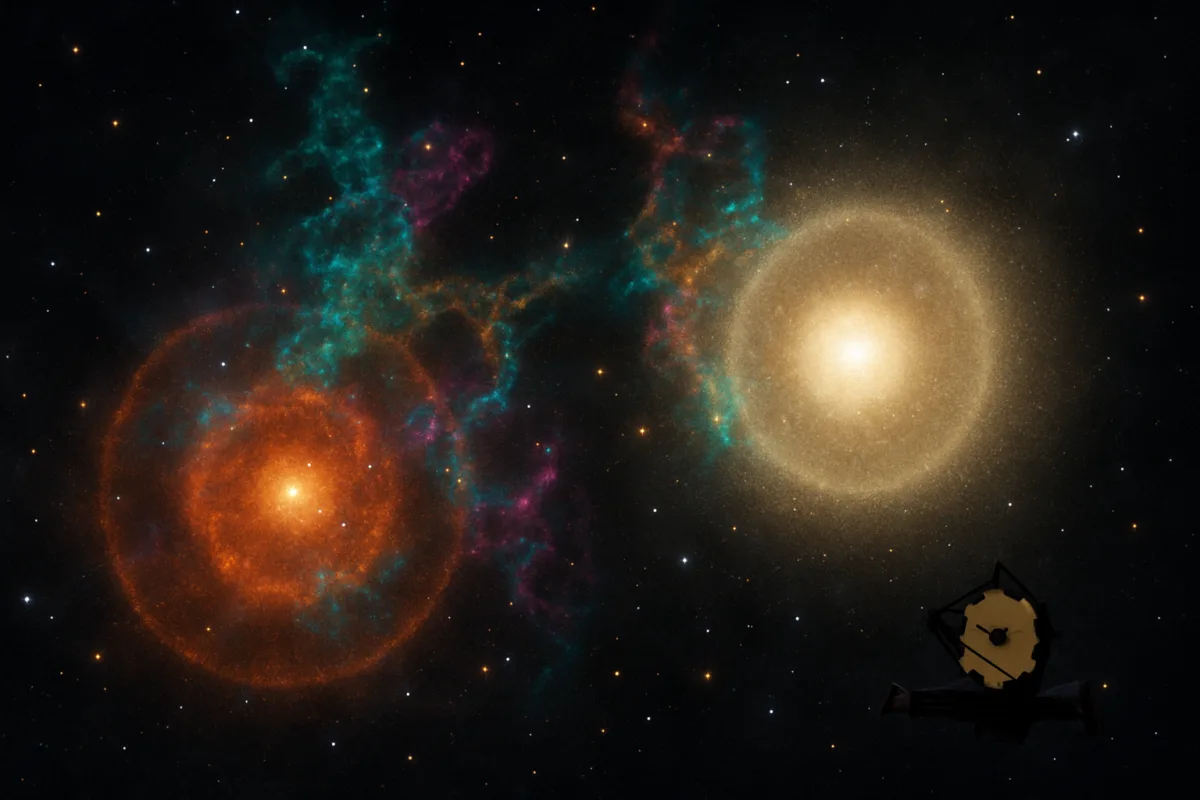
When the James Webb Space Telescope turned its Mid-Infrared Instrument toward Sextans A, it aimed to read the chemistry of old stars in a chemically sparse environment. The spectra returned a puzzle: two different ageing stars, each operating under a near-starvation diet of heavy elements, appeared to be making solid grains that astronomers expected to become rare as metallicity fell. One star bears the unmistakable fingerprint of silicon carbide, while another’s smooth infrared glow is best explained by metallic iron grains. Understanding how those solids could form in a galaxy that contains only a few percent of the Sun’s metals demands a stepwise analysis of the observations, the models used to interpret them, and the physical processes inside and around asymptotic giant branch stars that assemble dust from gas.
Setting up the observation: target selection and spectral tools
The investigation began with a deliberate selection of targets: six asymptotic giant branch (AGB) stars in Sextans A chosen to sample both carbon-rich and oxygen-rich chemistries. Webb’s MIRI low-resolution spectrometer delivered mid-infrared spectra, where many dust species reveal themselves through characteristic emission or absorption features. The plan of attack followed a familiar observational workflow: isolate point sources, extract their spectra, compare observed spectral energy distributions (SEDs) against template features and radiative-transfer models, and assess which grain compositions can reconcile the data. Every step of this chain — from background subtraction to model selection — shapes the inferences about dust species in a low-metallicity context.
Identifying silicon carbide: a clear spectroscopic fingerprint
One of the six stars showed an emission bump near 11.3 micrometres, the classic mid-infrared signature of silicon carbide (SiC). The spectrum also displayed strong acetylene absorption, consistent with a carbon-rich atmosphere. The identification of SiC is relatively direct: laboratory and astronomical SiC spectra match the observed feature in wavelength and shape well enough to be described as confirmed.
Process steps that led to this attribution
First, the pipeline extracted an SED cleaned of instrumental and sky backgrounds. Next, the analysis isolated emission excesses above the expected stellar continuum and compared them with known dust spectral libraries. The 11.3 μm emission feature’s position and profile aligned with established SiC templates. Additional consistency checks — such as the simultaneous detection of molecular absorptions typical of carbon-rich outflows — reinforced the conclusion. Because carbon can be produced in situ inside AGB stars via thermal pulses and dredge-up, the presence of carbonaceous grains in a metal-poor star follows a plausible internal production pathway: dredged-up carbon shifts the C/O ratio above unity and enables carbon condensation even when silicon is scarce.
Inferring metallic iron: model-driven interpretation of a featureless continuum
The second interesting case lacked a sharp spectral feature near 10 μm where silicate grains normally produce emission in oxygen-rich winds. Instead, the infrared spectrum presented a smooth, strong excess. To interpret such a featureless continuum, the research team compared the observed SED to radiative-transfer models populated with various grain mixtures. A model dominated by metallic iron reproduced the observed shape best, while alternatives that relied on amorphous carbon or typical silicates failed to match the continuum without invoking implausible parameter choices.
Why this is an inference rather than a direct identification
Metallic iron grains absorb broadly and produce a largely featureless infrared continuum; they do not have the sharp spectral fingerprints that SiC or silicates do. Consequently, the conclusion that the star is producing iron dust depends on the relative failure of other plausible models and on the success of the iron-rich model. The inference also depends on assumptions about grain size distributions, shapes, porosity and the temperature structure of the circumstellar shell. Alternate grain compositions could, in principle, mimic a smooth continuum under some conditions, so the iron interpretation is model-dependent, albeit plausible.
Connecting stellar evolution to dust chemistry: the physical processes at work
To assess whether these dust pathways are surprising, we must trace the internal and circumstellar chemistry that leads from nuclear burning to solid grains. AGB stars evolve through thermal pulses that periodically mix processed material from interior shells to the surface. In carbon stars this dredge-up delivers new carbon that can outweigh the oxygen in the atmosphere, enabling amorphous carbon and SiC condensation. In oxygen-rich AGB stars, surface abundances of oxygen, silicon and magnesium usually allow silicate formation; however, other processes can alter that expectation.
Hot bottom burning and supply-limited chemistry
For relatively massive AGB stars, hot bottom burning can convert surface oxygen and magnesium into heavier elements or deplete them in ways that impede silicate formation. Sextans A’s oxygen-rich star may be massive enough to experience this process. In an environment already poor in magnesium and silicon, hot bottom burning can shift the circumstellar chemistry toward species that actually condense more readily under those conditions — metallic iron being one such species. The sequence is logical: inherit a thin supply of refractory elements, alter relative abundances further through internal nucleosynthesis, expel material into a wind, and allow the local temperature-pressure structure of the outflow to select which solids can form first.
Quantifying yields and assessing uncertainties
A critical part of the analysis is estimating how much dust these stars could produce and what that implies for galactic dust budgets. The study’s models estimate that if metallic iron production persisted over the last 20,000–30,000 years of AGB evolution, the iron-dust yield could match or exceed the amounts predicted by some existing models for such stars. But this estimate carries several layers of uncertainty: the limited sample size, model assumptions about grain-growth efficiencies, the star’s exact mass and evolutionary stage, and the possibility that these particular stars are atypical.
Statistical and model-dependent caveats
Only six stars were observed, with a confirmed SiC detection in one and a likely iron-dominated wind in another. It would be premature to generalize to the whole galaxy or to infer broad changes to cosmic dust production without a larger, more representative sample. The inferred iron yield also rests on radiative-transfer fits that assume specific grain shapes and size distributions; altering those assumptions can change mass estimates. Thus, while the results are suggestive, they are not definitive evidence that current theoretical models have failed across the board.
Implications for dust in the early universe and model evolution
The core scientific interest is how these local observations map onto dust production in early galaxies. Dust detection in very young, high-redshift systems has posed a timing challenge: many low-mass AGB stars require hundreds of millions of years to evolve, so dust in the early universe is often attributed to supernovae or rapid interstellar grain growth. The Sextans A results point to a potential alternative or complementary channel: higher-mass AGB stars evolve on shorter timescales (tens of millions of years) and, if they can produce metallic iron or SiC efficiently even at low metallicity, they may contribute earlier than previously thought.
How grain composition shifts change broader physics
Grain composition affects how dust interacts with radiation, how it catalyses molecule formation, and how it survives shocks and sputtering. Iron-dominated grains absorb more efficiently at some wavelengths and have different catalytic properties compared with silicates or amorphous carbon. If low-metallicity environments favor different grain chemistries, then models of early galaxy opacity, cooling, and star formation may need to be adjusted to account for grain-type–dependent radiative and chemical effects.
Next steps: observations, theory, and laboratory experiments
To move from suggestive case studies to robust conclusions, the field needs coordinated follow-ups. Observationally, larger samples of massive, metal-poor AGB stars in Sextans A and comparable dwarf galaxies should be targeted with JWST and, where feasible, complementary facilities probing complementary wavelengths. Time-domain programs could track variability tied to mass-loss episodes. Theoretically, dust-formation networks should be expanded to examine iron condensation kinetics and nucleation under low-silicon conditions, and cosmological dust-evolution models should test the sensitivity of early-universe dust budgets to alternative AGB pathways. Laboratory studies of candidate grain formation at relevant temperatures and partial pressures would provide valuable inputs for models and spectral templates.
We are witnessing the refinement of a scientific process: an instrument delivers unexpected data, models are challenged, and the community iterates by enlarging samples, tightening physics, and testing alternative hypotheses. Sextans A does not overturn our understanding of dust production, but it reveals an underexplored route by which ageing stars can turn a meagre complement of heavy elements into solids. That nuance — that grain composition and formation efficiency can depend sensitively on both inherited chemistry and stellar evolution — is the key takeaway and the invitation to expand our surveys and simulations.

Dr. Morgan directed the Archives Program from 2014 to 2017, gaining extensive experience in research documentation, information management, and the preservation of scholarly resources. Throughout her career, she has worked closely with academic publications and research materials, developing expertise in evaluating scientific sources and communicating complex topics to broad audiences.
Her primary areas of specialization include scientific publishing, research communication, editorial review, and the translation of technical research into accessible educational content. She has contributed to projects involving space science, astronomy, environmental science, history, archaeology, and emerging scientific discoveries, always emphasizing accuracy, transparency, and the responsible presentation of evidence.
As Editorial Director of Muskurahat.us, Dr. Morgan leads the editorial review process for scientific articles, ensuring that content is based on reputable sources, peer-reviewed research whenever available, and publications from recognized universities, research institutions, and international scientific organizations.
She is committed to promoting scientific literacy through clear, engaging, and well-documented articles that help readers better understand scientific discoveries and their impact on society. Her editorial philosophy is founded on accuracy, intellectual integrity, independent journalism, and continuous learning as scientific knowledge evolves.
Through her work at Muskurahat.us, Dr. Morgan supports the publication of trustworthy scientific content that makes complex research accessible to readers around the world while maintaining rigorous editorial standards.