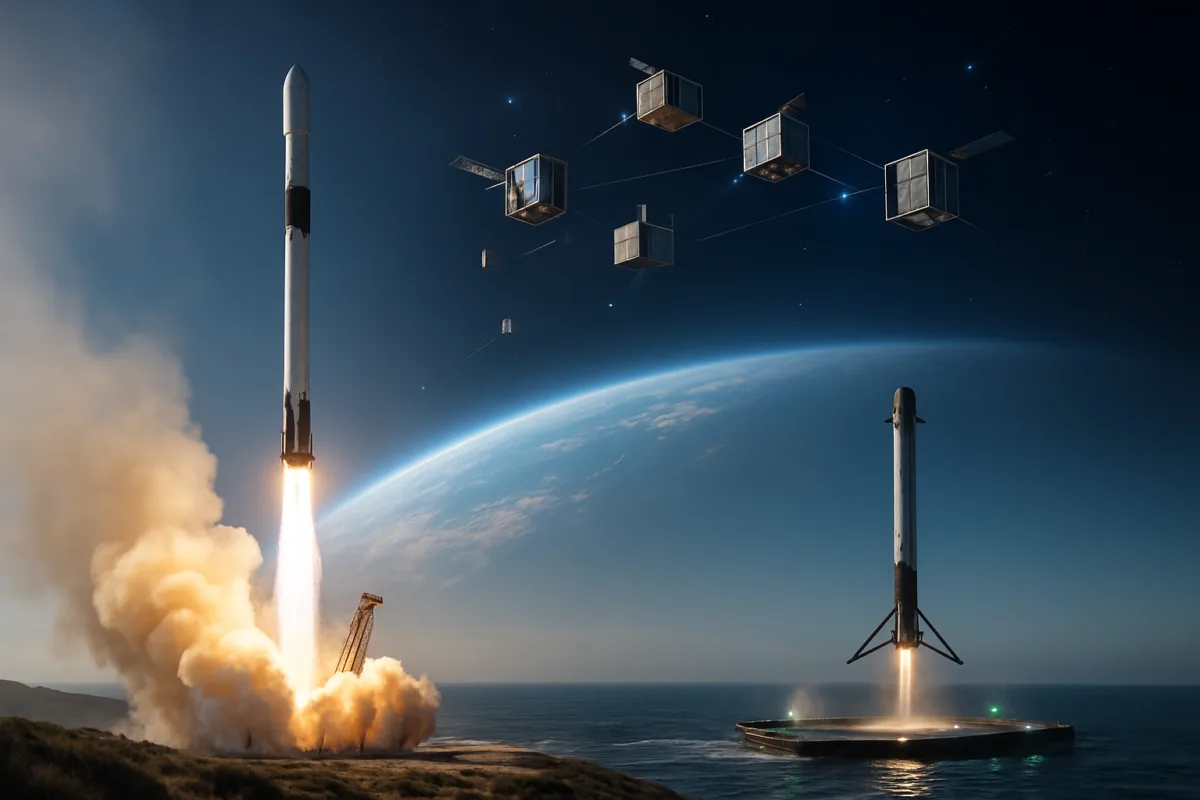
On July 16, 2026, a Falcon 9 rocket carried 21 more small satellites into low Earth orbit for the Space Development Agency’s Transport Layer, bringing the constellation to 63 of a planned 126 spacecraft. The milestone is both significant and incomplete: it marks a clear restart of a program that had been paused for nine months, yet the optical laser mesh meant to knit those satellites into a high-speed, resilient network has not been switched on. Understanding what that combination of progress and incompletion means for military space architecture, resilience, and operational timelines requires a close look at why the program paused, what the Transport Layer is designed to do, and how the next steps will shape whether these satellites simply float in formation or become a functional battle network.
The transport layer: backbone by design
The Transport Layer is conceived as the communications backbone of the Proliferated Warfighter Space Architecture (PWSA). Built from hundreds of low Earth orbit (LEO) small satellites distributed across multiple orbital planes, the Transport Layer’s role is to move data across space quickly and securely, shuttling tactical information, sensor feeds, and command-and-control traffic between satellites, ground stations, ships and aircraft. Its distinctive technical promise rests on optical intersatellite links (OISLs) — laser channels intended to pass data at near-light speeds between satellites without relying on ground relays.
Why optical links matter
Optical intersatellite links reduce latency by enabling direct space-to-space routing and increase resilience by providing multiple pathways for traffic even if some satellites or ground nodes are degraded. In a conflict environment, an optically connected mesh can route around damaged nodes and make it harder for an adversary to sever critical flows with a handful of strikes. The Transport Layer’s architects envisioned the mosaic of many small, replaceable satellites as a hedge against single-point failures and strategic targeting.
What July 16 actually delivered
The Falcon 9 mission designated T1TL-E launched from Vandenberg Space Force Base at 4:32 p.m. Eastern and deployed 21 additional Tranche 1 Transport Layer satellites built by York Space Systems. That lift added to 21 York satellites placed in orbit in September and 21 Lockheed Martin spacecraft launched in October 2025, bringing the total to 63 satellites — exactly half of the original Tranche 1 plan. The booster, identified as 1103, was on its fourth flight and landed on the droneship Of Course I Still Love You approximately 8.5 minutes after liftoff. At the SDA’s request, SpaceX cut its webcast shortly after the booster landing and did not disclose the precise deployment locations for the payloads.
A restart, not a finish line
Equally important than the hardware that reached orbit is what that hardware cannot yet do. SDA Director Gurpartap “GP” Sandhoo explained that the program had been paused because of thermal-modeling discrepancies, contact and ground-entry point delays, and propulsion and orbit-raising issues on the first 42 satellites already in orbit. The pause and subsequent fixes indicate that the assembly line approach — buying many small satellites in two-year tranches with the expectation that they will function well enough on orbit to keep cadence — ran into the reality of complex on-orbit behavior that cannot be fully validated on the factory floor.
From a monthly cadence to readiness-based launches
One of the most revealing shifts announced in the wake of the July 16 flight is procedural. The SDA had once aimed for roughly monthly launches to populate Tranche 1. That expectation has been replaced by a readiness-based approach: satellites will fly when spacecraft checkout, integration and testing indicate they are prepared, rather than on a rigid calendar. This flips the conventional narrative that launch availability is the primary bottleneck; instead, satellite build and test readiness now pace the program. Put plainly, a reliable cargo-slinging capability from commercial providers cannot substitute for robust spacecraft validation.
Impacts on planning and operations
Changing the pacing item affects more than just launch manifests. It alters logistics, budgeting, and war-gaming assumptions about when networked capabilities will be on hand. Military planners who expected a steady cadence of incremental capability may need to rework timelines for when resilient, mesh-enabled services will actually be available to combatant commands and forward units.
The mesh that’s still in the dark
Despite reaching 63 satellites, the optical mesh — the very mechanism that would let those satellites route data among themselves — remains unproven and, as of the July briefing, largely dark. SDA’s plan is incremental: establish OISLs within each orbital plane first, then tackle the more complex task of cross-plane links. Inter-plane connections require tighter pointing precision, more advanced handoff protocols, and an understanding of how relative motion across planes affects throughput and latency. Until those links are active and validated, the Transport Layer operates as a set of discrete data pipes delivering information to ground stations, not as an interconnected web routing traffic autonomously across space.
Why the mesh matters operationally
An incomplete mesh has operational consequences. Without spaceborne routing, the constellation remains partially dependent on terrestrial nodes and planned ground-entry points. That reliance reduces the network’s ability to reroute around localized damage and increases the exposure of critical flows to ground-based attacks, jamming or diplomatic pressure affecting access to hosted commercial infrastructure. The mesh is the feature that turns a collection of satellites into a resilient tactical network; its absence changes risk profiles and limits the range of missions the constellation can support.
Technical and programmatic fragility
The program’s halfway point is not unusual for first-of-a-kind systems. Complex software, thermal environments different from predictions, and the friction of integrating hardware from multiple vendors all contribute to a slow and iterative maturation in orbit. Yet these are also vulnerabilities. If issues continue to appear faster than fixes can be fielded, momentum could stall again — not because launches are unavailable, but because the agency is unwilling to risk placing flawed hardware into a system intended to support warfighters in contested environments.
Vendor diversity and integration risk
Tranche 1 includes satellites from York Space Systems, Lockheed Martin and Northrop Grumman. Multiple vendors help avoid monolithic single-point failures and encourage competition, but they also increase software and hardware integration complexity. Establishing a reliable mesh requires not only each vendor’s components to function correctly but also tightly harmonized communications protocols, thermal behaviors, and propulsion/attitude control performance across different spacecraft designs.
Strategic context and why the Pentagon is building its own network
Commercial LEO communications have transformed terrestrial operations and highlighted the tactical value of distributed, low-latency space services. Yet the Pentagon is cautious about relying on commercial constellations for primary military functions; corporate policy changes or geopolitical pressure can alter access overnight. The PWSA and its Transport Layer are an attempt to secure sovereign, assured capabilities that a military can control directly. Other nations are drawing similar conclusions about sovereign space capability, investing in responsive launch and domestic satellites to reduce foreign dependencies.
What half a constellation actually buys
Sixty-three satellites are real and useful, but they do not yet deliver the full distributed resilience envisaged for PWSA. They provide increased redundancy, additional ground entry opportunities, and more data pipes for specific missions, but without an operative mesh the constellation cannot fully exploit the advantages of optical intersatellite routing. The SDA’s July 16 launch bought time — more assets in orbit, more chances to iterate software, and a larger testbed for enabling optical links — but whether that time becomes sustained capability depends on the success of the next series of developmental steps.
The coming months and launches will be determinative. If readiness-centric pacing yields robust, validated spacecraft that can be networked reliably in-plane and then across planes, the SDA will validate its fast-iterate, proliferated model. If hardware and software anomalies persist, the program risks repeatedly sliding into repair cycles that erode confidence and delay the capability spiral intended to outpace adversaries. The T1TL-E mission demonstrates that industrial-scale lift is no longer the limiting factor; the harder work lies in proving that a swarm of small satellites can be knitted into a high-speed, resilient mesh capable of supporting operational military missions at scale.

Dr. Morgan directed the Archives Program from 2014 to 2017, gaining extensive experience in research documentation, information management, and the preservation of scholarly resources. Throughout her career, she has worked closely with academic publications and research materials, developing expertise in evaluating scientific sources and communicating complex topics to broad audiences.
Her primary areas of specialization include scientific publishing, research communication, editorial review, and the translation of technical research into accessible educational content. She has contributed to projects involving space science, astronomy, environmental science, history, archaeology, and emerging scientific discoveries, always emphasizing accuracy, transparency, and the responsible presentation of evidence.
As Editorial Director of Muskurahat.us, Dr. Morgan leads the editorial review process for scientific articles, ensuring that content is based on reputable sources, peer-reviewed research whenever available, and publications from recognized universities, research institutions, and international scientific organizations.
She is committed to promoting scientific literacy through clear, engaging, and well-documented articles that help readers better understand scientific discoveries and their impact on society. Her editorial philosophy is founded on accuracy, intellectual integrity, independent journalism, and continuous learning as scientific knowledge evolves.
Through her work at Muskurahat.us, Dr. Morgan supports the publication of trustworthy scientific content that makes complex research accessible to readers around the world while maintaining rigorous editorial standards.