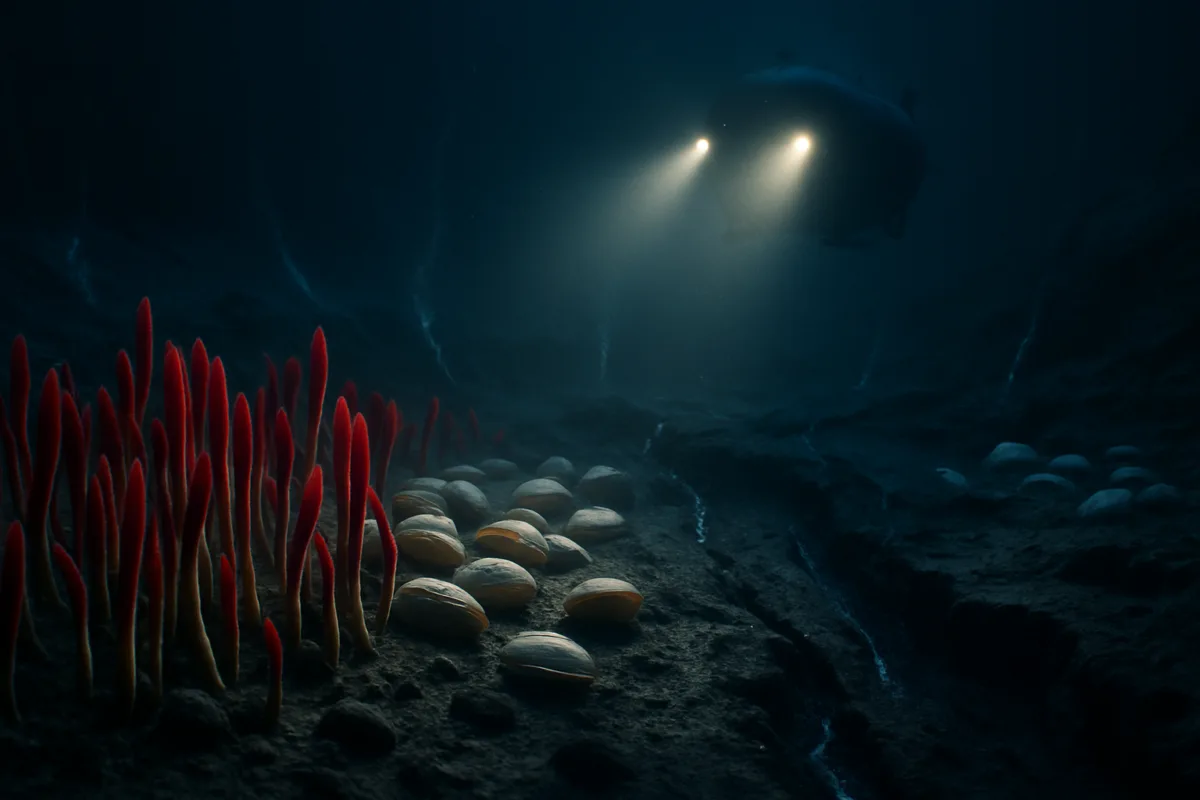
Six miles beneath the Pacific, where sunlight never reaches and pressure is crushing, an extraordinary ecosystem has been found thriving on chemical energy rather than sunlight. Crewed dives by the Chinese submersible Fendouzhe recorded dense fields of blood-red tubeworms and beds of white clams living on methane and hydrogen sulfide seeping from the trench floor, extending down to 9,533 metres. This discovery not only sets a new depth record for animal communities but also reframes how we think about the drivers of life in the planet’s deepest habitats.
The expedition and its significance
The observations derive from a survey conducted between 8 July and 17 August 2024 by the Institute of Deep-sea Science and Engineering at the Chinese Academy of Sciences, operating from the research vessel Tansuoyihao with the crewed full-ocean-depth submersible Fendouzhe. The team surveyed wide stretches of the Kuril–Kamchatka Trench and the western Aleutian Trench, covering depths from about 5,800 metres to the record 9,533 metres. Rather than spotting an isolated patch of life, researchers documented continuous communities spanning roughly 2,500 kilometres along trench floors. That spatial scale is unprecedented for chemosynthetic life at such extreme depth and suggests a persistent, landscape-scale phenomenon.
What the submersible saw
Footage released with the study shows dense aggregations of siboglinid polychaetes, the family that includes the familiar deep-sea tubeworms, and dense beds of clams. The tubeworms extend tubes from the sediment and unfurl red plumes that are richly pigmented by haemoglobin; these plumes are the exposed parts of a complex symbiosis. Nearby, clusters of white-shelled bivalves dot the sediment like a lawn. The appearance is not the sparse, slow-accumulating detritus field that many associate with hadal depths; instead it looks like a chemically supported oasis, with organisms arranged in ecologically structured patches rather than as scattered individuals.
Why the depth matters
Prior to this work, hadal chemosynthetic communities had been observed only sporadically, with the previous depth record held by sightings in the Japan Trench at 7,434 metres. Those records were patchy and isolated. The new observations push the confirmed depth by more than two kilometres and do so with continuity: a long section of trench floor populated by such communities rather than a handful of chance finds. The researchers use the phrase Chemosynthetic Life Corridor to describe this continuous distribution, a hypothesis supported by the breadth of their dataset but one that will need testing across other trenches and basins.
Chemosynthesis: life without sunlight
The key to these ecosystems is chemosynthesis, a fundamentally different base of the food web than photosynthesis. In sunlit habitats, plants and phytoplankton capture solar energy to fix carbon. In these trench-floor communities, bacteria perform an analogous chemical trick: they harvest energy from the oxidation of reduced compounds such as methane and hydrogen sulfide and use that energy to convert inorganic carbon into organic matter. The tubeworms and clams host these bacteria internally, relying on their microbial partners to produce the nutrients that sustain the animal host.
Symbiosis and functional anatomy
Siboglinid worms lack a digestive tract as adults; instead they provide a protected environment and transport mechanisms for their symbionts. Their red plumes contain haemoglobin-like molecules that transport oxygen and sulfide to internal tissues, enabling the chemosynthetic bacteria to function. Bivalves host chemosynthetic microbes in gill tissues and often have adaptations for harvesting reduced chemicals from the sediment or porewaters. The visible morphology—red feeding plumes and white clam beds—therefore signals a deep and intimate biological reliance on chemical energy sources rather than particulate food from the overlying ocean.
Geology and geochemistry: where the energy comes from
Geochemical analyses reported by the team indicate that methane and hydrogen sulfide are being advected upward along faults in the trench floor. Importantly, the methane bears a microbial isotopic signature, which implies that it is produced by microbes decomposing buried organic matter in deeper sediments rather than being thermogenic gas from deep crustal sources. That points to an active sub-seafloor biosphere, one that generates reduced carbon compounds later tapped by the surface-dwelling chemosynthetic communities.
Fault-controlled fluxes and habitat continuity
The presence of faults and fractures in trench systems creates conduits that can deliver reduced chemicals from subsurface reservoirs to the seafloor over long distances. Where those conduits are common and permeable, seepage can be extensive and persistent, generating the conditions needed for continuous chemosynthetic communities. If such fault-controlled fluxes are a common feature of hadal trenches, the corridor hypothesis gains plausibility. If, however, these trenches are geologically special, then the corridors could be more constrained in distribution. Distinguishing between those scenarios requires comparative surveys across multiple trenches and tectonic settings.
Implications for sub-seafloor life
The microbial signature of the methane implies a sizeable microbial community within buried sediments, metabolizing organic carbon and generating reduced gases. That has two linked implications. First, the sub-seafloor biosphere may be more active and consequential than often assumed in hadal settings. Second, the carbon processed by that biosphere may feed seafloor communities independently of the vertical flux of sinking particles from the surface ocean. This vertical decoupling alters how we must think about carbon pathways and budgets at extreme depth.
Rewriting parts of the deep-carbon narrative
For decades, hadal ecosystems were often described as relying primarily on the slow rain of organic detritus from the surface ocean. The new findings complicate that picture by demonstrating a substantial, chemically fueled benthic community that draws carbon and energy from sedimentary processes. That does not mean the surface-derived detrital pathway is irrelevant—most deep-sea ecosystems are shaped by a mix of inputs—but it does mean that global carbon accounting needs to consider chemosynthetic production in deep trenches as a potentially nontrivial pathway for organic carbon fixation and transfer.
How big a role might these systems play?
Quantifying the contribution of trench chemosynthesis to global carbon cycles will require measurements of community biomass, rates of microbial production and methane flux, and an understanding of spatial extent. The reported 2,500-kilometre stretched distribution hints at a potentially large cumulative footprint, but translating spatial coverage into carbon fluxes depends on per-unit-area productivity, which may vary with seep intensity, sediment permeability, and local geology. Targeted sampling and long-term monitoring will be essential to translate discovery into numbers that can feed global models.
Methodological and geopolitical context
This work showcases a capability that only a handful of nations possess: crewed full-ocean-depth diving with repeat visits to the same locations. The study was funded under national programs and executed with domestically built platforms, which matters because repeated access enabled systematic surveys rather than chance encounters. At the same time, the scientific questions raised are transnational—understanding global patterns of chemosynthetic life, carbon cycling, and sub-seafloor microbial activity is best served by international collaboration, shared data, and parallel surveys in other trench systems operated by independent teams.
What to expect from future work
Immediate next steps include expanding surveys to other trenches to test the corridor hypothesis, measuring in situ methane and sulfide fluxes, and sampling symbionts and sediment microbial communities to trace carbon pathways. Technology will matter: long-duration seafloor observatories, improved sampling tools that preserve delicate chemistry, and more sophisticated geophysical imaging of fault systems will all be needed. Multidisciplinary teams combining geology, microbiology, zoology, and ocean biogeochemistry will provide the integrated perspective necessary to move from description to process-level understanding.
The discovery of thriving tubeworm and clam communities at 9,533 metres forces a reappraisal of life at extreme depth: ecosystems can be extensive, tightly coupled to subsurface microbial activity, and sustained by geologic plumbing that connects buried carbon to living communities. As more trenches are surveyed and the rates of chemical fluxes are quantified, we will gain a clearer picture of how sizeable and how influential these deep, chemosynthesis-driven oases are in the global ocean. For now, the image of blood-red plumes and white clam beds in total darkness is a reminder that life finds pathways wherever energy is available, and that the deep Earth and the deep ocean are connected in ways we are only beginning to map.

Dr. Morgan directed the Archives Program from 2014 to 2017, gaining extensive experience in research documentation, information management, and the preservation of scholarly resources. Throughout her career, she has worked closely with academic publications and research materials, developing expertise in evaluating scientific sources and communicating complex topics to broad audiences.
Her primary areas of specialization include scientific publishing, research communication, editorial review, and the translation of technical research into accessible educational content. She has contributed to projects involving space science, astronomy, environmental science, history, archaeology, and emerging scientific discoveries, always emphasizing accuracy, transparency, and the responsible presentation of evidence.
As Editorial Director of Muskurahat.us, Dr. Morgan leads the editorial review process for scientific articles, ensuring that content is based on reputable sources, peer-reviewed research whenever available, and publications from recognized universities, research institutions, and international scientific organizations.
She is committed to promoting scientific literacy through clear, engaging, and well-documented articles that help readers better understand scientific discoveries and their impact on society. Her editorial philosophy is founded on accuracy, intellectual integrity, independent journalism, and continuous learning as scientific knowledge evolves.
Through her work at Muskurahat.us, Dr. Morgan supports the publication of trustworthy scientific content that makes complex research accessible to readers around the world while maintaining rigorous editorial standards.