In July 2025 researchers reported a laboratory demonstration that used concentrated sunlight to extract water directly from lunar soil returned by China’s Chang’e-5 mission, then converted that water into oxygen, hydrogen and carbon monoxide. The work did not produce life-ready breathable air or fill a rocket tank on the Moon, but it fused extraction and chemical conversion into a single photothermal process — an advance that could simplify future in-situ resource utilisation (ISRU) plants if engineers can translate the chemistry into durable hardware for the lunar environment.
The photothermal concept: sunlight, soil and chemistry in one loop
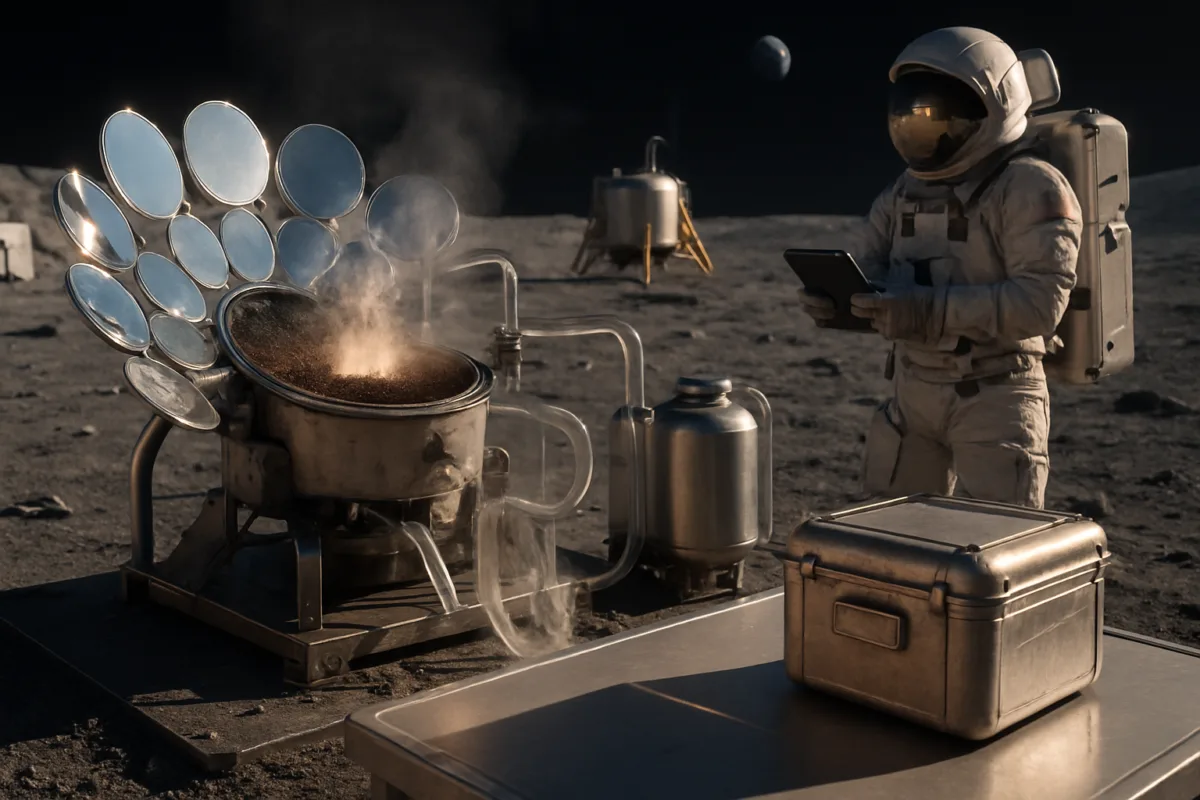
The team’s reactor concentrated light to generate heat, drove water release from regolith and then used components of that same heated soil as catalysts to convert the liberated volatiles into useful gases. Sunlight supplied the energy; the regolith not only stored the water in mineral-bound forms but also performed two further roles: as an absorber of solar heat and as a catalytic medium that promotes reactions between the released water and a carbon dioxide feedstock.
How the process unfolds, step by step
First, concentrated sunlight warms a bed of lunar soil. On the real Moon this would be accomplished with mirrors or lenses that focus photons into a small volume, raising the temperature and desorbing hydroxyls and molecular water associated with minerals and glass phases. Second, once water vapor is released, it can be captured and routed, but in the demonstration the warmed regolith also helped catalyse reactions with carbon dioxide to form oxygen, hydrogen and carbon monoxide.
The immediate products are not a sealed, flight-qualified propellant or a hospital-grade breathing mix. Rather, the experiment produced oxygen (which can be used as an oxidiser or further purified for life support), hydrogen (a fuel) and carbon monoxide (a component of synthesis gas). Together hydrogen and carbon monoxide form syngas, a flexible feedstock for making additional fuels and chemicals.
The crucial role of ilmenite and mineral catalysis
A major reason this integrated approach works is the catalytic behavior of iron- and titanium-bearing minerals in lunar regolith, notably ilmenite. When heated, such minerals facilitate redox reactions that convert water and carbon dioxide into oxygen and reduced carbon species. In other words, the soil participates actively in the chemistry instead of acting merely as inert material to be processed and discarded.
Where the inputs come from: Chang’e-5 samples, crew CO2 and sunlight
The lab demonstration used allocated fragments of Chang’e-5 material and also simulated lunar soil made to match the returned composition. Chang’e-5 landed in northern Oceanus Procellarum and returned 1.731 kilograms of regolith to Earth; analyses of those samples and in-situ mid-latitude measurements show the soil is dry by terrestrial standards but contains hydrogen-bearing species at tens of parts per million. Such concentrations are far lower than ice-rich polar deposits but are still chemically exploitable.
Why carbon dioxide must be supplied from habitats
The Moon lacks a useful ambient atmosphere, so carbon dioxide for the conversion reactions is not available on-site in appreciable amounts. The proposed ISRU loop envisions using CO2 recovered from crew exhalations and life-support scrubbers inside a habitat. That idea is elegant: waste CO2 that must be removed from living quarters becomes a reactant that, combined with sunlight and regolith, yields oxygen and fuels — closing part of the life-support and propellant loop.
Economics and the $83,000-per-gallon headline
The paper cites an illustrative figure that lifting a US gallon of water into space costs roughly $83,000. A US gallon is about 3.8 kilograms, putting the implied mass penalty at roughly $22,000 per kilogram. This is not a universal tariff from any single launch provider; real costs vary with vehicle, destination and mission architecture. Still, the message is clear: water is heavy, and every kilogram produced locally can reduce mass that would otherwise have to be launched from Earth, freeing launch capacity for equipment and supplies that cannot easily be made on the Moon.
ISRU as strategic infrastructure
NASA groups work like this under in-situ resource utilisation. ISRU aims to produce water, breathable air, propellants and construction materials from local sources. The strategy reduces dependence on Earth and changes the economics and resilience of sustained lunar presence. But designing extraction systems requires reliable data about the location, concentration and physical state of lunar volatiles, and current measurements are insufficient to finalize designs for large-scale systems.
What the laboratory result does and does not prove
The Joule paper establishes plausible chemistry: real lunar material, heated by concentrated light, can yield water and then convert it into oxygen and fuel ingredients using the soil’s own catalytic properties. It does not, however, demonstrate a complete working plant. The experiment did not operate in vacuum, under lunar gravity, through long thermal cycles, or with realistic abrasive dust dynamics. It did not produce certified breathable gas or fill propellant tanks. In short, the chemistry is promising; the engineering to make it continuous, robust and autonomous remains to be done.
System-level requirements beyond the reactor
A fielded lunar ISRU facility must combine many moving parts: excavation and material handling capable of moving abrasive regolith without destroying seals and bearings; concentrator optics that stay clean across dust storms, micrometeorite impacts and thermal cycling; gas capture, separation, purification and storage systems that meet life-support or propulsion purity standards; and control systems that allow remote operation with limited maintenance options. Water quality is itself a system problem: certain electrolysers need deionised water, others tolerate lower purity but demand higher operating temperatures.
Storage, compression and further processing
Once gases are produced they must be separated and conditioned. Oxygen intended for breathing needs scrubbing and certification; oxygen intended as an oxidiser for propellant must be stored or liquefied and delivered into tanks at known purity and pressure. Hydrogen is challenging to store onboard a lunar base because it requires cryogenic systems or advanced containment. Converting syngas into methalox or other conventional propellant components requires additional reactors and catalysts, increasing complexity and power demand.
Lessons from recent lunar demonstrations and the path forward
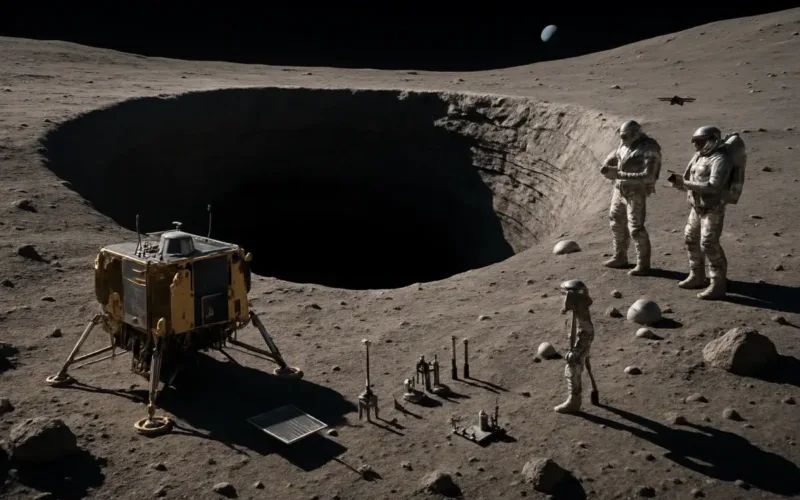
Transitioning from a laboratory chemistry demonstration to a functioning lunar plant is nontrivial. PRIME-1, a NASA mission in March 2025, illustrated the difficulty: its drill and mass spectrometer operated after landing near the lunar south pole, but the lander settled on its side and the surface activities were cut to about ten hours instead of the planned ten days. The instruments worked, yet the mission did not confirm local water. That kind of operational fragility highlights why the next persuasive step for this photothermal approach is not another paper but sustained testing in chambers and on the surface.
What to expect from the next milestones
Near-term priorities include prolonged operation inside a vacuum chamber that reproduces lunar pressure, temperature cycles and radiation exposure while demonstrating continuous feeding of simulant and durability of optics and seals. Engineers also need to show measured energy usage, mass yields, gas purities and how the unit tolerates abrasive dust over time. The next leap would be a small surface demonstration — a proof-of-concept reactor deployed on the Moon with telemetry of power input, product rates and purity under real conditions.
Measurable success criteria
Useful benchmarks include sustained operation for multiple lunar day-night cycles, consistent water extraction rates tied to known regolith compositions, verified purification pathways that yield breathing-grade oxygen or flight-ready oxidiser, and an energy-per-kilogram metric that makes local production economically compelling compared with launch alternatives. Equally important are mechanical reliability metrics: mean time between failures for seals, actuators and concentrator arrays.
Ultimately, this work reframes a question about lunar logistics into an engineering programme. The July 2025 experiment demonstrated a promising integration of photothermal heating and catalysis using real lunar samples; it did not eliminate the need to ship some water from Earth today, but it pointed toward a future where sunlight, soil and crew-generated waste become part of a tightly coupled life-support and propellant economy. Turning that chemistry into hardware will require realistic testing, ruggedization against dust and temperature extremes, and careful attention to gas handling and purity. If those engineering hurdles can be cleared, producing oxygen and fuel ingredients on the Moon would shift the balance of mass and cost in human exploration, letting crews rely less on Earth for routine supplies and more on the resources under their feet.

Dr. Morgan directed the Archives Program from 2014 to 2017, gaining extensive experience in research documentation, information management, and the preservation of scholarly resources. Throughout her career, she has worked closely with academic publications and research materials, developing expertise in evaluating scientific sources and communicating complex topics to broad audiences.
Her primary areas of specialization include scientific publishing, research communication, editorial review, and the translation of technical research into accessible educational content. She has contributed to projects involving space science, astronomy, environmental science, history, archaeology, and emerging scientific discoveries, always emphasizing accuracy, transparency, and the responsible presentation of evidence.
As Editorial Director of Muskurahat.us, Dr. Morgan leads the editorial review process for scientific articles, ensuring that content is based on reputable sources, peer-reviewed research whenever available, and publications from recognized universities, research institutions, and international scientific organizations.
She is committed to promoting scientific literacy through clear, engaging, and well-documented articles that help readers better understand scientific discoveries and their impact on society. Her editorial philosophy is founded on accuracy, intellectual integrity, independent journalism, and continuous learning as scientific knowledge evolves.
Through her work at Muskurahat.us, Dr. Morgan supports the publication of trustworthy scientific content that makes complex research accessible to readers around the world while maintaining rigorous editorial standards.