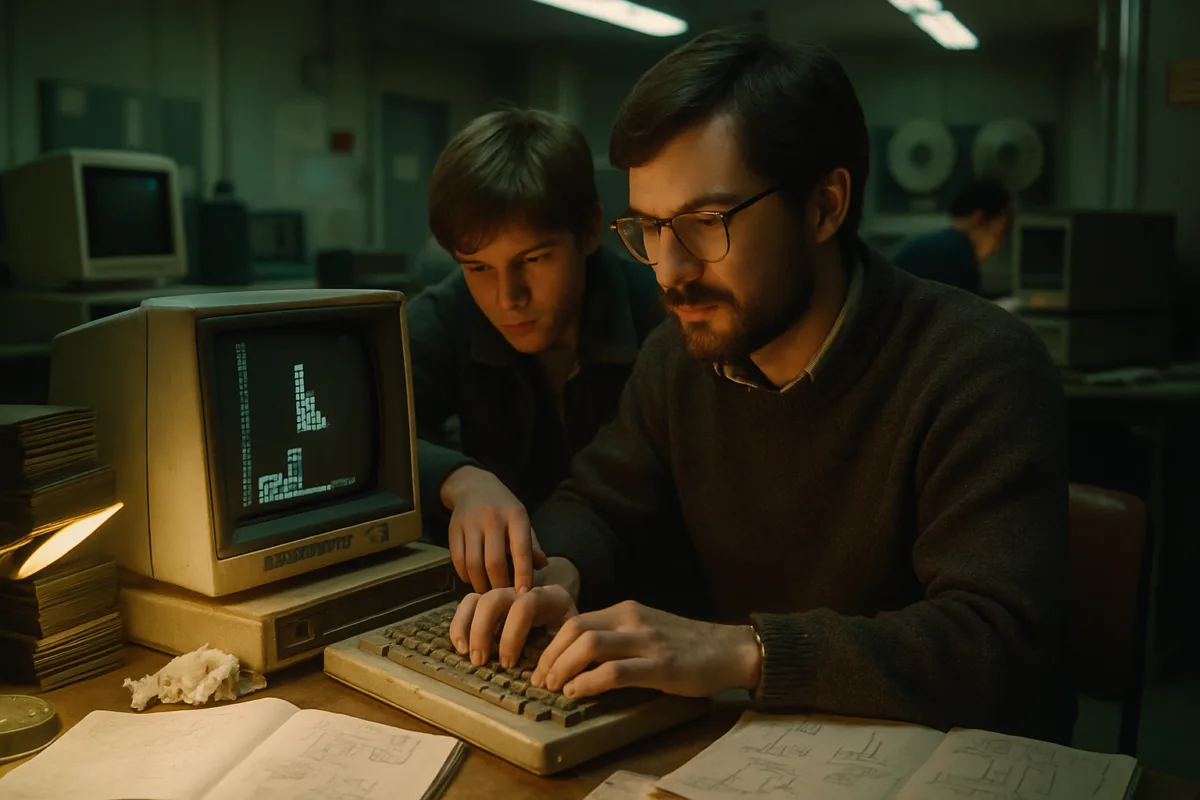
In the summer of 1984, a Soviet research lab in Moscow produced one of the most influential pieces of interactive entertainment the world has seen — not in a polished studio, but as a small experiment to test a new, nearly featureless computer. What began as a playful exercise in fitting shapes together on a monochrome terminal would become Tetris: a design so robust that it survived countless ports, platforms, and corporate battles, even as the creator waited years to see any financial recognition.
The machine that made a game
The technical constraints surrounding Tetris’s birth are central to understanding both its form and its fate. Alexey Pajitnov was working with an Electronika 60, a Soviet minicomputer modeled on the Western PDP‑11. The machine had only a few kilobytes of memory and no true graphical display capability. Images were rendered as text characters on a monochrome terminal — the equivalent of shaping a puzzle out of punctuation marks. Pajitnov wrote his prototype in Pascal and used pairs of square brackets and other characters to suggest falling tetrominoes. It was, by necessity, minimal.
Design forged by scarcity
Scarcity is a creative constraint, and in Pajitnov’s case it focused the design until nothing non‑essential remained. The seven tetromino shapes, the mechanic of lines clearing when filled, the steady acceleration of falling pieces, and the mounting pressure of a stacking playfield: all of these elements are immutable in the earliest versions. They are not the result of testing many flashy features; they are what remains when every surplus is stripped away. That is why successive ports and reproductions — even on systems with vastly greater resources — have rarely altered the game’s core mechanics. The design is elegant, compact, and durable.
How a program traveled without a market
Understanding Tetris’s spread requires looking beyond purely technical explanations to the social and economic realities of the Eastern Bloc. The Soviet Union had no conventional retail software market and severe legal restrictions on private commerce. Distribution of programs was informal: floppy disks copied by hand, works shared among colleagues, and software passed along through networks of researchers and hobbyists. This informal, person‑to‑person circulation was how Tetris left its birthplace.
The Hungary connection and Western interest
A copy of Pajitnov’s game reached a Hungarian computing institute where a young programmer, Vadim Gerasimov, ported it to an IBM PC — a crucial step because the IBM PC offered proper graphics and a path to western distribution. In 1986, Robert Stein, a London software salesman, saw Tetris running in Hungary and recognized its commercial potential. From a floppy disk in a foreign institute to a British salesman’s attention, the game began a journey into the international marketplace, but not without difficulty.
The tangle of rights and a missing rouble
In Western software markets, the path from creator to rights holder is typically straightforward: the person or company that makes a program licenses it, earns royalties, or sells it outright. In the Soviet system that produced Tetris, that was not the case. Pajitnov was a state employee working on state equipment, so, under Soviet rules, the ownership of the software resided with the state. Licensing was handled by ELORG (Elektronorgtechnica), the Soviet foreign‑trade body authorized to manage technology transfers and sales abroad. Money flowed in the West; the connection between those payments and the individual inventor was, for many years, effectively non‑existent.
Big companies, muddled deals
Tetris’s westward path attracted major industry players: Mirrorsoft, Spectrum HoloByte, Atari, Sega and, importantly, Nintendo. Each publisher negotiated its own version of distribution and localization. The stakes rose enormously with the Game Boy deal. Nintendo’s portable console transformed Tetris from a computer pastime into a cultural phenomenon, and the Game Boy edition alone sold tens of millions of copies. It also amplified the irony: Pajitnov, the designer whose simple idea underpinned so much commercial value, received no royalties for over a decade.
Numbers that illuminate and obscure
Estimates of lost royalties vary. Some reporting places Pajitnov’s missed earnings in the tens or hundreds of millions of dollars when measured against hundreds of millions of total global sales. Precise accounting is difficult after transactions pass through many intermediaries and decades, but the scale of the discrepancy is clear. This was not a mere clerical oversight; it was the structural result of a system where intellectual property created on state time could not be privately owned.
The twelve‑year arc to recognition
The legal and political changes that followed the collapse of the Soviet Union opened a pathway for Pajitnov. With new international relationships and private agreements, the rights situation shifted. After moving to Seattle — aided by Henk Rogers, the entrepreneur who had pushed hard for the Game Boy deal — Pajitnov saw his original arrangement expire in 1996. At that point, he and Rogers founded the Tetris Company to manage licensing and ensure tighter control over the brand. Only then did Pajitnov begin to earn from the creation he had made more than a decade earlier.
Work, credit, and the public sector
The story’s legal resolution is partial and nuanced. Pajitnov did eventually gain control and compensation, but the delay raises enduring questions about how credit and rewards are distributed when innovation occurs within publicly funded institutions. Large, state‑owned research efforts have produced great technological advances — and those advances often generate private commercial returns. Tetris is a particularly clean instance of a broader pattern: the individual creator produces something that accrues massive value, while legal and structural frameworks assign ownership elsewhere.
Design lessons from a terminal game
Beyond the legal drama, Tetris offers design lessons that remain instructive. First, constraints can promote clarity. The Electronika 60’s hardware limitations forced a focus on core mechanics, producing a game that was accessible and immediately rewarding. Second, universality can emerge from simplicity. The rules of Tetris are easy to grasp: rotate, translate, and fit pieces. But mastering the flow and patterns of the falling shapes yields deep skill and varied play. Third, portability benefits from conceptual minimalism: a system with few moving parts transfers more cleanly across hardware and cultural contexts.
Why the original version still feels right
Play modern editions of Tetris and you still feel the quiet tension of that 1984 prototype: the cognitive puzzle of managing space, the urgency of a rising stack, the clarity of consequences when a line clears. Those sensations are not artifacts of nostalgia. They are baked into the mechanics. Designers who study Tetris find in it a clear example of emergent depth deriving from a short list of robust rules. It demonstrates how a tightly constrained design can produce enduring engagement.
How Tetris reframes stories about talent and reward
Narratives about brilliant creators quickly default to tidy moral: talent leads to recognition and reward. Tetris complicates that tale. Pajitnov’s ingenuity created immense value long before the market or the legal framework allowed him to capture any of it. When the Soviet Union dissolved and legal pathways opened, he did benefit — but the timeline shows that social, political, and economic structures substantially shape who eventually receives recognition and remuneration. For anyone interested in innovation policy or the ethics of technology transfer, Tetris is an instructive case study.
Decades on, Tetris appears in headlines for speed records, anniversaries, and new ports, but the quieter origin story is arguably the most revealing: a debugging experiment on a low‑memory Soviet minicomputer, copies passed hand to hand on floppy disks, and a design resilient enough to outlast the legal regime that briefly held its rights. That convergence of constraint, sharing, and institutional ownership makes Tetris more than a game: it is a compact lesson in how invention, distribution, and reward can sometimes move on different schedules. The pyramid of falling shapes is a useful metaphor — the game itself remains deceptively simple while the story behind it is complex — and remembering that helps us see how many technologies we consider personal or private actually have deeper, collective roots.

Dr. Morgan directed the Archives Program from 2014 to 2017, gaining extensive experience in research documentation, information management, and the preservation of scholarly resources. Throughout her career, she has worked closely with academic publications and research materials, developing expertise in evaluating scientific sources and communicating complex topics to broad audiences.
Her primary areas of specialization include scientific publishing, research communication, editorial review, and the translation of technical research into accessible educational content. She has contributed to projects involving space science, astronomy, environmental science, history, archaeology, and emerging scientific discoveries, always emphasizing accuracy, transparency, and the responsible presentation of evidence.
As Editorial Director of Muskurahat.us, Dr. Morgan leads the editorial review process for scientific articles, ensuring that content is based on reputable sources, peer-reviewed research whenever available, and publications from recognized universities, research institutions, and international scientific organizations.
She is committed to promoting scientific literacy through clear, engaging, and well-documented articles that help readers better understand scientific discoveries and their impact on society. Her editorial philosophy is founded on accuracy, intellectual integrity, independent journalism, and continuous learning as scientific knowledge evolves.
Through her work at Muskurahat.us, Dr. Morgan supports the publication of trustworthy scientific content that makes complex research accessible to readers around the world while maintaining rigorous editorial standards.