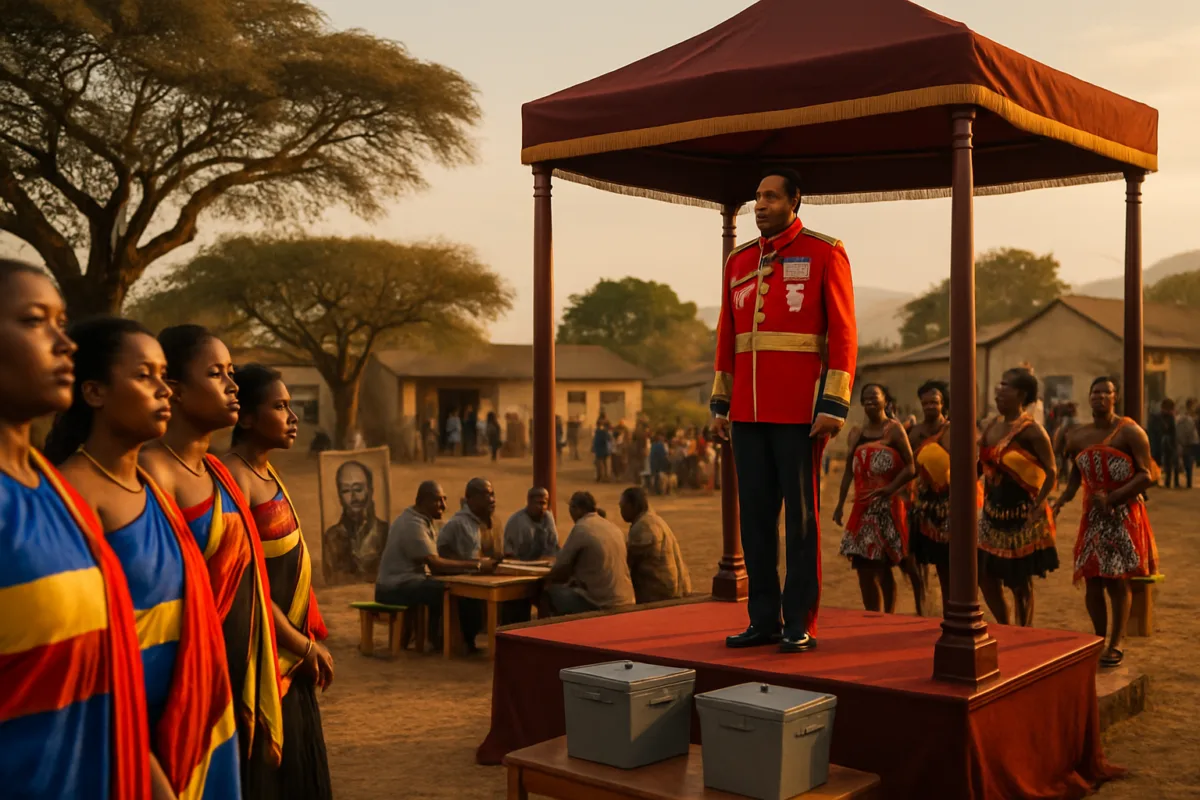
For four decades King Mswati III has occupied the apex of Eswatini’s political order, combining ritual authority with practical control over government institutions. The country displays the formal trappings of a modern state—constituencies, a bicameral parliament, ministries, and periodic elections—yet the palace remains the ultimate arbiter of who governs, how laws are applied, and which political voices are permitted into public contests. To understand Eswatini today is to trace the ways in which constitutional texts, customary practice and coercive power have been braided together to produce a system that calls itself unique and, to critics, feels immutable.
How Eswatini’s institutions concentrate authority
Eswatini has a written constitution adopted in 2005 and a visible structure of state institutions. In practice, however, many of those institutions are constrained by mechanisms that place the monarch above, rather than subject to, conventional checks and balances. The king appoints the prime minister, cabinet members and portions of the legislature. He can dissolve parliament, veto legislation and enjoys immunity from prosecution. Senior judges and officials can be appointed on the crown’s terms, which means the judiciary and civil service often operate with a strong deference to royal prerogative.
Formal law versus political reality
Freedom House and other observers have noted the dissonance between formal legal arrangements and political reality. Ministries exist and public services are delivered in many areas, but the absence of meaningful contestation at the national level and the ability of the monarch to dismiss executive officials mean that policy direction ultimately answers to the palace. This makes it difficult for legislative or judicial bodies to act as independent checks: their appointments and operational space are shaped by royal authority.
The role of the Queen Mother and customary checks
A traditional dual monarchy places the Queen Mother (the Ndlovukati) at the center of cultural life alongside the king. While the Queen Mother participates in state ceremony and can influence succession customs, the operative political power has largely rested with the king. One genuine restraint on absolute succession is the customary process by which the royal council and the Queen Mother’s lineage select an heir after the monarch’s death—an important, if limited, institutional constraint that relies on established practices rather than formal law.
Elections without parties: the Tinkhundla system
Perhaps the most distinctive feature of Eswatini’s political architecture is the deliberate exclusion of political parties from formal electoral competition. Political parties were banned in 1973 under a royal decree, a prohibition that remains effectively in force despite the existence of several political groupings. Rather than competitive party politics, Eswatini uses the Tinkhundla system: grassroots nominations at local traditional meeting places select individual candidates who then run as independents on their personal merit.
How the Tinkhundla system operates
In practice, voters participate in a two-stage process. Potential candidates are nominated at the constituency (Tinkhundla) level and the most endorsed names proceed to a general election. Winners take seats in the House of Assembly, after which the king appoints additional members and fills portions of the Senate. The system emphasizes local representation and cultural tradition, presenting itself as a direct line between ordinary citizens and their representatives without the intermediary of party structures.
Critiques and defenses
Proponents of Tinkhundla argue that it reflects Swazi tradition and prevents external, factional politics from fracturing social cohesion. The government frames the arrangement as a homegrown solution that nurtures consensus and local accountability. Critics counter that the party ban converts elections into managed appointments: without organized platforms, manifesto debates or party discipline, national policy choices are harder to contest and sustained opposition movements are deprived of institutional channels. International observers such as the African Union have recommended reconsideration of the ban on parties, while the government maintains that the system suits Eswatini’s social fabric.
Social spending, spectacle and scrutiny
Royal occasions and state spending have been sources of controversy, especially when lavish pageantry is set against persistent social needs. The king’s 40-year jubilee in April 2026—replete with scarlet military tunics, flag-colored choirs and high-profile performers—reignited debates about prioritization. Supporters point to long-term investments and social programs, most notably the implementation of free primary education following the 2010 Free Primary Education Act, and argue that the monarchy has used state resources to expand infrastructure and cultural institutions.
Economic realities on the ground
Yet a significant share of Eswatini’s roughly 1.2 million population lives in poverty, and questions about transparency and fiscal priorities persist. For many citizens, the visible pageantry of royal life sits uneasily next to limited access to health care, employment and economic opportunity. In a context where executive appointments and senior personnel decisions originate in the palace, public scrutiny of state finances and accountability mechanisms face structural constraints that make it harder for citizens to influence long-term policy priorities.
Protests, repression and the human-rights record
Eswatini’s political compact has been periodically ruptured by unrest. Large-scale pro-democracy protests in 2021 were dispersed by security forces, and reports indicated dozens of deaths and significant repression. The killing of prominent human-rights lawyer Thulani Maseko in January 2023 illustrated the risks faced by dissenting voices; his murder remains unresolved and emblematic of deeper accountability gaps. Regional actors and civil society have urged dialogue and reform, but substantive negotiations that alter the balance of power have yet to materialize.
Regional pressure and stalled dialogues
Since the 2021 unrest, the Southern African Development Community (SADC) and other regional bodies have called on the king to engage in national dialogue. While a Sibaya—a traditional advisory gathering—was convened after the 2023 elections, it did not evolve into the broad, binding negotiations that external envoys recommended. The African Union’s observers described the 2023 vote as peaceful but reiterated the recommendation to review the law barring parties. Progress toward the kind of political opening demanded by activists and regional partners has faltered in the years following the unrest.
What constraints remain and what to watch
The balance of power in Eswatini is not absolute in every dimension. Customary succession rules, the role of the Queen Mother and the royal council introduce heritage-based checks that could shape future transitions. Electoral cycles continue, and local-level participation through the Tinkhundla network gives many citizens a forum for representation on everyday matters. At the same time, the centralization of appointment powers, legislative vetoes and judicial dependencies leave systemic change difficult without the monarch’s consent or a profound shift in elite alignments.
Upcoming milestones and indicators
The next general election is due by 2028, and whether it will be contested under the same party-less rules is a key indicator to watch. Observers will look for three developments: whether the government acts on AU recommendations regarding party participation; whether SADC-backed mediation results in a credible national dialogue with tangible commitments; and whether accountability measures are introduced for past abuses, including transparent investigations into deaths during protests and high-profile assassinations. Progress on any of these fronts would signal a rebalancing of power; continued inaction would likely entrench the status quo.
Eswatini’s political configuration poses a series of trade-offs between cultural continuity and democratic openness, between centralized coordination and pluralist contestation. The Tinkhundla system and the royal prerogatives that define it can, in theory, generate stability and preserve traditional governance forms. Yet where institutional design prevents meaningful challenge, it also raises questions about accountability, human rights and long-term responsiveness to citizens’ needs. Whether reform arrives via dialogue, gradual legal change, internal elite negotiation or popular mobilization will depend on both domestic pressures and regional diplomacy. For those watching Eswatini, the coming years will test whether a system anchored in custom and concentrated authority can adapt to demands for participation and redress, or whether it will remain a structure that visibly contains the instruments of modern governance while shielding the ultimate decision-making power from ordinary political contestation.

Dr. Morgan directed the Archives Program from 2014 to 2017, gaining extensive experience in research documentation, information management, and the preservation of scholarly resources. Throughout her career, she has worked closely with academic publications and research materials, developing expertise in evaluating scientific sources and communicating complex topics to broad audiences.
Her primary areas of specialization include scientific publishing, research communication, editorial review, and the translation of technical research into accessible educational content. She has contributed to projects involving space science, astronomy, environmental science, history, archaeology, and emerging scientific discoveries, always emphasizing accuracy, transparency, and the responsible presentation of evidence.
As Editorial Director of Muskurahat.us, Dr. Morgan leads the editorial review process for scientific articles, ensuring that content is based on reputable sources, peer-reviewed research whenever available, and publications from recognized universities, research institutions, and international scientific organizations.
She is committed to promoting scientific literacy through clear, engaging, and well-documented articles that help readers better understand scientific discoveries and their impact on society. Her editorial philosophy is founded on accuracy, intellectual integrity, independent journalism, and continuous learning as scientific knowledge evolves.
Through her work at Muskurahat.us, Dr. Morgan supports the publication of trustworthy scientific content that makes complex research accessible to readers around the world while maintaining rigorous editorial standards.