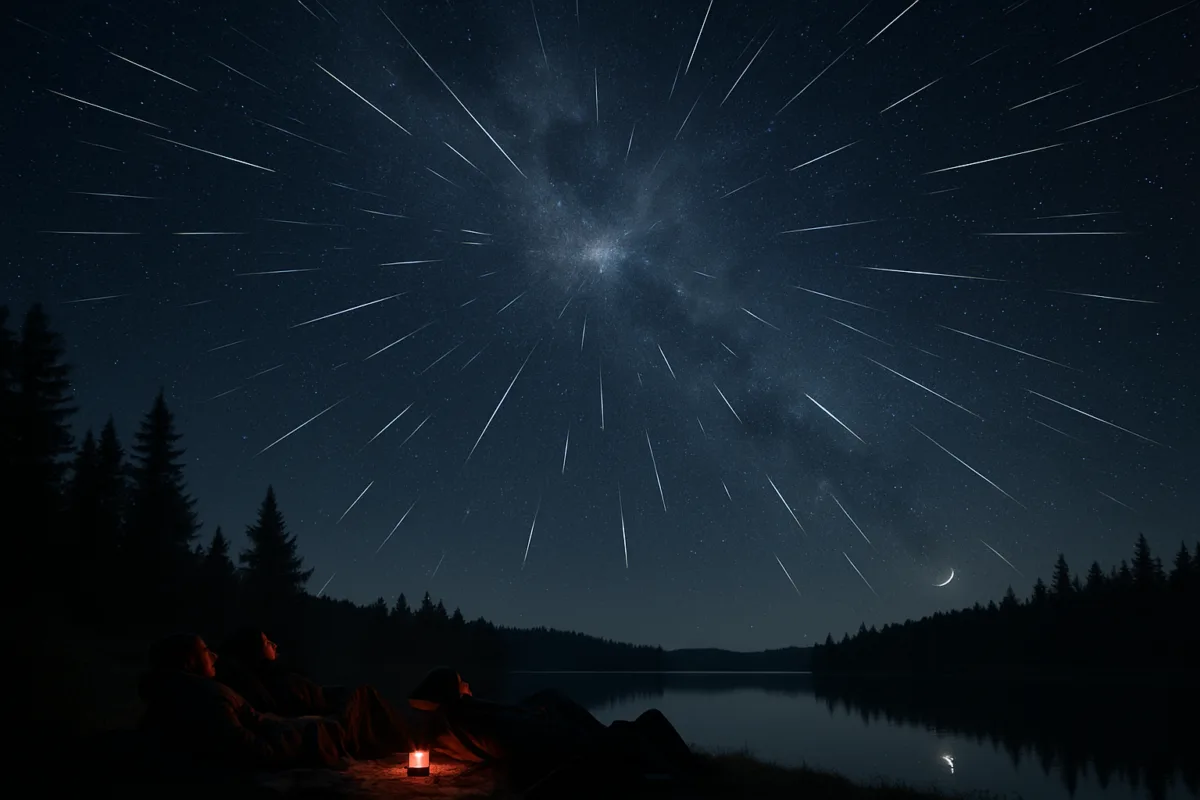
On a clear October night in 1946, observers across parts of Europe and North America watched a sky that looked as if it had been set alight. The Draconid meteor shower, usually a modest early October display, erupted into what eyewitnesses described as thousands of streaks across the heavens. That extraordinary storm has echoed through astronomical literature ever since, shaping how both the public and researchers think about the relationship between comets, their debris, and the spectacular brief fireworks we call meteor storms.
What happened in 1946 and why it matters
The 1946 Draconid event stands out in the twentieth century because of its intensity. Estimates vary, but observers recorded a zenithal hourly rate that could be anywhere from a couple thousand to ten thousand meteors per hour. Radar records corroborated the reports, showing rates that climbed dramatically over the course of several hours. This kind of storm is not typical for the Draconids in most years, when the shower often produces only a handful of meteors per hour under dark skies.
The role of debris filaments
Comet 21P/Giacobini-Zinner sheds dust and small particles each time it swings through the inner solar system. Over many orbits, these particles disperse into streams and filaments that follow the comet’s path. When Earth intersects one of the dense filaments, the result can be an intense display. The 1946 and 1933 storms were such cases: Earth passed through particularly compact, recently shed filaments and the flux of particles entering the atmosphere skyrocketed.
Why such storms are rare
Filaments are localized and clumpy. They are shaped by the comet’s past activity, the gravitational nudges of planets, and subtle forces like solar radiation pressure. Most orbits of Earth cross only diffuse remnants of the comet’s trail, which is why the Draconids are usually unremarkable. Only occasionally does the geometry of Earth’s orbit and the comet’s debris distribution align to produce a storm.
21P/Giacobini-Zinner: the comet behind the meteor shower
21P/Giacobini-Zinner is a short period comet with an orbital period of about 6.5 years. It is the parent body of the Draconid meteor shower, sometimes called the Giacobinids. Each perihelion, the comet warms as it approaches the sun and releases volatile gases and dust. Over successive returns, those releases build a complex structure of debris along the comet’s orbit.
Distance to the comet vs. meteor activity
A key point often lost in popular coverage is that the comet’s current distance from Earth is not a reliable predictor of meteor activity. The comet may be near perihelion and appear relatively close in the context of its own orbital cycle, but unless Earth crosses one of the dense debris filaments produced on a specific past pass, a dramatic meteor storm will not occur. The 2018 close approach of 21P, for instance, brought the comet to within roughly 0.39 astronomical units of Earth, the nearest it had been in decades, yet the observed Draconid activity was only a modest enhancement, not a storm.
How past orbits influence present displays
Filaments are tied to specific past passages of the comet. A filament laid down in a particular year will drift and evolve over time, and planets like Jupiter can perturb the stream. When Earth intersects a filament created decades or centuries earlier, the particles in that filament determine the shower’s intensity and timing. Predicting which filament Earth will cross requires detailed dynamical modeling rather than simply noting where the comet is right now.
What to expect from the Draconids in 2026
Comet 21P reached perihelion on 25 March 2025 and is once again making its way outward. Forecasts for the 2026 Draconids, compiled by organizations that model debris trails and observational history, do not predict a significant outburst. The expected activity is around five to ten meteors per hour under dark skies, a typical rate for non-storm years. The predicted peak occurs near 1 UTC on 9 October 2026, with the best viewing window from the evening of 8 October into the early morning of 9 October.
Why predictions can still be uncertain
Modern meteor forecasting is far more sophisticated than the guesswork of earlier decades: researchers run simulations of ejecta dynamics, account for gravitational perturbations, and compare models with past observations. Still, the fine structure of a meteor stream is complex. Small particles are subject to forces that are difficult to model precisely over many decades. The result is that even well-founded forecasts may miss an unexpected enhancement, as has occurred before. The 2011 and 2012 Draconid increases were successfully anticipated in advance, which shows the models can work, but there remains residual uncertainty.
Moonlight and other viewing considerations
For 2026, the moon phase is helpful: a thin waning crescent is expected to be present around the predicted peak time, meaning lunar glare should not be a major problem for visual observers. The Draconids are also unusual among major showers in that they tend to produce more meteors in the evening hours than after midnight, which makes them convenient for many observers. To get the best experience, find a dark location away from city lights and allow your eyes to adapt for at least 20 to 30 minutes.
How meteor researchers model showers and why that matters for observers
Meteor researchers combine historical observations, cometary dynamics, and physical models of particulate ejection to build forecasts. They trace the evolution of particles released during past perihelia and compute where those particles will be when Earth crosses the comet’s orbital path. When a modeled filament intersects Earth’s orbit at a given time and geometry, researchers can estimate the timing and intensity of a potential outburst.
Limitations of current models
Models must make assumptions about particle sizes, ejection velocities, and how solar radiation pressure modifies orbits. They also need accurate records of the comet’s past positions and the gravitational influences it experienced. Small errors can compound over many orbits, so while models can often identify likely years for enhanced activity, they cannot guarantee a storm will occur. Conversely, models sometimes miss smaller-scale clumps that produce surprise outbursts.
Why this is good science
Uncertainty does not mean the science is weak; rather, it reflects the complexity of celestial mechanics and the chaotic influences in the solar system. Each observed outburst provides data that feed back into models, improving our understanding of cometary shedding and particle evolution. The work of observers, both professional and amateur, is essential: visual counts, video recordings, and radar detections all refine the picture.
Practical tips for anyone planning to watch the 2026 Draconids
If you plan to go out and look for Draconids in October 2026, a few practical tips can improve your chances of a memorable night. Dress warmly and bring a reclining chair or blanket so you can look up comfortably. Choose a site with a wide, dark horizon and minimal light pollution. Give your eyes time to adjust to darkness and avoid looking at screens. Binoculars and telescopes are not helpful for meteor watching; instead, let your gaze roam the sky. Since the radiant is in the constellation Draco, which is high for many northern observers in early October evenings, face roughly north or northwest for the best geometry.
Remember that patience is part of the experience. Most years yield only a handful of meteors per hour from the Draconids, but the occasional bright, slow-moving Draconid can be a delight. If you are interested in contributing scientifically, consider recording timestamps and directions of meteors or join a local observing group that collates visual or video counts.
Watching the sky with realistic expectations is often the most rewarding approach. The 1946 storm remains one of the great meteor spectacles of the last century, and it anchors our understanding of what is possible when cometary debris and Earth’s orbit align just so. For 2026, the evidence points to a modest, pleasant show rather than a storm, but the night sky can surprise. A clear, dark October evening, a slim crescent moon, and a devotion to simply looking up might still reward you with a sudden streak that reminds you how dynamic our small corner of the solar system can be.

Dr. Morgan directed the Archives Program from 2014 to 2017, gaining extensive experience in research documentation, information management, and the preservation of scholarly resources. Throughout her career, she has worked closely with academic publications and research materials, developing expertise in evaluating scientific sources and communicating complex topics to broad audiences.
Her primary areas of specialization include scientific publishing, research communication, editorial review, and the translation of technical research into accessible educational content. She has contributed to projects involving space science, astronomy, environmental science, history, archaeology, and emerging scientific discoveries, always emphasizing accuracy, transparency, and the responsible presentation of evidence.
As Editorial Director of Muskurahat.us, Dr. Morgan leads the editorial review process for scientific articles, ensuring that content is based on reputable sources, peer-reviewed research whenever available, and publications from recognized universities, research institutions, and international scientific organizations.
She is committed to promoting scientific literacy through clear, engaging, and well-documented articles that help readers better understand scientific discoveries and their impact on society. Her editorial philosophy is founded on accuracy, intellectual integrity, independent journalism, and continuous learning as scientific knowledge evolves.
Through her work at Muskurahat.us, Dr. Morgan supports the publication of trustworthy scientific content that makes complex research accessible to readers around the world while maintaining rigorous editorial standards.