On 17 April 1970, with an oxygen tank explosion having crippled their command module, the three astronauts of Apollo 13 faced a string of daunting navigation problems. Guidance computers were powered down, vents and debris obscured star sightings, and every ampere of electricity mattered. Yet in the craft’s cramped interior, the crew executed a precisely timed manual burn that refined their approach to Earth. That short manoeuvre — often rendered in popular lore as “14 seconds, a wristwatch and the edge of Earth” — is an elegant mix of human skill, contingency planning and ground support. The real story is richer and more instructive than the legend.
The manoeuvre in context: one correction among many
It’s tempting to treat the manually timed burn as the single heroic pivot that brought Apollo 13 home. In truth, it was the last link in a carefully managed sequence. The crew and Mission Control had already restored a free-return trajectory after the accident, and subsequent burns and trajectory refinements shortened the trip to Earth. The final correction, logged as MCC-7 in NASA records, occurred around 105 hours 18 minutes into the mission and trimmed the approach to place the spacecraft within the narrow atmospheric entry corridor.
That corridor allowed minimal margin for error. Too steep and the capsule would experience excessive deceleration and heating; too shallow and it could skip out of the atmosphere. The manual burn’s role was precise but limited: adjust velocity enough to put the capsule in the correct corridor for re-entry.
How visuals replaced the inertial platform
With the primary guidance platform powered down, the crew could not rely on the usual inertial references. Instead they recreated a three-axis attitude solution from two visual axes and a stopwatch. Commander Jim Lovell used the lunar module’s Crewman Optical Alignment Sight to view Earth and hold roll and yaw against the planet’s terminator — the curved line where day transitions to night. Lunar module pilot Fred Haise used the Alignment Optical Telescope to sight on the Sun for pitch control. Between those two references, the crew approximated the full attitude normally supplied by the inertial guidance system.
Ground teams had already calculated the required change in velocity and transmitted a procedure to the crew. The astronauts’ task was to maintain the attitude, start the descent engine, and shut it down at the precise time. The descent propulsion system was set to about 10 percent thrust for the maneuver, making it deliberately forgiving of minor timing or attitude errors.
Division of labour and disciplined improvisation
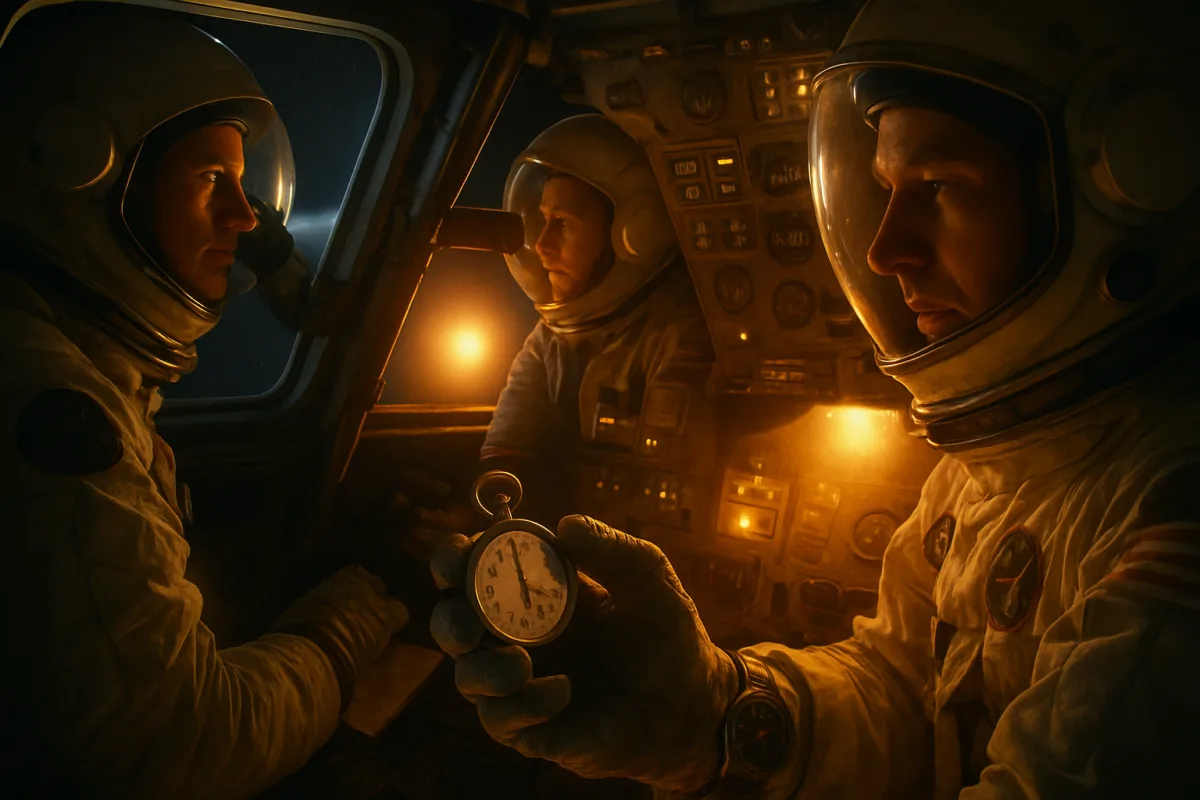
The burn was not a solo act. The Apollo 13 Flight Journal reconstructs an operation divided among the three astronauts: Haise fired small thrusters to settle propellant and monitored pitch; Lovell started and controlled the descent engine and addressed roll; Jack Swigert worked from the command module to keep time and call the shutdown. What looks cinematic in a single image was in reality coordinated procedure, practiced skills, and clear roles.
Importantly, the procedure was not invented ad hoc. It had roots in contingency checklists and training exercises. Mission planners and engineers had prepared for engine firings under degraded guidance conditions, and the crew adapted a known approach to the specifics of their situation. That balance — improvisation grounded in prior planning — is one of Apollo 13’s most critical lessons.
The wristwatch detail: evidence versus legend
Popular retellings often emphasize that the burn was timed precisely with a wristwatch, frequently identifying an Omega Speedmaster. NASA’s contemporaneous debrief confirms that the crew set up a timer and that Swigert called the shutdown. The identification of a specific wristwatch comes from crew recollections and Omega’s historical account. Given that the Speedmaster was standard-issued crew equipment, this claim is plausible. But clear distinctions between primary sources and later retellings matter if we want to separate fact from narrative compression.
Likewise, the “14 seconds” cited in many stories is a rounded number. Mission documents give 14.8 seconds. Rounding and simplification serve narrative clarity, but they strip away nuance: a 14.8-second burn at 10 percent thrust behaves differently than one at full thrust and small fractions of a second can matter in orbital mechanics. The core achievement stands, but the trimming of detail turns complex engineering into a memorable image.
Did Apollo 13 change training for subsequent crews?
After the crisis, Commander Lovell urged NASA to adopt the manual technique he’d used as part of standard crew preparation. A post-flight engineering review recounted how the crew had modified contingency procedures and relied on Earth, Sun and Moon sightings in place of obstructed star fixes. Those findings influenced training: surviving summaries show later missions integrated manual ascents, contingency burns and simulator runs that reflected Apollo 13’s lessons.
However, public archival records do not show a directive explicitly mandating that every subsequent crew rehearse the exact “terminator-and-watch” drill as a named, standalone exercise. Training summaries for Apollo 15 and later crews note debriefings and sessions covering manual control and contingency manoeuvres, but not a checklist that replicates the exact geometry and timing of MCC-7. The institutional response is clear — crews trained for manual, visually referenced manoeuvres — but the cinematic version of a single mandated ritual for all crews is less well documented.
Why that distinction matters
When an engineering solution becomes a legend, the lessons can be distorted. If Apollo 13 is reduced to a single perfect improvisation, it suggests the mission succeeded because of spontaneous genius alone. The reality — that success came through prior contingency planning, disciplined execution, clear communication with ground teams, and an acceptance of imperfect but workable solutions — is more useful.
Engineering and operational cultures benefit from this richer understanding. It encourages design for graceful degradation, cross-training across teams, and the institutional humility to expect failures and rehearse responses. The story of that 14.8-second burn is not merely inspirational; it’s instructive.
Human factors, equipment, and the art of making do
The scene inside the lunar module was cramped and tense. The lunar module’s instrument panels, familiar controls, and standard-issue equipment like the Speedmaster stopwatch were repurposed as life-saving tools. Apollo 13 demonstrated how equipment redundancy, even in modest forms, can save a mission when primary systems fail.
It also illustrated the human side of spacecraft navigation. Sighting techniques rely on human perception; astronauts learn to use imperfect visual cues; they handle stress, fatigue, and uncertainty. Swigert’s calm “start” and “stop” calls with the timer, Lovell’s steady hand on the controls, and Haise’s thruster inputs were as critical as the computed burn duration. Training that preserves and hones those human capabilities — practiced manual control, cross-checking procedures, and coordinated responsibilities — is essential for resilient operations.
From emergency improvisation to institutional memory
The transfer of Apollo 13’s lessons into NASA’s training ethos shows how organizations translate crisis experience into practice. Debriefings, written reviews, simulator scenarios and updated contingency checklists all contributed. The result was not a single named drill but a reinforced preparedness culture: crews practiced manual control and contingency burns, flight controllers rehearsed degraded guidance scenarios, and engineers examined design changes to reduce similar risks in future missions.
The myth of a single, mandatory “terminator-and-watch” drill obscures as much as it reveals. The truth — that Apollo 13’s manual burn combined trained contingency procedures, precise ground calculations, and calm, divided action inside the spacecraft — is more revealing. It highlights how complex systems succeed when people, tools and processes interlock to manage uncertainty and adapt to unforeseen failures. That layered resilience is a better model for future exploration than any single cinematic image could convey.
Viewed another way, the story of Apollo 13’s final manoeuvre reminds us that engineering is as much about preparing for breakdowns as it is about building flawless systems. Teams that rehearse for the improbable, maintain clear roles under stress, and preserve simple, reliable fallback techniques are the ones that convert crisis into survival and learning. The legacy of that short burn lives on in the quieter, less glamorous practices that keep missions safe and missions teachable.

Dr. Morgan directed the Archives Program from 2014 to 2017, gaining extensive experience in research documentation, information management, and the preservation of scholarly resources. Throughout her career, she has worked closely with academic publications and research materials, developing expertise in evaluating scientific sources and communicating complex topics to broad audiences.
Her primary areas of specialization include scientific publishing, research communication, editorial review, and the translation of technical research into accessible educational content. She has contributed to projects involving space science, astronomy, environmental science, history, archaeology, and emerging scientific discoveries, always emphasizing accuracy, transparency, and the responsible presentation of evidence.
As Editorial Director of Muskurahat.us, Dr. Morgan leads the editorial review process for scientific articles, ensuring that content is based on reputable sources, peer-reviewed research whenever available, and publications from recognized universities, research institutions, and international scientific organizations.
She is committed to promoting scientific literacy through clear, engaging, and well-documented articles that help readers better understand scientific discoveries and their impact on society. Her editorial philosophy is founded on accuracy, intellectual integrity, independent journalism, and continuous learning as scientific knowledge evolves.
Through her work at Muskurahat.us, Dr. Morgan supports the publication of trustworthy scientific content that makes complex research accessible to readers around the world while maintaining rigorous editorial standards.