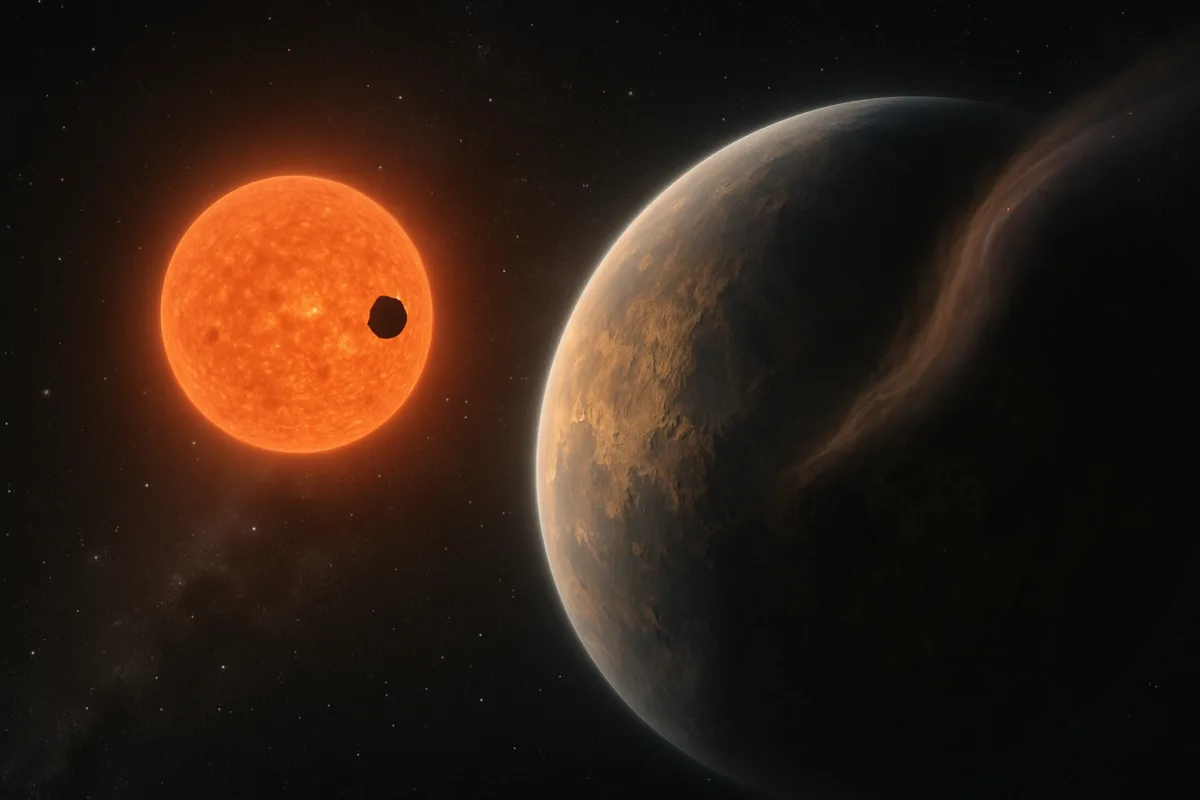
For decades the search for temperate rocky worlds beyond our solar system has been punctuated by disappointment: planets that sat in their stars’ habitable zones but were revealed to be barren, airless rocks. The detection of helium escaping from LHS 1140 b changes that script in a fundamental way. This super-Earth, orbiting a nearby red dwarf about 48 light-years away, has provided the first unambiguous evidence that a rocky world in another star’s habitable zone retains some of its atmosphere. That discovery opens a new chapter in exoplanetary science: we can now move from asking whether a temperate rocky planet has any air at all to asking what that air is made of, whether liquid water might exist, and whether conditions could support life as we know it.
How the helium signal was found
Detecting the faint fingerprints of an exoplanet’s atmosphere requires patience, the right geometry, and a sensitive instrument. LHS 1140 b transits its star every 24.7 days, and during those transits a sliver of starlight filters through the thin layer of gas surrounding the planet. Different atoms and molecules absorb light at characteristic wavelengths, imprinting absorption lines on the spectrum we observe. In September 2024, Collin Cherubim and an international team used the WINERED near-infrared spectrograph mounted on the 6.5-metre Magellan Clay Telescope in Chile to capture such a transit. A fortunate alignment allowed observations of both LHS 1140 b and its inner sibling, LHS 1140 c, on the same night.
Why helium matters
The spectrum of planet b showed strong absorption from helium at high altitudes, extending beyond the planet’s solid radius. Helium is an inert, light atom that is relatively easy to strip away from the upper atmosphere when exposed to high-energy radiation from a host star. So its presence in a detectable, escaping form reveals two things at once: first, there is an extended atmosphere around the planet; second, that atmosphere is being eroded by stellar radiation. The contrast with planet c, which showed no comparable helium signature, underscores that this is not a systematic detection artifact but a physical difference between the two worlds.
What the helium detection does — and doesn’t — tell us
Finding helium in the escaping upper atmosphere proves that LHS 1140 b has some atmospheric reservoir, likely long-lived. Current models and the planet’s estimated age of more than three billion years imply that the detection cannot easily be explained by a transient envelope; if helium is detectable now, a supply of gas must still be present. However, the helium absorption probes the high-altitude region where light atoms dominate. It does not directly reveal the composition of the lower atmosphere near the surface, where molecules such as nitrogen, oxygen, carbon dioxide, and water vapour would be the key markers of habitability.
Limits of the current data
One caveat tempers the excitement: the helium signal appeared strongly in the 2024 dataset but was not recovered in follow-up observations in 2025. The authors of the study interpret this discrepancy as possible variability in the escaping gas flow, perhaps driven by changes in the star’s high-energy output or transient atmospheric dynamics. Alternatively, the non-detection could reflect observational sensitivity limits or geometric effects. A repeat detection will be crucial to confirm the persistence of helium and to probe whether escape rates vary in time.
Planetary properties that help retain an atmosphere
LHS 1140 b’s physical characteristics increase its chances of holding onto an atmosphere compared with many other known rocky exoplanets. With a radius roughly 1.73 times that of Earth and a mass about 5.6 times Earth’s, the planet’s surface gravity is substantially stronger than Earth’s. That stronger gravity helps heavier atoms and molecules remain gravitationally bound, even while light atoms such as helium leak away. Models presented by the team indicate that heavier species could still be present in the lower atmosphere despite ongoing helium escape.
The role of the host star
The host star, LHS 1140, is an M dwarf — a small, cool red star — but it appears to be older and comparatively quiet in its high-energy emissions. That matters because young, active red dwarfs can emit intense ultraviolet and X-ray radiation that strips atmospheres from close-in planets, often leaving them as lifeless basaltic cinders. LHS 1140 sits at the quieter end of the distribution for its class: it still produces enough high-energy photons to drive helium escape, but not so much that a dense atmosphere would be necessarily impossible to retain. In this system, orbital distance also helps: LHS 1140 b orbits farther out than its inner neighbor, exposing it to less irradiation and increasing its odds of atmospheric survival.
Liquid water: a modeled possibility, not an observation
When scientists talk about habitable zones, they mean the range of distances from a star where surface temperatures could allow liquid water to exist under the right atmospheric conditions. LHS 1140 b receives stellar energy compatible with liquid water if a sufficient atmosphere is present, but telescopes have not imaged any ocean, nor have they directly measured surface pressure or temperature. A 2024 analysis of the planet’s mass and radius suggested that it is less dense than a purely Earth-like rocky body, raising the possibility that water could account for roughly 9 to 19 percent of its mass. That is a substantial fraction: if true, it could imply global oceans or significant water layers beneath an atmosphere.
Constraints from Webb and Hubble
Observations with the James Webb Space Telescope published in The Astrophysical Journal Letters ruled out a thick, hydrogen-rich mini-Neptune envelope with high confidence. Those data contained tentative, low-significance evidence consistent with a nitrogen-dominated atmosphere, but the signal was too weak to claim a detection. The new helium result shifts the balance of interpretation: the planet is far less likely to be airless, and a heavier lower atmosphere paired with possible substantial water reserves remains plausible. However, helium alone cannot confirm those deeper layers or a surface ocean.
Comparative lessons from LHS 1140 c and the value of context
The presence of two transiting planets in the same system — one showing escaping helium and the other not — is an invaluable natural experiment. LHS 1140 c, closer to the star, exhibited no helium signal in the same observations, suggesting that stellar radiation and orbital proximity are key determinants of atmospheric survival. Put simply, planets that are more massive, orbit farther out, and have host stars with lower high-energy output stand a better chance of keeping atmospheres over geological timescales. The contrast in this system provides concrete evidence for those theoretical expectations and refines the parameters that scientists will use when prioritizing targets for detailed atmospheric study.
Why variability matters
The 2025 non-detection raises the possibility that atmospheric escape is episodic or that the star’s output fluctuates enough to modulate the signal. If atmospheric loss is variable, that has implications for how atmospheres evolve and how we should schedule observational campaigns to capture representative conditions. It also influences our interpretations of single-epoch non-detections: a planet might harbor a tenuous atmosphere that appears invisible in one observation but becomes detectable in another.
What comes next: Webb, Hubble, and repeated scrutiny
LHS 1140 b has been folded into coordinated programs using both Hubble and the James Webb Space Telescope under initiatives that target rocky worlds. Future transits will be used to test whether the helium signal returns and to probe the lower atmosphere for molecules such as carbon dioxide, water vapour, and nitrogen. A confirmed, repeat helium detection would strengthen the case for a substantial atmospheric reservoir and help quantify the current escape rate. Repeated Webb measurements with high spectral precision will be needed to distinguish a nitrogen-rich, potentially Earth-like atmosphere from alternative heavy compositions. Complementary observations across different wavelengths will refine constraints on pressure, temperature, and molecular abundances.
Implications for habitability research
There is no evidence of life nor of a surface ocean on LHS 1140 b yet, and the presence of helium in an escaping upper atmosphere does not by itself indicate a habitable environment. But the detection changes the framing of the scientific questions. It transitions the field from salvaging candidate rocky planets to building comparative atmospheric science for temperate worlds. With a confirmed atmosphere, scientists can now ask targeted questions about atmospheric chemistry, climate regimes (including the possibility of a tidally locked day-night dichotomy), and long-term atmospheric stability — questions that are the foundation of any serious assessment of habitability.
What this discovery ultimately demonstrates is that not all rocky exoplanets around red dwarfs are doomed to be sterilized by their stars’ youthful fury. Under the right combination of mass, orbital distance, and stellar behavior, a rocky world can keep some of its air for billions of years. LHS 1140 b has given astronomers the crucial first confirmation that such worlds exist beyond our solar system, and it now stands as a prime laboratory for exploring the ingredients and processes that determine whether a temperate planet can sustain a stable, life-friendly environment over geological timescales.

Dr. Morgan directed the Archives Program from 2014 to 2017, gaining extensive experience in research documentation, information management, and the preservation of scholarly resources. Throughout her career, she has worked closely with academic publications and research materials, developing expertise in evaluating scientific sources and communicating complex topics to broad audiences.
Her primary areas of specialization include scientific publishing, research communication, editorial review, and the translation of technical research into accessible educational content. She has contributed to projects involving space science, astronomy, environmental science, history, archaeology, and emerging scientific discoveries, always emphasizing accuracy, transparency, and the responsible presentation of evidence.
As Editorial Director of Muskurahat.us, Dr. Morgan leads the editorial review process for scientific articles, ensuring that content is based on reputable sources, peer-reviewed research whenever available, and publications from recognized universities, research institutions, and international scientific organizations.
She is committed to promoting scientific literacy through clear, engaging, and well-documented articles that help readers better understand scientific discoveries and their impact on society. Her editorial philosophy is founded on accuracy, intellectual integrity, independent journalism, and continuous learning as scientific knowledge evolves.
Through her work at Muskurahat.us, Dr. Morgan supports the publication of trustworthy scientific content that makes complex research accessible to readers around the world while maintaining rigorous editorial standards.