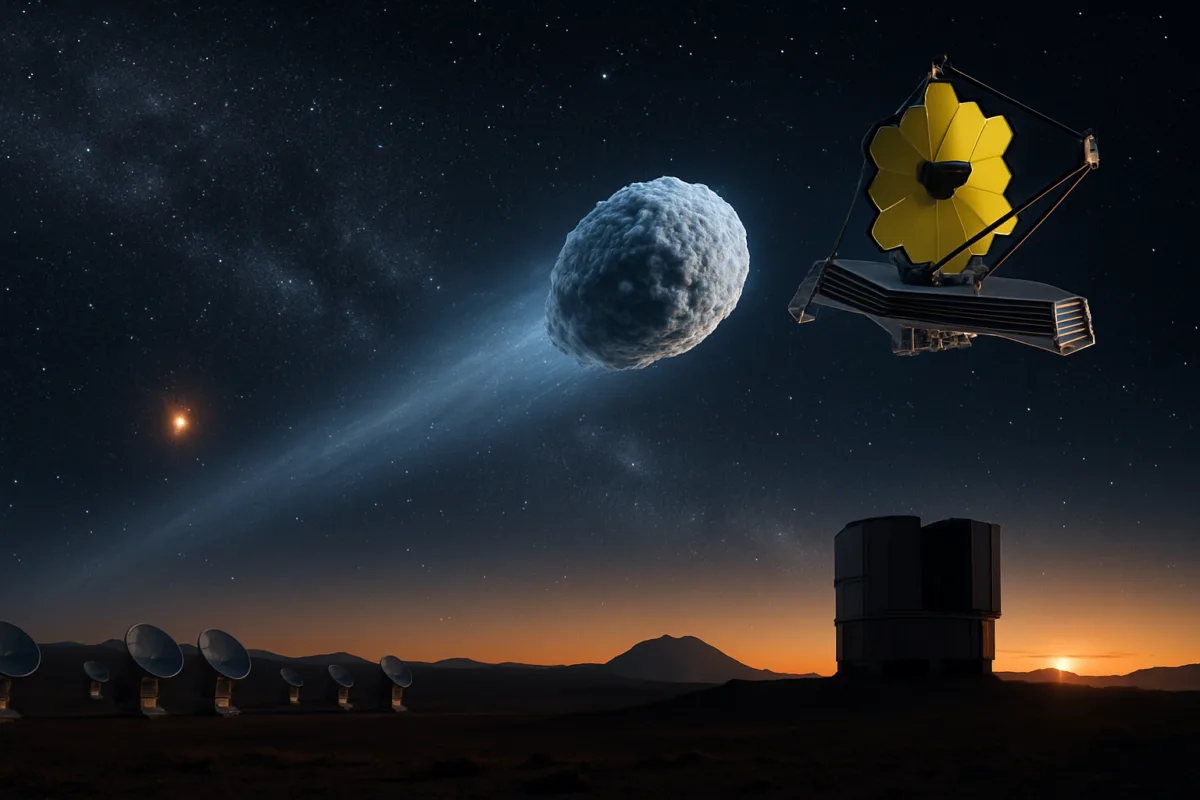
Comets have long been treated as frozen time capsules from their home systems: icy leftovers that formed alongside planets and then spent eons on the outskirts, waiting for a perturbation to send them sunward. The interstellar comet 3I/ATLAS refuses that comfortable, local narrative. Observations made with the James Webb Space Telescope (JWST), the Atacama Large Millimeter/submillimeter Array (ALMA), and the Very Large Telescope (VLT) show that its water is unusually rich in deuterium — the heavy isotope of hydrogen — suggesting that this visitor formed under conditions far colder and chemically different from those that produced comets in our Solar System.
What the heavy hydrogen tells us
Deuterium is a hydrogen atom with an extra neutron. When it substitutes for ordinary hydrogen in a water molecule, the result is a subtle chemical signature that can persist for billions of years. The ratio of deuterium to hydrogen (D/H) in cometary water is therefore a powerful probe of the temperature and chemical history of the environment in which the ice formed. Cold environments favor reactions that concentrate deuterium in certain molecules; warmer or more chemically active environments tend to dilute or erase that enrichment.
3I/ATLAS: an outlier among comets
In a Nature paper published in June 2026, Martin Cordiner and colleagues reported JWST NIRSpec measurements indicating a water D/H value near 0.98 percent for 3I/ATLAS. That is roughly 30 times higher than D/H values typically measured in comets that formed in the Solar System. Independent ALMA observations had earlier reached a similar conclusion about semi-heavy water abundances, and VLT spectroscopy added an isotopic perspective on carbon and nitrogen. The combined result is not merely a surprising chemical quirk; it is a consistent isotopic pattern that points to formation in a very cold, metal-poor environment.
How telescopes read a comet’s chemical memory
Telescopes don’t sample ice directly the way a spacecraft return would, but instruments like NIRSpec and ALMA can detect molecular fingerprints in gas released from a comet as it warms. For comets that approach the Sun, sunlight vaporizes surface ices and releases gas into a coma that telescopes can analyze. Different isotopologues — molecules that differ only in isotopic composition, like H2O versus HDO — absorb and emit light at slightly different wavelengths. Sensitive spectrographs measure these differences and derive isotopic ratios.
Why combining instruments matters
Each facility brings complementary strengths. ALMA excels at measuring rotational transitions of molecules in the radio and submillimeter, offering high spectral resolution for isotopic lines. JWST’s NIRSpec gives unmatched infrared sensitivity and broader coverage of vibrational transitions, which can detect water and organic molecules in faint comae. The VLT provides ground-based optical and near-infrared spectroscopy that can refine isotopic ratios of carbon and nitrogen. Together, they create a multi-wavelength isotopic portrait of an object that would otherwise be beyond detailed chemical characterization.
Cold, metal-poor, and ancient: assembling the birthplace story
The phrase “metal-poor” in astronomy means an environment containing fewer elements heavier than hydrogen and helium. Such environments are characteristic of earlier cosmic epochs before repeated generations of stars enriched the interstellar medium with heavier elements. The isotopic composition reported for 3I/ATLAS — heavy water combined with unusual carbon ratios — is consistent with a formation region that was both cold and relatively metal-poor. Cold favors strong D enrichment in water ice; metal-poor gas ties the composition to an earlier time in the galaxy’s chemical evolution.
Age as an inference, not a timestamp
When papers suggest that 3I/ATLAS could be 10–12 billion years old, they are not reporting a radiometric date like those used for rocks. Instead, researchers infer an age range by comparing measured isotopic ratios to models of how isotopes accumulate and how metallicity evolves across galactic history. Those models — combined with knowledge of how cold chemistry operates in protoplanetary disks — point toward formation long before the Sun, which is about 4.6 billion years old. Far from an exact birth certificate, this is a plausible historical reconstruction grounded in chemistry and astrophysical context.
Why interstellar comets expand our view of planet formation
Until recently, the Solar System was the only laboratory where small bodies could be directly sampled by telescopes or spacecraft. Interstellar visitors change that. Each interstellar object is a tiny piece of another planetary system passing through our neighborhood, offering an otherwise unreachable sample of chemical and isotopic conditions that can exist across the galaxy. Only three interstellar objects have been confirmed so far — 1I/ʻOumuamua, 2I/Borisov, and 3I/ATLAS — and each has pushed astronomers to broaden their expectations.
From dynamical oddities to chemical witnesses
ʻOumuamua was puzzling by shape and behavior, while Borisov more closely resembled a typical comet but still carried non-Solar chemistry. 3I/ATLAS has been unusual in a different way: bright and chemically rich enough for detailed isotopic study, providing a clearer chemical witness of an environment that likely differed sharply from the Sun’s protoplanetary disk. These interstellar emissaries are not just dynamical oddities; they are direct probes of how planet-forming chemistry varies in space and time.
Reframing what “relic” means
When we call comets relics, we often assume they are relics of their local system. 3I/ATLAS reminds us that a relic can also be a fossil from a long-ago, chemically distinct epoch in the galaxy. A comet from the Oort Cloud is a relic of the Solar System’s formation; an interstellar comet may be a relic of a planetary system formed when the Milky Way itself was chemically younger and colder.
Limits, uncertainties and next steps
No single finding is final. The path of 3I/ATLAS through the galaxy cannot be uniquely reconstructed, and the exact parent star system remains unknown. Isotopic interpretations depend on models of chemical fractionation and galactic chemical evolution, both of which have uncertainties. Different formation scenarios in cold disks can produce similar isotopic signals, and subsequent heating or processing might alter some signatures. Nevertheless, the agreement among independent facilities and different isotopic systems strengthens the conclusion that 3I/ATLAS is not typical of Solar System comets.
Future observations of additional interstellar visitors will be crucial. If more objects show similarly elevated D/H ratios or other isotopic anomalies, that would indicate a broader diversity of disk conditions across the galaxy and perhaps identify population signatures tied to age or galactic location. Improved models that couple disk chemistry, isotope fractionation, and galactic chemical evolution will help narrow the range of plausible histories for objects like 3I/ATLAS.
Implications for astrobiology and cosmochemistry
Isotopic ratios feed into questions that extend beyond where a single comet formed. Deuterium enrichment affects the chemistry of water and organics, which in turn shapes the initial inventory of volatiles that young planets receive. Understanding how common different isotopic regimes are across the galaxy informs models of volatile delivery, planet habitability, and chemical evolution at large scales. If some planetary systems formed in colder, more deuterium-rich environments, their water chemistry and prebiotic pathways might follow different trajectories from those in systems like our own.
At the same time, these findings temper the tendency to generalize from the Solar System. The planetary systems we can study directly — through protoplanetary disk observations and the occasional interstellar escapee — form a patchwork of conditions. Each new data point refines our picture of what typical, rare, or possible chemical environments look like for planet formation across cosmic time.
3I/ATLAS passed through the Solar System like a messenger from a distant chemical past. Its unusually heavy water, revealed by coordinated observations from JWST, ALMA and the VLT, is a fingerprint of formation that likely took place in a cold, metal-poor disk — an environment shaped when the galaxy was younger and less enriched in heavy elements. The result reframes our assumptions about cometary chemistry and highlights the value of capturing isotopic information while these interstellar visitors are briefly within reach. Each such comet that we catch offers a rare chance to sample the variety of planetary nurseries that have existed across the Milky Way, and to understand how our own Solar System fits into that broader, evolving tapestry.

Dr. Morgan directed the Archives Program from 2014 to 2017, gaining extensive experience in research documentation, information management, and the preservation of scholarly resources. Throughout her career, she has worked closely with academic publications and research materials, developing expertise in evaluating scientific sources and communicating complex topics to broad audiences.
Her primary areas of specialization include scientific publishing, research communication, editorial review, and the translation of technical research into accessible educational content. She has contributed to projects involving space science, astronomy, environmental science, history, archaeology, and emerging scientific discoveries, always emphasizing accuracy, transparency, and the responsible presentation of evidence.
As Editorial Director of Muskurahat.us, Dr. Morgan leads the editorial review process for scientific articles, ensuring that content is based on reputable sources, peer-reviewed research whenever available, and publications from recognized universities, research institutions, and international scientific organizations.
She is committed to promoting scientific literacy through clear, engaging, and well-documented articles that help readers better understand scientific discoveries and their impact on society. Her editorial philosophy is founded on accuracy, intellectual integrity, independent journalism, and continuous learning as scientific knowledge evolves.
Through her work at Muskurahat.us, Dr. Morgan supports the publication of trustworthy scientific content that makes complex research accessible to readers around the world while maintaining rigorous editorial standards.